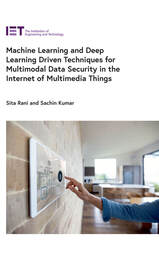
front cover of Machine Learning and Deep Learning Driven Techniques for Multimodal Data Security in the Internet of Multimedia Things
Machine Learning and Deep Learning Driven Techniques for Multimodal Data Security in the Internet of Multimedia Things
Sita Rani
The Institution of Engineering and Technology, 2026
We are living in an AI and data-driven era. A huge volume of data is generated from all sectors including smart cities, intelligent transportation systems, smart healthcare, education, smart agriculture and smart industrial processes. This information comprises multiple modalities such as textual data, images, sound, gestures and genetic sequences, which are generated through various sources.
[more]

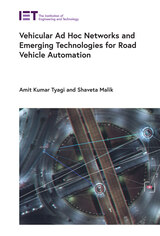
front cover of Machine Learning, Blockchain Technologies and Big Data Analytics for IoTs
Machine Learning, Blockchain Technologies and Big Data Analytics for IoTs
Methods, technologies and applications
Amit Kumar Tyagi
The Institution of Engineering and Technology, 2022
Internet of Things (IoTs) are now being integrated at a large scale in fast-developing applications such as healthcare, transportation, education, finance, insurance and retail. The next generation of automated applications will command machines to do tasks better and more efficiently. Both industry and academic researchers are looking at transforming applications using machine learning and deep learning to build better models and by taking advantage of the decentralized nature of Blockchain. But the advent of these new technologies also brings very high expectations to industries, organisations and users. The decrease of computing costs, the improvement of data integrity in Blockchain, and the verification of transactions using Machine Learning are becoming essential goals.
[more]

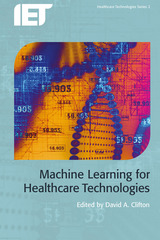
front cover of Machine Learning for Healthcare Technologies
Machine Learning for Healthcare Technologies
David A. Clifton
The Institution of Engineering and Technology, 2017
This book provides a snapshot of the state of current research at the interface between machine learning and healthcare with special emphasis on machine learning projects that are (or are close to) achieving improvement in patient outcomes. The book provides overviews on a range of technologies including detecting artefactual events in vital signs monitoring data; patient physiological monitoring; tracking infectious disease; predicting antibiotic resistance from genomic data; and managing chronic disease.
[more]

front cover of Machine Learning in Medical Imaging and Computer Vision
Machine Learning in Medical Imaging and Computer Vision
Amita Nandal
The Institution of Engineering and Technology, 2024
Medical images can highlight differences between healthy tissue and unhealthy tissue and these images can then be assessed by a healthcare professional to identify the stage and spread of a disease so a treatment path can be established. With machine learning techniques becoming more prevalent in healthcare, algorithms can be trained to identify healthy or unhealthy tissues and quickly differentiate between the two. Statistical models can be used to process numerous images of the same type in a fraction of the time it would take a human to assess the same quantity, saving time and money in aiding practitioners in their assessment.
[more]

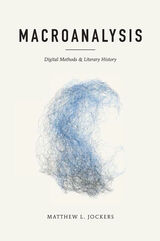
front cover of Macroanalysis
Macroanalysis
Digital Methods and Literary History
Matthew L. Jockers
University of Illinois Press, 2013
In this volume, Matthew L. Jockers introduces readers to large-scale literary computing and the revolutionary potential of macroanalysis--a new approach to the study of the literary record designed for probing the digital-textual world as it exists today, in digital form and in large quantities. Using computational analysis to retrieve key words, phrases, and linguistic patterns across thousands of texts in digital libraries, researchers can draw conclusions based on quantifiable evidence regarding how literary trends are employed over time, across periods, within regions, or within demographic groups, as well as how cultural, historical, and societal linkages may bind individual authors, texts, and genres into an aggregate literary culture.
 
Moving beyond the limitations of literary interpretation based on the "close-reading" of individual works, Jockers describes how this new method of studying large collections of digital material can help us to better understand and contextualize the individual works within those collections.

[more]

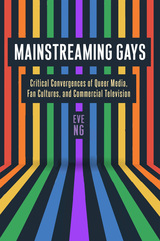
front cover of Mainstreaming Gays
Mainstreaming Gays
Critical Convergences of Queer Media, Fan Cultures, and Commercial Television
Eve Ng
Rutgers University Press, 2023
Mainstreaming Gays discusses a key transitional period linking the eras of legacy and streaming, analyzing how queer production and interaction that had earlier occurred outside the mainstream was transformed by multiple converging trends: the emergence of digital media, the rising influence of fan cultures, and increasing interest in LGBTQ content within commercial media. The U.S. networks Bravo and Logo broke new ground in the early 2000s and 2010s with their channel programming, as well as bringing in a new cohort of LGBTQ digital content creators, providing unprecedented opportunities for independent queer producers, and hosting distinctive spaces for queer interaction online centered on pop culture and politics rather than dating. These developments constituted the ground from which recent developments for LGBTQ content and queer sociality online have emerged. Mainstreaming Gays is critical reading for those interested in media production, fandom, subcultures, and LGBTQ digital media.
 
[more]

front cover of Making Believe
Making Believe
Screen Performance and Special Effects in Popular Cinema
Bode, Lisa
Rutgers University Press, 2017
In the past twenty years, we have seen the rise of digital effects cinema in which the human performer is entangled with animation, collaged with other performers, or inserted into perilous or fantastic situations and scenery. Making Believe sheds new light on these developments by historicizing screen performance within the context of visual and special effects cinema and technological change in Hollywood filmmaking, through the silent, early sound, and current digital eras.
 
Making Believe incorporates North American film reviews and editorials, actor and crew interviews, trade and fan magazine commentary, actor training manuals, and film production publicity materials to discuss the shifts in screen acting practice and philosophy around transfiguring makeup, doubles, motion capture, and acting to absent places or characters. Along the way it considers how performers and visual and special effects crew work together, and struggle with the industry, critics, and each other to define the aesthetic value of their work, in an industrial system of technological reproduction. Bode opens our eyes to the performing illusions we love and the tensions we experience in wanting to believe in spite of our knowledge that it is all make believe in the end.
 
[more]

logo for The Institution of Engineering and Technology
Managing Complexity in Software Engineering
R.J. Mitchell
The Institution of Engineering and Technology, 1990
Software engineering products are becoming ever more complex, because software is being used in the solution of more technically difficult problems and because the size of software projects continues to grow. A key question for software engineers is how to cope with this complexity. There is no single answer, and software engineers must attack the problem from a number of perspectives. A technical perspective reveals new paradigms for system development, including two paradigms that show particular promise: object-oriented design and formal methods. A management perspective recognises that good project management is vital to the success of a complex project. The scale of modern projects makes it essential to use automated support, so software engineers must also look at how to manage complexity from an automation perspective. Automated support can come in the form of discrete tools for particular tasks, or a packaged set of tools in a support environment.
[more]

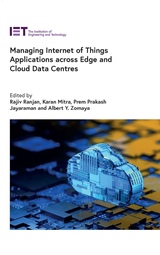
front cover of Managing Internet of Things Applications across Edge and Cloud Data Centres
Managing Internet of Things Applications across Edge and Cloud Data Centres
Rajiv Ranjan
The Institution of Engineering and Technology, 2024
Cloud computing has been a game changer for internet-based applications such as content delivery networks, social networking and multi-tier enterprise applications. However, the requirements for low-latency data access, security, bandwidth, mobility, and cost have challenged centralized data center-based cloud computing models, which is driving the need for the novel computing paradigms of edge and fog computing. The internet of things (IoT) focuses on discovery, aggregation, management, and acting on data originating from internet-connected devices via programmable sensors, actuators, mobile phones, surveillance cameras, routers, gateways and switches. But the aggregation of this data is expensive and can be time consuming.
[more]

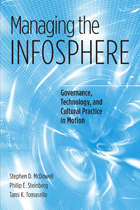
front cover of Managing the Infosphere
Managing the Infosphere
Governance, Technology, and Cultural Practice in Motion
Stephen D. McDowell, Philip E. Steinberg and Tami K. Tomasello
Temple University Press, 2007
Managing the Infosphere examines the global world of communications as a mobile space that overlaps uneasily with the world of sovereign, territorial nation-states.  Drawing on their expertise in geography, political science, international relations, and communication studies, the authors investigate specific policy problems encountered when international organizations, corporations, and individual users try to "manage" a space that simultaneously contradicts and supports existing institutions and systems of governance, identity, and technology.

The authors argue that the roles of these systems in cyberspace cannot be fully understood unless they are seen as mutually constituting each other in specific historical structures, institutions, and practices.  With vision and insight, the authors look beyond the Internet to examine the entire networked world, from cell phones and satellites to global tourism and business travel.
[more]

front cover of Manifesting Violence
Manifesting Violence
White Terrorism, Digital Culture, and the Rhetoric of Replacement
Casey Ryan Kelly and William Joseph Sipe
University of Alabama Press, 2025

When communication becomes the engine of white supremacist violence.

Manifesting Violence: White Terrorism, Digital Culture, and the Rhetoric of Replacement by Casey Ryan Kelly and William Joseph Sipe is a compelling exploration of how the digital world has become a fertile ground for white supremacist ideology. Through an in-depth analysis of white supremacist manifestos, online rhetoric, and the myth of “white genocide,” Kelly and Sipe uncover the disturbing ways in which digital culture facilitates the spread of racist ideology and the radicalization of individuals. By examining the language of white nationalism—calls to defend the white race, family, and children—Kelly and Sipe reveal how these messages, often disguised as entertainment or humor, gradually transform passive consumers into active participants in a dangerous ideology.

Manifesting Violence sheds light on the alarming shift from organized white supremacist groups to a decentralized digital arena where hate speech is disguised as humor and online conversations foster a culture of violence. Kelly and Sipe’s thorough investigation of this growing digital ecosystem offers a chilling glimpse into the dark underbelly of online extremism. A must-read for anyone seeking to understand the growing threat of hate-motivated violence and the urgent need to address its roots in digital culture, Kelly and Sipe offer rich insights to readers, researchers, academics, and policymakers concerned about extremism, online radicalization, and white supremacy.
[more]

front cover of Many-Core Computing
Many-Core Computing
Hardware and software
Bashir M. Al-Hashimi
The Institution of Engineering and Technology, 2019
Computing has moved away from a focus on performance-centric serial computation, instead towards energy-efficient parallel computation. This provides continued performance increases without increasing clock frequencies, and overcomes the thermal and power limitations of the dark-silicon era. As the number of parallel cores increases, we transition into the many-core computing era. There is considerable interest in developing methods, tools, architectures and applications to support many-core computing.
[more]

front cover of Marx and Digital Machines
Marx and Digital Machines
Alienation, Technology, Capitalism
Mike Healy
University of Westminster Press, 2020

“Healy closes his marvellous book by saying that ‘alienation is a constant feature and is experienced as a norm rather than as an aberration’.” - https://marxandphilosophy.org.uk/reviews/19718_marx-and-digital-machines-alienation-technology-capitalism-by-mike-healy-reviewed-by-thomas-klikauer/

This book explores the fundamental contradiction at the heart of the digital environment: technology offers all manner of promises, yet habitually fails to deliver. This failure often arises from numerous problems: the proficiency of the technology or end-user, policy failure at various levels, or a combination of these. Solutions such as better technology and more effective end-user education are often put into place to solve these failures. 

Mike Healy argues that such approaches are inherently faulty drawing upon qualitative research informed by Marx’s theory of alienation. Using Marx’s theory, he considers participants in three distinct settings: the workplace of information and communications technology (ICT) professionals; university scholars researching the ethical and societal implications of our digital environment; and a group of pensioners living in South London, UK, undertaking ICT training. By delving beneath the surface of how digital technologies are created, researched and experienced, this study illustrates the contradictory nature of our digital lives, as they directly arise from the needs of capitalism. 

The book also places Marx’s theory in contrast to the mainstream approaches derived from Seaman and Blauner. In researching and comprehending ICT, this book reaffirms the superior explanatory power of Marx’s theory of alienation.
[more]

front cover of The Mathematical Theory of Communication
The Mathematical Theory of Communication
Claude E. Shannon and Warren Weaver
University of Illinois Press, 1998
Scientific knowledge grows at a phenomenal pace--but few books have had as lasting an impact or played as important a role in our modern world as The Mathematical Theory of Communication, published originally as a paper on communication theory more than fifty years ago. Republished in book form shortly thereafter, it has since gone through four hardcover and sixteen paperback printings.  It is a revolutionary work, astounding in its foresight and contemporaneity.  The University of Illinois Press is pleased and honored to issue this commemorative reprinting of a classic.
 
 
[more]

front cover of MATLAB® for Electrical and Computer Engineering Students and Professionals
MATLAB® for Electrical and Computer Engineering Students and Professionals
With Simulink®
Roland Priemer
The Institution of Engineering and Technology, 2013
This book combines the teaching of the MATLAB® programming language with the presentation and development of carefully selected electrical and computer engineering (ECE) fundamentals. This is what distinguishes it from other books concerned with MATLAB®: it is directed specifically to ECE concerns. Students will see, quite explicitly, how and why MATLAB® is well suited to solve practical ECE problems.
[more]

front cover of Matrix Factorization for Multimedia Clustering
Matrix Factorization for Multimedia Clustering
Models, techniques, optimization and applications
Hangjun Che
The Institution of Engineering and Technology, 2025
Clustering is a fundamental problem in multimedia information processing. This co-authored book explores clustering principles through advanced data analysis techniques, such as matrix and tensor factorization, which are highly relevant for multimedia information processing. Multimedia data may exhibit various forms of noise represented from multiple perspectives, making traditional clustering approaches less effective. The authors consider complex conditions such as noise sensitivity and discuss methods to address these challenges in the context of multimedia data. They also examine popular regularization techniques, providing theoretical analyses that demonstrate the relationship between regularization and clustering performance.
[more]

front cover of A Matter of Trust
A Matter of Trust
Building Integrity into Data, Statistics and Records to Support the Sustainable Development Goals
Edited by Anne Thurston
University of London Press, 2020
The United Nations Sustainable Development Goals initiative has the potential to set the direction for a future world that works for everyone. Approved by 193 United Nations member countries in September 2016 to help guide global and national development policies through the year 2030, the seventeen goals build on the successes of the Millennium Development Goals, but also include new priority areas, such as climate change, economic inequality, innovation, sustainable consumption, peace, and justice. Assessed against commonly agreed targets and indicators, the goals should facilitate inter-governmental cooperation and the development of regional and even global development strategies. This book explores, through a series of case studies, the substantial challenges for assembling reliable data and statistics to address pressing development challenges, particularly in Africa. By highlighting the enormous potential value of creating and using high quality data, statistics, and records as an interconnected resource and describing how this can be achieved, the book will contribute to defining meaningful and realistic global and national development policies in the critical period to 2030.
[more]

front cover of The Means of Prediction
The Means of Prediction
How AI Really Works (and Who Benefits)
Maximilian Kasy
University of Chicago Press, 2025
An eye-opening examination of how power—not technology—will define life with AI.

AI is inescapable, from its mundane uses online to its increasingly consequential decision-making in courtrooms, job interviews, and wars. The ubiquity of AI is so great that it might produce public resignation—a sense that the technology is our shared fate.
 
As economist Maximilian Kasy shows in The Means of Prediction, artificial intelligence, far from being an unstoppable force, is irrevocably shaped by human decisions—choices made to date by the ownership class that steers its development and deployment. Kasy shows that the technology of AI is ultimately not that complex. It is insidious, however, in its capacity to steer results to its owners’ wants and ends. Kasy clearly and accessibly explains the fundamental principles on which AI works, and, in doing so, reveals that the real conflict isn’t between humans and machines, but between those who control the machines and the rest of us.
 
The Means of Prediction offers a powerful vision of the future of AI: a future not shaped by technology, but by the technology’s owners. Amid a deluge of debates about technical details, new possibilities, and social problems, Kasy cuts to the core issue: Who controls AI’s objectives, and how is this control maintained? The answer lies in what he calls “the means of prediction,” or the essential resources required for building AI systems: data, computing power, expertise, and energy. As Kasy shows, in a world already defined by inequality, one of humanity’s most consequential technologies has been and will be steered by those already in power.
 
Against those stakes, Kasy offers an elegant framework both for understanding AI’s capabilities and for designing its public control. He makes a compelling case for democratic control over AI objectives as the answer to mounting concerns about AI's risks and harms. The Means of Prediction is a revelation, both an expert undressing of a technology that has masqueraded as more complicated and a compelling call for public oversight of this transformative technology.
 
[more]

front cover of The Means of Prediction
The Means of Prediction
How AI Really Works (and Who Benefits)
Maximilian Kasy
University of Chicago Press, 2025

An eye-opening examination of how power—not technology—will define life with AI.

AI is inescapable, from its mundane uses online to its increasingly consequential decision-making in courtrooms, job interviews, and wars. The ubiquity of AI is so great that it might produce public resignation—a sense that the technology is our shared fate.
 
As economist Maximilian Kasy shows in The Means of Prediction, artificial intelligence, far from being an unstoppable force, is irrevocably shaped by human decisions—choices made to date by the ownership class that steers its development and deployment. Kasy shows that the technology of AI is ultimately not that complex. It is insidious, however, in its capacity to steer results to its owners’ wants and ends. Kasy clearly and accessibly explains the fundamental principles on which AI works, and, in doing so, reveals that the real conflict isn’t between humans and machines, but between those who control the machines and the rest of us.
 
The Means of Prediction offers a powerful vision of the future of AI: a future not shaped by technology, but by the technology’s owners. Amid a deluge of debates about technical details, new possibilities, and social problems, Kasy cuts to the core issue: Who controls AI’s objectives, and how is this control maintained? The answer lies in what he calls “the means of prediction,” or the essential resources required for building AI systems: data, computing power, expertise, and energy. As Kasy shows, in a world already defined by inequality, one of humanity’s most consequential technologies has been and will be steered by those already in power.
 
Against those stakes, Kasy offers an elegant framework both for understanding AI’s capabilities and for designing its public control. He makes a compelling case for democratic control over AI objectives as the answer to mounting concerns about AI's risks and harms. The Means of Prediction is a revelation, both an expert undressing of a technology that has masqueraded as more complicated and a compelling call for public oversight of this transformative technology.
 

[more]

front cover of Media Cultures of the Russian 1990s
Media Cultures of the Russian 1990s
Inventing the Post-Soviet Public Sphere
Edited by Maya Vinokour
Amherst College Press, 2025
Examining Russian-language media from the “long 1990s”—the period beginning with Mikhail Gorbachev’s policy of glasnost (“openness”) and ending with the election of President Vladimir Putin—Media Cultures of the Russian 1990s shows how post-Soviet civil society emerged simultaneously with the explosion of new media, especially a newly liberated television and internet. A brief and contested period of media independence ensued as explosive creativity collided with rank commercialism, journalistic integrity with burgeoning political ambitions, and fringe with mainstream. By the late 1990s, however, the media landscape had succumbed to economic and political exploitation. The causes and nature of this shift, which set the stage for Putin’s crackdown on independent media after 2000—as well as Russia’s slide into aggressive authoritarianism—are embedded in the era’s media artifacts.

Written by an interdisciplinary group of experts, this edited collection addresses the mutual influence among disparate spheres of public life that enabled the media “Wild West” of the first post-Soviet decade. As a joint platform, the volume and the associated Multimedia Sourcebook of the Russian 1990s present the decade’s media cultures in a manner that reflects their historical interconnectedness and relationship to the global present.

Edited by Maya Vinokour with contributions from Bradley Gorski, Courtney Doucette, Fabrizio Fenghi, Rita Safariants, Daniil Leiderman, Thomas Keenan, and Pavel Khazanov.

[more]

front cover of Medical Information Processing and Security
Medical Information Processing and Security
Techniques and applications
Amit Kumar Singh
The Institution of Engineering and Technology, 2022
Smart healthcare systems, made up of advanced wearable devices, internet of things (IoT) technologies and mobile internet connectivity, allow significant medical information to be easily and regularly transmitted over public networks. Personal patient information and clinical records are stored on hospitals and healthcare centres and can be accessed remotely by healthcare workers. Due to the widespread increase in the sheer volume of medical data being collected and created all the time, it has never been more important to ensure that such information is collected, stored and processed in a reliable and secure manner.
[more]

front cover of Medical Professionalism in the New Information Age
Medical Professionalism in the New Information Age
Edited and with an Introduction by David J. Rothman and David Blumenthal
Rutgers University Press, 2011
With computerized health information receiving unprecedented government support, a group of health policy scholars analyze the intricate legal, social, and professional implications of the new technology. These essays explore how Health Information Technology (HIT) may alter relationships between physicians and patients, physicians and other providers, and physicians and their home institutions. Patient use of web-based information may undermine the traditional information monopoly that physicians have long enjoyed. New IT systems may increase physicians' legal liability and heighten expectations about transparency. Case studies on kidney transplants and maternity practices reveal the unanticipated effects, positive and negative, of patient uses of the new technology. An independent HIT profession may emerge, bringing another organized interest into the medical arena. Taken together, these investigations cast new light on the challenges and opportunities presented by HIT.
[more]

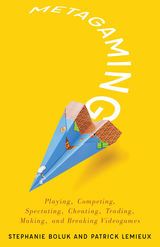
front cover of Metagaming
Metagaming
Playing, Competing, Spectating, Cheating, Trading, Making, and Breaking Videogames
Stephanie Boluk
University of Minnesota Press, 2017

The greatest trick the videogame industry ever pulled was convincing the world that videogames were games rather than a medium for making metagames. Elegantly defined as “games about games,” metagames implicate a diverse range of practices that stray outside the boundaries and bend the rules: from technical glitches and forbidden strategies to Renaissance painting, algorithmic trading, professional sports, and the War on Terror. In Metagaming, Stephanie Boluk and Patrick LeMieux demonstrate how games always extend beyond the screen, and how modders, mappers, streamers, spectators, analysts, and artists are changing the way we play.

Metagaming uncovers these alternative histories of play by exploring the strange experiences and unexpected effects that emerge in, on, around, and through videogames. Players puzzle through the problems of perspectival rendering in Portal, perform clandestine acts of electronic espionage in EVE Online, compete and commentate in Korean StarCraft, and speedrun The Legend of Zelda in record times (with or without the use of vision). Companies like Valve attempt to capture the metagame through international e-sports and online marketplaces while the corporate history of Super Mario Bros. is undermined by the endless levels of Infinite Mario, the frustrating pranks of Asshole Mario, and even Super Mario Clouds, a ROM hack exhibited at the Whitney Museum of American Art.

One of the only books to include original software alongside each chapter, Metagaming transforms videogames from packaged products into instruments, equipment, tools, and toys for intervening in the sensory and political economies of everyday life. And although videogames conflate the creativity, criticality, and craft of play with the act of consumption, we don’t simply play videogames—we make metagames.


[more]

logo for University of Chicago Press
Microcomputers and Education
Edited by Jack Culbertson and Luvern L. Cunningham
University of Chicago Press, 1986

front cover of Modal Logic and Process Algebra
Modal Logic and Process Algebra
Edited by Alban Ponse, Maarten de Rijke, and Yde Venema
CSLI, 1995
Labelled transition systems are mathematical models for dynamic behaviour, or processes, and thus form a research field of common interest to logicians and theoretical computer scientists. In computer science, this notion is a fundamental one in the formal analysis of programming languages, in particular in process theory. In modal logic, transition systems are the central object of study under the name of Kripke models. This volume collects a number of research papers on modal logic and process theory. Its unifying theme is the notion of a bisimulation. Bisimulations are relations over transition systems, and provide a key tool in identifying the processes represented by these structures. The volume offers an up-to-date overview of perspectives on labeled transition systems and bisimulations.
[more]

front cover of Model-Based Requirements Engineering
Model-Based Requirements Engineering
Jon Holt
The Institution of Engineering and Technology, 2011
This book provides a hands-on introduction to model-based requirements engineering and management by describing a set of views that form the basis for the approach. These views take into account each individual requirement in terms of its description, but then also provide each requirement with meaning by putting it into the correct 'context'. A requirement that has been put into a context is known as a 'use case' and may be based upon either stakeholders or levels of hierarchy in a system. Each use case must then be analysed and validated by defining a combination of scenarios and formal mathematical and logic-based proofs that provide the rigour required for safety-critical and mission-critical systems.
[more]

front cover of Modeling and Simulation of Complex Communication Networks
Modeling and Simulation of Complex Communication Networks
Muaz A. Niazi
The Institution of Engineering and Technology, 2019
Modern network systems such as Internet of Things, Smart Grid, VoIP traffic, Peer-to-Peer protocol, and social networks, are inherently complex. They require powerful and realistic models and tools not only for analysis and simulation but also for prediction.
[more]

front cover of Modelling Enterprise Architectures
Modelling Enterprise Architectures
Jon Holt
The Institution of Engineering and Technology, 2010
For any organisation to be successful in an increasingly competitive and global working environment, it is essential that there is a clear understanding of all aspects of the business. Given that no two organisations are exactly alike, there is no definitive understanding of exactly what these aspects are as they will depend on the organisation's nature, size and so on. Some of the aspects of the business that must be considered include: process models, process descriptions, competencies, standards, methodologies, infrastructure, people and business goals.
[more]

front cover of Mondo Nano
Mondo Nano
Fun and Games in the World of Digital Matter
Colin Milburn
Duke University Press, 2015
In Mondo Nano Colin Milburn takes his readers on a playful expedition through the emerging landscape of nanotechnology, offering a light-hearted yet critical account of our high-tech world of fun and games. This expedition ventures into discussions of the first nanocars, the popular video games Second Life, Crysis, and BioShock, international nanosoccer tournaments, and utopian nano cities. Along the way, Milburn shows how the methods, dispositions, and goals of nanotechnology research converge with video game culture. With an emphasis on play, scientists and gamers alike are building a new world atom by atom, transforming scientific speculations and video game fantasies into reality. Milburn suggests that the closing of the gap between bits and atoms entices scientists, geeks, and gamers to dream of a completely programmable future. Welcome to the wild world of Mondo Nano.
[more]

front cover of MOOCs and Their Afterlives
MOOCs and Their Afterlives
Experiments in Scale and Access in Higher Education
Edited by Elizabeth Losh
University of Chicago Press, 2017
A trio of headlines in the Chronicle of Higher Education seem to say it all: in 2013, “A Bold Move Toward MOOCs Sends Shock Waves;” in 2014, “Doubts About MOOCs Continue to Rise,” and in 2015, “The MOOC Hype Fades.” At the beginning of the 2010s, MOOCs, or Massive Open Online Courses, seemed poised to completely revolutionize higher education. But now, just a few years into the revolution, educators’ enthusiasm seems to have cooled. As advocates and critics try to make sense of the rise and fall of these courses, both groups are united by one question: Where do we go from here?

Elizabeth Losh has gathered experts from across disciplines—education, rhetoric, philosophy, literary studies, history, computer science, and journalism—to tease out lessons and chart a course into the future of open, online education. Instructors talk about what worked and what didn’t. Students share their experiences as participants. And scholars consider the ethics of this education. The collection goes beyond MOOCs to cover variants such as hybrid or blended courses, SPOCs (Small Personalized Online Courses), and DOCCs (Distributed Open Collaborative Course). Together, these essays provide a unique, even-handed look at the MOOC movement and will serve as a thoughtful guide to those shaping the next steps for open education.

[more]

front cover of More-than-Human Aging
More-than-Human Aging
Animals, Robots, and Care in Later Life
Cristina Douglas
Rutgers University Press, 2025
What does later life look like when it is lived in the companionship of other species? Similarly, how do other species age (or not) with humans, and what sort of (a)symmetries, if any, are brought to light around how we understand and think about aging? So far, aging has been investigated in the social sciences in purely human terms. This is the first collection of original work that considers aging as taking place in relation to other species. This volume aims to start a conversation about aging by taking its more-than-human participants seriously—that is, not only as a support for or context of human aging but also, more symmetrically, as agents and subjects in the process of aging. The contributors draw upon richly descriptive ethnographic accounts, including moments of connection between seniors and dogs in a long-term care facility, human care for aging laboratory animals, and robotic companionship in later life. The ethnographies in this volume not only enrich our understanding of more-than-human companionship during the human aging process but also challenge and urge us to rethink what it means to live later in life in ecologically entangled social and moral worlds.
[more]

logo for Intellect Books
The Music of Nobuo Uematsu in the Final Fantasy Series
Edited by Richard Anatone
Intellect Books, 2023
On the oeuvre of Nobuo Uematsu, the Beethoven of video game music.

Japanese musician and composer Nobuo Uematsu has built his career and reputation on his soundtracks to the enduring Final Fantasy video game series, which are notable for their remarkable cinematic feel. Today Uematsu is one of Japan’s most beloved living composers, credited with inspiring a new generation of classical music fans. This volume, the first book-length study of the music of Uematsu, takes a variety of different analytical approaches to his body of work. It offers readers interested in ludomusicology—the study of and research into video game music—a variety of ways with which to understand Uematsu’s compositional process and the role that video game music has in the overall gaming experience.

[more]

front cover of My Life as a Night Elf Priest
My Life as a Night Elf Priest
An Anthropological Account of World of Warcraft
Bonnie A. Nardi
University of Michigan Press, 2010

"Ever since the creators of the animated television show South Park turned their lovingly sardonic gaze on the massively multiplayer online game World of Warcraft for an entire episode, WoW's status as an icon of digital culture has been secure. My Life as a Night Elf Priest digs deep beneath the surface of that icon to explore the rich particulars of the World of Warcraft player's experience."
—Julian Dibbell, Wired

"World of Warcraft is the best representative of a significant new technology, art form, and sector of society: the theme-oriented virtual world. Bonnie Nardi's pioneering transnational ethnography explores this game both sensitively and systematically using the methods of cultural anthropology and aesthetics with intensive personal experience as a guild member, media teacher, and magical quest Elf."

—William Sims Bainbridge, author of The Warcraft Civilization and editor of Online Worlds
 
“Nardi skillfully covers all of the hot button issues that come to mind when people think of video games like World of Warcraft such as game addiction, sexism, and violence. What gives this book its value are its unexpected gems of rare and beautifully detailed research on less sensationalized topics of interest such as the World of Warcraft player community in China, game modding, the increasingly blurred line between play and work, and the rich and fascinating lives of players and player cultures.  Nardi brings World of Warcraft down to earth for non-players and ties it to social and cultural theory for scholars.  . . . the best ethnography of a single virtual world produced so far.”
—Lisa Nakamura, University of Illinois

World of Warcraft rapidly became one of the most popular online world games on the planet, amassing 11.5 million subscribers—officially making it an online community of gamers that had more inhabitants than the state of Ohio and was almost twice as populous as Scotland. It's a massively multiplayer online game, or MMO in gamer jargon, where each person controls a single character inside a virtual world, interacting with other people's characters and computer-controlled monsters, quest-givers, and merchants.

In My Life as a Night Elf Priest, Bonnie Nardi, a well-known ethnographer who has published extensively on how theories of what we do intersect with how we adopt and use technology, compiles more than three years of participatory research in Warcraft play and culture in the United States and China into this field study of player behavior and activity. She introduces us to her research strategy and the history, structure, and culture of Warcraft; argues for applying activity theory and theories of aesthetic experience to the study of gaming and play; and educates us on issues of gender, culture, and addiction as part of the play experience. Nardi paints a compelling portrait of what drives online gamers both in this country and in China, where she spent a month studying players in Internet cafes.

Bonnie Nardi has given us a fresh look not only at World of Warcraft but at the field of game studies as a whole. One of the first in-depth studies of a game that has become an icon of digital culture, My Life as a Night Elf Priest will capture the interest of both the gamer and the ethnographer.

Bonnie A. Nardi is an anthropologist by training and a professor in the Department of Informatics in the Donald Bren School of Information and Computer Sciences at the University of California, Irvine. Her research focus is the social implications of digital technologies. She is the author of A Small Matter of Programming: Perspectives on End User Computing and the coauthor of Information Ecologies: Using Technology with Heart and Acting with Technology: Activity Theory and Interaction Design.

Cover art by Jessica Damsky
[more]

front cover of My Mother Was a Computer
My Mother Was a Computer
Digital Subjects and Literary Texts
N. Katherine Hayles
University of Chicago Press, 2005
We live in a world, according to N. Katherine Hayles, where new languages are constantly emerging, proliferating, and fading into obsolescence. These are languages of our own making: the programming languages written in code for the intelligent machines we call computers. Hayles's latest exploration provides an exciting new way of understanding the relations between code and language and considers how their interactions have affected creative, technological, and artistic practices.

My Mother Was a Computer explores how the impact of code on everyday life has become comparable to that of speech and writing: language and code have grown more entangled, the lines that once separated humans from machines, analog from digital, and old technologies from new ones have become blurred. My Mother Was a Computer gives us the tools necessary to make sense of these complex relationships. Hayles argues that we live in an age of intermediation that challenges our ideas about language, subjectivity, literary objects, and textuality. This process of intermediation takes place where digital media interact with cultural practices associated with older media, and here Hayles sharply portrays such interactions: how code differs from speech; how electronic text differs from print; the effects of digital media on the idea of the self; the effects of digitality on printed books; our conceptions of computers as living beings; the possibility that human consciousness itself might be computational; and the subjective cosmology wherein humans see the universe through the lens of their own digital age.

We are the children of computers in more than one sense, and no critic has done more than N. Katherine Hayles to explain how these technologies define us and our culture. Heady and provocative, My Mother Was a Computer will be judged as her best work yet.
[more]


Send via email Share on Facebook Share on Twitter