
 A SCHOLARLY BOOK REPOSITORY
6 start with M start with M
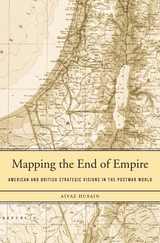
By the end of World War II, strategists in Washington and London looked ahead to a new era in which the United States shouldered global responsibilities and Britain concentrated its regional interests more narrowly. The two powers also viewed the Muslim world through very different lenses. Mapping the End of Empire reveals how Anglo–American perceptions of geography shaped postcolonial futures from the Middle East to South Asia.
Aiyaz Husain shows that American and British postwar strategy drew on popular notions of geography as well as academic and military knowledge. Once codified in maps and memoranda, these perspectives became foundations of foreign policy. In South Asia, American officials envisioned an independent Pakistan blocking Soviet influence, an objective that outweighed other considerations in the contested Kashmir region. Shoring up Pakistan meshed perfectly with British hopes for a quiescent Indian subcontinent once partition became inevitable. But serious differences with Britain arose over America’s support for the new state of Israel. Viewing the Mediterranean as a European lake of sorts, U.S. officials—even in parts of the State Department—linked Palestine with Europe, deeming it a perfectly logical destination for Jewish refugees. But British strategists feared that the installation of a Jewish state in Palestine could incite Muslim ire from one corner of the Islamic world to the other.
As Husain makes clear, these perspectives also influenced the Dumbarton Oaks Conference and blueprints for the UN Security Council and shaped French and Dutch colonial fortunes in the Levant and the East Indies.

For over thirty years, David F. Kelly has worked with medical practitioners, students, families, and the sick and dying to confront the difficult and often painful issues that concern medical treatment at the end of life. In this short and practical book, Kelly shares his vast experience, providing a rich resource for thinking about life's most painful decisions.
Kelly outlines eight major issues regarding end-of-life care as seen through the lens of the Catholic medical ethics tradition. He looks at the distinction between ordinary and extraordinary means; the difference between killing and allowing to die; criteria of patient competence; what to do in the case of incompetent patients; the meaning and use of advance directives; the morality of hydration and nutrition; physician-assisted suicide and euthanasia; and medical futility. Kelly's analysis is sprinkled with significant legal decisions and, throughout, elaborations on how the Catholic medical ethics tradition—as well as teachings of bishops and popes—understands each issue. He provides a helpful glossary to supplement his introduction to the terminology used by philosophical health care ethics. Included in Kelly's discussion is his lucid description of why the Catholic tradition supports the discontinuation of medical care in the Terry Schiavo case. He also explores John Paul II's controversial papal allocution concerning hydration and nutrition for unconscious patients, arguing that the Catholic tradition does not require feeding the permanently unconscious.
Medical Care at the End of Life addresses the major issues that inform this last stage of caregiving. It offers a critical guide to understanding the medical ethics and relevant legal cases needed for clear thinking when individuals are faced with those crucial decisions.
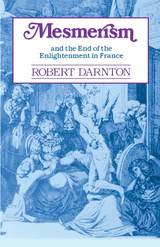
“[An] excellent and exemplary study in the history of ideas…Provides a commendable model for those interested in the way ‘true’ and ‘false’ ideas interact and broadly influence behavior.” —Science
Early in 1788, Franz Anton Mesmer, a Viennese physician, arrived in Paris and began to promulgate a somewhat exotic theory of healing that almost immediately seized the imagination of the general populace. Robert Darnton, in his lively study of mesmerism and its relation to eighteenth-century radical political thought and popular scientific notions, provides a useful contribution to the study of popular culture and the manner in which ideas are diffused down through various social levels.

The emergence of a distinctly modern form of tragedy is often associated with the introduction of middle-class characters and settings to high drama during the early eighteenth century. What has not been explored previously, however, is how such tragedy uses modernity’s social circumstances to stage metaphysical conditions that are destructive to human worlds. Leonardo F. Lisi pursues this argument by focusing on three central yet distinct figures in the history of modern thought and theater: eighteenth-century English dramatist George Lillo, early nineteenth-century Italian poet Giacomo Leopardi, and late nineteenth-century Norwegian iconoclast Henrik Ibsen. Modern Tragedy and the End of Worlds: Lillo, Leopardi, Ibsen shows that their works share a critical theme: the impossibility of sustaining human forms of meaning in the face of modern materialism, finance, and reason. Viewed in this light, Lisi argues that modern tragedy requires thinking together the incommensurable scales of human existence and the inhuman processes on which it rests—a task that continues to have profound relevance for imagining the end of worlds in the Anthropocene.
READERS
Browse our collection.
PUBLISHERS
See BiblioVault's publisher services.
STUDENT SERVICES
Files for college accessibility offices.
RECENTLY PUBLISHED




UChicago Accessibility Resources
home | accessibility | search | about | contact us
BiblioVault ® 2001 - 2025
The University of Chicago Press