front cover of Making Climate Tech Work
Making Climate Tech Work
Policies that Drive Innovation
Alon Tal
Island Press, 2024
Climate tech is critical for averting planetary chaos. Half the greenhouse gas reductions required to reach “net-zero” climate targets in 2050 will need to come from technologies that have not yet been invented.  Without effective government interventions, market incentives alone will not produce a rapid transition to a low-carbon economy. The commercial value of innovative climate technology, especially in its early phases, remains underpriced—far below its social value. The good news is that smart policies can change these dynamics and catalyze the necessary creativity and investment in clean technology, and its deployment. The key question is: which approaches can lead us to future carbon neutrality, and which are likely to fall short?

In Making Climate Tech Work, environmental policy expert Alon Tal demystifies climate innovation programs around the world—no policy background needed. Beginning with a review of government’s general role in technology policy development, Tal assesses each policy alternative, describing eye-opening experiments in diverse countries, presenting a range of case studies, interviewing leading decarbonization experts, and interpreting new empirical data. Discover how Germany incentivized renewables; Denmark became a wind energy superpower; Australia phased out incandescent bulbs; California’s prisons pioneered low-carbon menus; and why carbon taxes have failed around the world—but could be designed for success.

Tal distills the benefits and drawbacks of each policy, along with related ethical questions and public perceptions. He concludes by addressing two commonly overlooked issues in climate policy: disruption of workers’ livelihoods from the clean energy transition; and integrating the Global South into the planet’s new low-carbon economy—as the region that has contributed least to climate change but which must be part of a global solution. Tal not only evaluates which policy strategies effectively reduce emissions but also how they can promote climate tech innovation.

Humanity is ultimately in a race against time and effective climate policies are critical to ensure a sustainable future. Making Climate Tech Work serves as an essential primer for policymakers, academics, activists, and anyone interested in climate solutions.
[more]

logo for Pluto Press
Making Peace with the Earth
Vandana Shiva
Pluto Press, 2013

In this compelling and rigorously documented exposition, Vandana Shiva demolishes the myths propagated by corporate globalisation in its pursuit of profit and power and shows its devastating environmental impact.

Shiva argues that consumerism lubricates the war against the earth and that corporate control violates all ethical and ecological limits. She takes the reader on a journey through the world's devastated eco-landscape, one of genetic engineering, industrial development and land-grabs in Africa, Asia and South America. She concludes that exploitation of this order is incurring an ecological and economic debt that is unsustainable.

Making Peace with the Earth outlines how a paradigm shift to earth-centred politics and economics is our only chance of survival and how collective resistance to corporate exploitation can open the way to a new environmentalism.

[more]

logo for University of Chicago Press Journals
Marine Resource Economics, volume 37 number 3 (July 2022)
The University of Chicago Press
University of Chicago Press Journals, 2022

logo for University of Chicago Press Journals
Marine Resource Economics, volume 37 number 4 (October 2022)
The University of Chicago Press
University of Chicago Press Journals, 2022

front cover of Marine Resource Economics, volume 38 number 1 (January 2023)
Marine Resource Economics, volume 38 number 1 (January 2023)
The University of Chicago Press
University of Chicago Press Journals, 2023
This is volume 38 issue 1 of Marine Resource Economics. Marine Resource Economics (MRE) publishes creative and scholarly economic analyses of a range of issues related to natural resource use in the global marine environment. The scope of the journal includes conceptual and empirical investigations aimed at addressing real-world ocean and coastal policy problems. MRE is an outlet for early results and imaginative new thinking on emerging topics in the marine environment, as well as rigorous theoretical and empirical analyses of questions that have long interested economists who study the oceans. A pluralistic forum for researchers and policy makers, MRE encourages challenges to conventional paradigms and perspectives. The journal is comprised of five sections: Articles, Perspectives, Case Studies, Systematic Reviews, and Book Reviews.
[more]

front cover of Marine Resource Economics, volume 38 number 2 (April 2023)
Marine Resource Economics, volume 38 number 2 (April 2023)
The University of Chicago Press
University of Chicago Press Journals, 2023
This is volume 38 issue 2 of Marine Resource Economics. Marine Resource Economics (MRE) publishes creative and scholarly economic analyses of a range of issues related to natural resource use in the global marine environment. The scope of the journal includes conceptual and empirical investigations aimed at addressing real-world ocean and coastal policy problems. MRE is an outlet for early results and imaginative new thinking on emerging topics in the marine environment, as well as rigorous theoretical and empirical analyses of questions that have long interested economists who study the oceans. A pluralistic forum for researchers and policy makers, MRE encourages challenges to conventional paradigms and perspectives. The journal is comprised of five sections: Articles, Perspectives, Case Studies, Systematic Reviews, and Book Reviews.
[more]

front cover of Marine Resource Economics, volume 38 number 3 (July 2023)
Marine Resource Economics, volume 38 number 3 (July 2023)
The University of Chicago Press
University of Chicago Press Journals, 2023
This is volume 38 issue 3 of Marine Resource Economics. Marine Resource Economics (MRE) publishes creative and scholarly economic analyses of a range of issues related to natural resource use in the global marine environment. The scope of the journal includes conceptual and empirical investigations aimed at addressing real-world ocean and coastal policy problems. MRE is an outlet for early results and imaginative new thinking on emerging topics in the marine environment, as well as rigorous theoretical and empirical analyses of questions that have long interested economists who study the oceans. A pluralistic forum for researchers and policy makers, MRE encourages challenges to conventional paradigms and perspectives. The journal is comprised of five sections: Articles, Perspectives, Case Studies, Systematic Reviews, and Book Reviews.
[more]

front cover of Marine Resource Economics, volume 38 number 4 (October 2023)
Marine Resource Economics, volume 38 number 4 (October 2023)
The University of Chicago Press
University of Chicago Press Journals, 2023
This is volume 38 issue 4 of Marine Resource Economics. Marine Resource Economics (MRE) publishes creative and scholarly economic analyses of a range of issues related to natural resource use in the global marine environment. The scope of the journal includes conceptual and empirical investigations aimed at addressing real-world ocean and coastal policy problems. MRE is an outlet for early results and imaginative new thinking on emerging topics in the marine environment, as well as rigorous theoretical and empirical analyses of questions that have long interested economists who study the oceans. A pluralistic forum for researchers and policy makers, MRE encourages challenges to conventional paradigms and perspectives. The journal is comprised of five sections: Articles, Perspectives, Case Studies, Systematic Reviews, and Book Reviews.
[more]

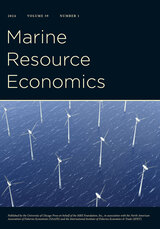
front cover of Marine Resource Economics, volume 39 number 1 (January 2024)
Marine Resource Economics, volume 39 number 1 (January 2024)
The University of Chicago Press
University of Chicago Press Journals, 2024
This is volume 39 issue 1 of Marine Resource Economics. Marine Resource Economics (MRE) publishes creative and scholarly economic analyses of a range of issues related to natural resource use in the global marine environment. The scope of the journal includes conceptual and empirical investigations aimed at addressing real-world ocean and coastal policy problems. MRE is an outlet for early results and imaginative new thinking on emerging topics in the marine environment, as well as rigorous theoretical and empirical analyses of questions that have long interested economists who study the oceans. A pluralistic forum for researchers and policy makers, MRE encourages challenges to conventional paradigms and perspectives. The journal is comprised of five sections: Articles, Perspectives, Case Studies, Systematic Reviews, and Book Reviews.
[more]

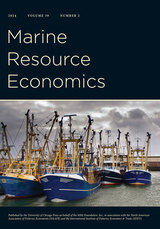
front cover of Marine Resource Economics, volume 39 number 2 (April 2024)
Marine Resource Economics, volume 39 number 2 (April 2024)
The University of Chicago Press
University of Chicago Press Journals, 2024
This is volume 39 issue 2 of Marine Resource Economics. Marine Resource Economics (MRE) publishes creative and scholarly economic analyses of a range of issues related to natural resource use in the global marine environment. The scope of the journal includes conceptual and empirical investigations aimed at addressing real-world ocean and coastal policy problems. MRE is an outlet for early results and imaginative new thinking on emerging topics in the marine environment, as well as rigorous theoretical and empirical analyses of questions that have long interested economists who study the oceans. A pluralistic forum for researchers and policy makers, MRE encourages challenges to conventional paradigms and perspectives. The journal is comprised of five sections: Articles, Perspectives, Case Studies, Systematic Reviews, and Book Reviews.
[more]

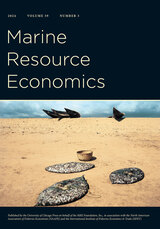
front cover of Marine Resource Economics, volume 39 number 3 (July 2024)
Marine Resource Economics, volume 39 number 3 (July 2024)
The University of Chicago Press
University of Chicago Press Journals, 2024
This is volume 39 issue 3 of Marine Resource Economics. Marine Resource Economics (MRE) publishes creative and scholarly economic analyses of a range of issues related to natural resource use in the global marine environment. The scope of the journal includes conceptual and empirical investigations aimed at addressing real-world ocean and coastal policy problems. MRE is an outlet for early results and imaginative new thinking on emerging topics in the marine environment, as well as rigorous theoretical and empirical analyses of questions that have long interested economists who study the oceans. A pluralistic forum for researchers and policy makers, MRE encourages challenges to conventional paradigms and perspectives. The journal is comprised of five sections: Articles, Perspectives, Case Studies, Systematic Reviews, and Book Reviews.
[more]

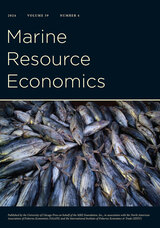
front cover of Marine Resource Economics, volume 39 number 4 (October 2024)
Marine Resource Economics, volume 39 number 4 (October 2024)
The University of Chicago Press
University of Chicago Press Journals, 2024
This is volume 39 issue 4 of Marine Resource Economics. Marine Resource Economics (MRE) publishes creative and scholarly economic analyses of a range of issues related to natural resource use in the global marine environment. The scope of the journal includes conceptual and empirical investigations aimed at addressing real-world ocean and coastal policy problems. MRE is an outlet for early results and imaginative new thinking on emerging topics in the marine environment, as well as rigorous theoretical and empirical analyses of questions that have long interested economists who study the oceans. A pluralistic forum for researchers and policy makers, MRE encourages challenges to conventional paradigms and perspectives. The journal is comprised of five sections: Articles, Perspectives, Case Studies, Systematic Reviews, and Book Reviews.
[more]

front cover of Marine Resource Economics, volume 40 number 1 (January 2025)
Marine Resource Economics, volume 40 number 1 (January 2025)
The University of Chicago Press
University of Chicago Press Journals, 2025
This is volume 40 issue 1 of Marine Resource Economics. Marine Resource Economics (MRE) publishes creative and scholarly economic analyses of a range of issues related to natural resource use in the global marine environment. The scope of the journal includes conceptual and empirical investigations aimed at addressing real-world ocean and coastal policy problems. MRE is an outlet for early results and imaginative new thinking on emerging topics in the marine environment, as well as rigorous theoretical and empirical analyses of questions that have long interested economists who study the oceans. A pluralistic forum for researchers and policy makers, MRE encourages challenges to conventional paradigms and perspectives. The journal is comprised of five sections: Articles, Perspectives, Case Studies, Systematic Reviews, and Book Reviews.
[more]

front cover of Marine Resource Economics, volume 40 number 2 (April 2025)
Marine Resource Economics, volume 40 number 2 (April 2025)
The University of Chicago Press
University of Chicago Press Journals, 2025
This is volume 40 issue 2 of Marine Resource Economics. Marine Resource Economics (MRE) publishes creative and scholarly economic analyses of a range of issues related to natural resource use in the global marine environment. The scope of the journal includes conceptual and empirical investigations aimed at addressing real-world ocean and coastal policy problems. MRE is an outlet for early results and imaginative new thinking on emerging topics in the marine environment, as well as rigorous theoretical and empirical analyses of questions that have long interested economists who study the oceans. A pluralistic forum for researchers and policy makers, MRE encourages challenges to conventional paradigms and perspectives. The journal is comprised of five sections: Articles, Perspectives, Case Studies, Systematic Reviews, and Book Reviews.
[more]

front cover of Marine Resource Economics, volume 40 number 3 (July 2025)
Marine Resource Economics, volume 40 number 3 (July 2025)
The University of Chicago Press
University of Chicago Press Journals, 2025
This is volume 40 issue 3 of Marine Resource Economics. Marine Resource Economics (MRE) publishes creative and scholarly economic analyses of a range of issues related to natural resource use in the global marine environment. The scope of the journal includes conceptual and empirical investigations aimed at addressing real-world ocean and coastal policy problems. MRE is an outlet for early results and imaginative new thinking on emerging topics in the marine environment, as well as rigorous theoretical and empirical analyses of questions that have long interested economists who study the oceans. A pluralistic forum for researchers and policy makers, MRE encourages challenges to conventional paradigms and perspectives. The journal is comprised of five sections: Articles, Perspectives, Case Studies, Systematic Reviews, and Book Reviews.
[more]

front cover of Marine Resource Economics, volume 40 number 4 (October 2025)
Marine Resource Economics, volume 40 number 4 (October 2025)
The University of Chicago Press
University of Chicago Press Journals, 2025
This is volume 40 issue 4 of Marine Resource Economics. Marine Resource Economics (MRE) publishes creative and scholarly economic analyses of a range of issues related to natural resource use in the global marine environment. The scope of the journal includes conceptual and empirical investigations aimed at addressing real-world ocean and coastal policy problems. MRE is an outlet for early results and imaginative new thinking on emerging topics in the marine environment, as well as rigorous theoretical and empirical analyses of questions that have long interested economists who study the oceans. A pluralistic forum for researchers and policy makers, MRE encourages challenges to conventional paradigms and perspectives. The journal is comprised of five sections: Articles, Perspectives, Case Studies, Systematic Reviews, and Book Reviews.
[more]

front cover of Marine Resource Economics, volume 41 number 1 (January 2026)
Marine Resource Economics, volume 41 number 1 (January 2026)
The University of Chicago Press
University of Chicago Press Journals, 2026
This is volume 41 issue 1 of Marine Resource Economics. Marine Resource Economics (MRE) publishes creative and scholarly economic analyses of a range of issues related to natural resource use in the global marine environment. The scope of the journal includes conceptual and empirical investigations aimed at addressing real-world ocean and coastal policy problems. MRE is an outlet for early results and imaginative new thinking on emerging topics in the marine environment, as well as rigorous theoretical and empirical analyses of questions that have long interested economists who study the oceans. A pluralistic forum for researchers and policy makers, MRE encourages challenges to conventional paradigms and perspectives. The journal is comprised of five sections: Articles, Perspectives, Case Studies, Systematic Reviews, and Book Reviews.
[more]

front cover of Marine Resource Economics, volume 41 number 2 (April 2026)
Marine Resource Economics, volume 41 number 2 (April 2026)
The University of Chicago Press
University of Chicago Press Journals, 2026
This is volume 41 issue 2 of Marine Resource Economics. Marine Resource Economics (MRE) publishes creative and scholarly economic analyses of a range of issues related to natural resource use in the global marine environment. The scope of the journal includes conceptual and empirical investigations aimed at addressing real-world ocean and coastal policy problems. MRE is an outlet for early results and imaginative new thinking on emerging topics in the marine environment, as well as rigorous theoretical and empirical analyses of questions that have long interested economists who study the oceans. A pluralistic forum for researchers and policy makers, MRE encourages challenges to conventional paradigms and perspectives. The journal is comprised of five sections: Articles, Perspectives, Case Studies, Systematic Reviews, and Book Reviews.
[more]

front cover of Marketing the Wilderness
Marketing the Wilderness
Outdoor Recreation, Indigenous Activism, and the Battle over Public Lands
Joseph Whitson
University of Minnesota Press, 2025

How outdoor industry marketing promotes an image of “the wilderness” as an unpeopled haven

Marketing the Wilderness analyzes the relationship between the outdoor recreation industry, public lands in the United States, and Indigenous sovereignty and representation in recreational spaces. Combining social media analysis, digital ethnography, and historical research, Joseph Whitson offers nuanced insights into more than a century of the outdoor recreation industry’s marketing strategies, unraveling its complicity in settler colonialism.

Complicating the narrative of outdoor recreation as a universal good, Whitson introduces the concept of “wildernessing” to describe the physical, legal, and rhetorical production of pristine, empty lands that undergirds the outdoor recreation industry, a process that further disenfranchises Indigenous people from whom these lands were stolen. He demonstrates how companies such as Patagonia and REI align with the mining and drilling industries in their need to remove Indigenous peoples and histories from valuable lands. And he describes the ways Indigenous and decolonial activists are subverting and resisting corporate marketing strategies to introduce new narratives of place.

Through the lens of environmental justice activism, Marketing the Wilderness reconsiders the ethics of recreational land use, advocating for engagement with issues of cultural representation and appropriation informed by Indigenous perspectives. As he discusses contemporary public land advocacy around places such as Bears Ears National Monument, Whitson focuses on the deeply fraught relationship between the outdoor recreation industry and Indigenous communities. Emphasizing the power of the corporate system and its treatment of land as a commodity under capitalism, he shows how these tensions shape the American idea of “wilderness” and what it means to fight for its preservation.

Retail e-book files for this title are screen-reader friendly with images accompanied by short alt text and/or extended descriptions.
[more]

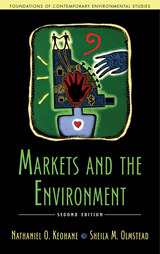
front cover of Markets and the Environment
Markets and the Environment
Nathaniel O. Keohane and Sheila M. Olmstead
Island Press, 2007
Markets and the Environment is a concise yet comprehensive introduction to a topic of central importance in understanding a wide range of environmental issues and policy approaches. It offers a clear overview of the fundamentals of environmental economics that will enable students and professionals to quickly grasp important concepts and to apply those concepts to real-world environmental problems. In addition, the book integrates normative, policy, and institutional issues at a principles level. Chapters examine: the benefits and costs of environmental protection, markets and market failure, natural resources as capital assets, and sustainability and economic development.
 
Markets and the Environment is the second volume in the Foundations of Contemporary Environmental Studies Series, edited by James Gustave Speth. The series presents concise guides to essential subjects in the environmental curriculum, incorporating a problem-based approach to teaching and learning.
[more]

front cover of Markets and the Environment, Second Edition
Markets and the Environment, Second Edition
Nathaniel O. Keohane and Sheila M. Olmstead
Island Press, 2015
A clear grasp of economics is essential to understanding why environmental problems arise and how we can address them. So it is with good reason that Markets and the Environment has become a classic text in environmental studies since its first publication in 2007. Now thoroughly revised with updated information on current environmental policy and real-world examples of market-based instruments, the primer is more relevant than ever.
 
The authors provide a concise yet thorough introduction to the economic theory of environmental policy and natural resource management. They begin with an overview of environmental economics before exploring topics including cost-benefit analysis, market failures and successes, and economic growth and sustainability. Readers of the first edition will notice new analysis of cost estimation as well as specific market instruments, including municipal water pricing and waste disposal. Particular attention is paid to behavioral economics and cap-and-trade programs for carbon.
 
Throughout, Markets and the Environment is written in an accessible, student-friendly style. It includes study questions for each chapter, as well as clear figures and relatable text boxes. The authors have long understood the need for a book to bridge the gap between short articles on environmental economics and tomes filled with complex algebra. Markets and the Environment makes clear how economics influences policy, the world around us, and our own lives. 
[more]

front cover of Measuring and Accounting for Environmental Public Goods
Measuring and Accounting for Environmental Public Goods
A National Accounts Perspective
Edited by Nicholas Z. Muller, Eli P. Fenichel, and Mary Bohman
University of Chicago Press, 2025

Provides strategies and approaches for integrating natural capital into environmental statistics.

While the importance of natural resources and the contributions of the environment to welfare are apparent, traditional national income and wealth accounting practices do not measure or value environmental public goods. This volume examines the conceptual and empirical basis for integrating natural capital—forests, oceans, and air—into the economic and environmental statistics that inform public policy. It offers innovative approaches to valuing nonmarket environmental goods and services, including strategies for capturing heterogeneity in measurement across types of capital, geography, and individuals.

The chapters focus on measuring productivity with adjustments for pollution damage, developing a microdata infrastructure to advance our understanding of the distribution of environmental amenities and hazards, and estimating long-run sustainable development indicators. Case studies consider coastal assets, forests, and marine ecosystems, and develop strategies for implementing specific environmental-economic accounts such as environmental activity accounts and natural capital accounts for forests and the marine economy. As national income accounting standards are updated to incorporate expanded guidance on issues related to natural capital, this timely book will help inform decisions on the measurement and treatment of climate, air, water, and other public goods.
[more]

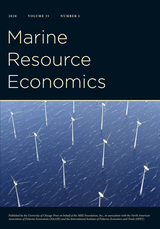
front cover of MRE vol 35 num 1
MRE vol 35 num 1
The University of Chicago Press
University of Chicago Press Journals, 2020
This is volume 35 issue 1 of Marine Resource Economics. Marine Resource Economics (MRE) publishes creative and scholarly economic analyses of a range of issues related to natural resource use in the global marine environment. The scope of the journal includes conceptual and empirical investigations aimed at addressing real-world ocean and coastal policy problems. MRE is an outlet for early results and imaginative new thinking on emerging topics in the marine environment, as well as rigorous theoretical and empirical analyses of questions that have long interested economists who study the oceans. A pluralistic forum for researchers and policy makers, MRE encourages challenges to conventional paradigms and perspectives. The journal is comprised of five sections: Articles, Perspectives, Case Studies, Systematic Reviews, and Book Reviews.
[more]


Send via email Share on Facebook Share on Twitter