
 A SCHOLARLY BOOK REPOSITORY
11 start with M start with M


"This book is a delight. It is not often that one has the privilege of working from a text this detailed and easy to use. It is living history, able to be practiced by novice and master alike, practical history which can be carried out in our own homes by those of us living in modern times."—Wanda Oram Miles, The Medieval Review
"The Medieval Kitchen, like other classic cookbooks, makes compulsive reading as well as providing a practical collection of recipes."—Heather O'Donoghue, Times Literary Supplement
This book examines techniques and technologies of food preparation, the spaces where food was cooked, the relationship between cooking and changes in suprahousehold economies, the religious and symbolic aspects of cooking, the relationship between cooking and social identity, and how examining foodways provides insight into social relations of production, distribution, and consumption. Contributors use a wide variety of evidence-including archaeological data; archival research; analysis of ceramics, fauna, botany, glass artifacts, stone tools, murals, and painted ceramics; ethnographic analogy; and the distribution of artifacts across space-to identify signs of cooking and food processing left by ancient cooks.
The Menial Art of Cooking is the first archaeological volume focused on cooking and food preparation in prehistoric and historic settings around the world and will interest archaeologists, social anthropologists, sociologists, and other scholars studying cooking and food preparation or subsistence.
New case studies documenting ten thousand years of cuisines across the cultures of Oaxaca, Mexico, from the earliest gathered plants, such as guajes, to the contemporary production of tejate and its health implications.
Among the richest culinary traditions in Mexico are those of the “eight regions” of the state of Oaxaca. Mesquite Pods to Mezcal brings together some of the most prominent scholars in Oaxacan archaeology and related fields to explore the evolution of the area’s world-renowned cuisines. This volume, the first to address food practices across Oaxaca through a long-term historical lens, covers the full spectrum of human occupation in Oaxaca, from the early Holocene to contemporary times. Contributors consider the deep history of agroecological management and large-scale landscape transformation, framing food production as a human-environment relation. They explore how, after the arrival of the Spanish, Oaxacan cuisines adapted, diets changed, and food became a stronger marker of identity. Examining the present, further studies document how traditional foodways persist and what they mean for contemporary Oaxacans, whether they are traveling ancient roads, working outside the region, or rebuilding after an earthquake. Together, the original case studies in this volume demonstrate how new methods and diverse theoretical approaches can come together to trace the development of a rich food tradition, one that is thriving today.
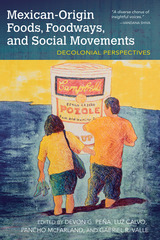
This collection of new essays offers groundbreaking perspectives on the ways that food and foodways serve as an element of decolonization in Mexican-origin communities.
The writers here take us from multigenerational acequia farmers, who trace their ancestry to Indigenous families in place well before the Oñate Entrada of 1598, to tomorrow’s transborder travelers who will be negotiating entry into the United States. Throughout, we witness the shifting mosaic of Mexican-origin foods and foodways in the fields, gardens, and kitchen tables from Chiapas to Alaska.
Global food systems are also considered from a critical agroecological perspective, including the ways colonialism affects native biocultural diversity, ecosystem resilience, and equality across species, human groups, and generations.
Mexican-Origin Foods, Foodways, and Social Movements is a major contribution to the understanding of the ways that Mexican-origin peoples have resisted and transformed food systems. It will animate scholarship on global food studies for years to come.
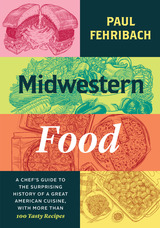
Celebrated chef Paul Fehribach has made his name serving up some of the most thoughtful and authentic regional southern cooking—not in the South, but in Chicago at Big Jones. But over the last several years, he has been looking to his Indiana roots in the kitchen, while digging deep into the archives to document and record the history and changing foodways of the Midwest.
Fehribach is as painstaking with his historical research as he is with his culinary execution. In Midwestern Food, he focuses not only on the past and present of Midwestern foodways but on the diverse cultural migrations from the Ohio River Valley north- and westward that have informed them. Drawing on a range of little-explored sources, he traces the influence of several heritages, especially German, and debunks many culinary myths along the way.
The book is also full of Fehribach’s delicious recipes informed by history and family alike, such as his grandfather's favorite watermelon rind pickles; sorghum-pecan sticky rolls; Detroit-style coney sauce; Duck and manoomin hotdish; pawpaw chiffon pie; strawberry pretzel gelatin salad (!); and he breaks the code to the most famous Midwestern pizza and BBQ styles you can easily reproduce at home. But it is more than just a cookbook, weaving together historical analysis and personal memoir with profiles of the chefs, purveyors, and farmers who make up the food networks of the region.
The result is a mouth-watering and surprising Midwestern feast from farm to plate. Flyover this!
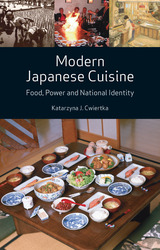
Katarzyna J. Cwiertka demonstrates that key shifts in the Japanese diet were, in many cases, a consequence of modern imperialism. Exploring reforms in military catering and home cooking, wartime food management and the rise of urban gastronomy, Cwiertka shows how Japan’s numerous regional cuisines were eventually replaced by a set of foods and practices with which the majority of Japanese today ardently identify.
The result of over a decade of research, Modern Japanese Cuisine is a fascinating look at the historical roots of some of the world’s best cooking and will provide appetizing reading for scholars of Japanese culture and foodies alike.
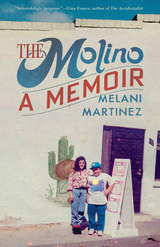
Set in one of Tucson’s first tamal and tortilla factories, The Molino is a hybrid memoir that reckons with one family’s loss of home, food, and faith.
Weaving together history, culture, and Mexican food traditions, Melani Martinez shares the story of her family’s life and work in the heart of their downtown eatery, El Rapido. Opened by Martinez’s great-grandfather, Aurelio Perez, in 1933, El Rapido served tamales and burritos to residents and visitors to Tucson’s historic Barrio Presidio for nearly seventy years. For the family, the factory that bound them together was known for the giant corn grinder churning behind the scenes—the molino. With clear eyes and warm humor, Martinez documents the work required to prepare food for others, and explores the heartbreaking aftermath of gentrification that forces the multigenerational family business to close its doors.
The Molino is also Martinez’s personal story—that of a young Tucsonense coming of age in the 1980s and ’90s. As a young woman she rejects the work in her father’s popular kitchen, but when the business closes, her world shifts and the family disbands. When she finds her way back home, the tortillería’s iconic mural provides a gateway into history and ruin, ancestry and sacrifice, industrial myth and artistic incarnation—revealing a sacred presence still alive in Tucson.
A must-read for foodies, history lovers, and anyone searching for spiritual truth in the desert, this is a story of belonging and transformation in the borderlands.
READERS
Browse our collection.
PUBLISHERS
See BiblioVault's publisher services.
STUDENT SERVICES
Files for college accessibility offices.
RECENTLY PUBLISHED





UChicago Accessibility Resources
home | accessibility | search | about | contact us
BiblioVault ® 2001 - 2026
The University of Chicago Press