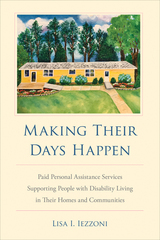
front cover of Making Their Days Happen
Making Their Days Happen
Paid Personal Assistance Services Supporting People with Disability Living in Their Homes and Communities
Lisa I. Iezzoni
Temple University Press, 2022

Most Americans—even those with significant disability—want to live in their homes and communities. Unpaid family members or friends often work as “informal” caregivers, helping those who need assistance— and many feel they have no option but to serve. In contrast, paid personal assistance services workers (PAS) provide a lifeline to those consumers with complex needs and limited social networks. However, there is a crisis looming in the increasing needs for paid PAS and the limited available PAS workforce.

Making Their Days Happen explores disability, health, and civil rights, along with relevant federal and state labor policies related to personal assistance services. Lisa Iezzoni addresses the legal context of paid PAS as well as financing mechanisms for obtaining home-based personal assistance. She also draws upon interviews she conducted with paid PAS consumers and PAS workers to explore PAS experiences and their perspectives about their work. 

Offering recommendations for improving future experiences of PAS consumers and providers, Iezzoni emphasizes that people with disabilities want to be a part of society, and PAS workers who do this low-wage work find satisfaction in helping them achieve their goals.
[more]

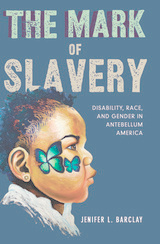
front cover of The Mark of Slavery
The Mark of Slavery
Disability, Race, and Gender in Antebellum America
Jenifer L. Barclay
University of Illinois Press, 2021
Exploring the disability history of slavery

Time and again, antebellum Americans justified slavery and white supremacy by linking blackness to disability, defectiveness, and dependency. Jenifer L. Barclay examines the ubiquitous narratives that depicted black people with disabilities as pitiable, monstrous, or comical, narratives used not only to defend slavery but argue against it. As she shows, this relationship between ableism and racism impacted racial identities during the antebellum period and played an overlooked role in shaping American history afterward. Barclay also illuminates the everyday lives of the ten percent of enslaved people who lived with disabilities. Devalued by slaveholders as unsound and therefore worthless, these individuals nonetheless carved out an unusual autonomy. Their roles as caregivers, healers, and keepers of memory made them esteemed within their own communities and celebrated figures in song and folklore.

Prescient in its analysis and rich in detail, The Mark of Slavery is a powerful addition to the intertwined histories of disability, slavery, and race.
[more]

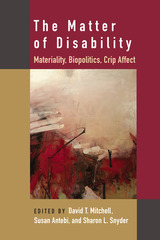
front cover of The Matter of Disability
The Matter of Disability
Materiality, Biopolitics, Crip Affect
David T. Mitchell, Susan Antebi, and Sharon L. Snyder, Editors
University of Michigan Press, 2019
The Matter of Disability returns disability to its proper place as an ongoing historical process of corporeal, cognitive, and sensory mutation operating in a world of dynamic, even cataclysmic, change. The book’s contributors offer new theorizations of human and nonhuman embodiments and their complex evolutions in our global present, in essays that explore how disability might be imagined as participant in the “complex elaboration of difference,” rather than something gone awry in an otherwise stable process. This alternative approach to materiality sheds new light on the capacities that exist within the depictions of disability that the book examines, including Spider-Man, Of Mice and Men, and Bloodchild.
[more]

front cover of Menace to the Future
Menace to the Future
A Disability and Queer History of Carceral Eugenics
Jess Whatcott
Duke University Press, 2024
In Menace to the Future, Jess Whatcott traces the link between US disability institutions and early twentieth-century eugenicist ideology, demonstrating how the legacy of those ideas continues to shape incarceration and detention today. Whatcott focuses on California, examining records from state institutions and reform organizations, newspapers, and state hospital museum exhibits. They reveal that state confinement, coercive treatment, care neglect, and forced sterilization were done out of the belief that the perceived unfitness of disabled, mad, and neurodivergent people was hereditary and thus posed a biological threat—a so-called menace to the future. Whatcott uncovers a history of disabled resistance to these institutions that predates disability rights movements, builds a genealogy of resistance, and tells a history of eugenics from below. Theorizing how what they call “carceral eugenics” informed state treatment of disabled, mad, and neurodivergent people a century ago, Whatcott shows not only how that same logic still exists in secure treatment facilities, state prisons, and immigration detention centers, but also why it must continue to be resisted.
[more]

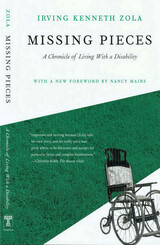
front cover of Missing Pieces
Missing Pieces
A Chronicle Of Living With A Disability
Kenneth Zola
Temple University Press, 2003
The personal odyssey of a man with a disability, this passionate book tries to tell as well as analyze what it is like to have a disability in a world that values vigor and health. Zola writes, "Missing Pieces is an unraveling of a social problem in the manner of Black Like Me. Like its author, I, too, am a trained social observer, but for me 'passing' was not an issue. For I already have the stigmata of the disabled—the braces, the limp, the cane—though I have spent much of my life denying their existence." The author started out in the role of a social scientist on a seven-day excursion to acquaint himself with an extraordinary experiment in living—Het Dorp, one of the few places in the world designed to promote "the optimum happiness" of those with severe physical disabilities. Neither a medial center nor a nursing home, Het Dorp is a village in the western-most part of the Netherlands. What began as a sociological attempt to describe this unusual setting became, through the author's growing awareness, what can only be called a socio-autobiography. Resuming his prior dependence on a wheelchair, the author experienced his own transformation from someone who is "normal" and "valid" to someone who is "invalid." The routine of Het Dorp became his: he lived in an architecturally modified home, visited the workshops, and shared meals, social events, conversation, and perceptions with the remarkably diverse residents. The author confronts some rarely discussed issues—the self-image of a person with a chronic disability, how one fills one's time, how one deals with authority and dependence, and love and sex. Missing Pieces offers striking insights into an aspect of the human condition shared by nearly 30 million Americans. It is must-read for the general reader, as well as for the rehabilitation counselor, social worker, or social scientist.
[more]

front cover of Mrs. Sigourney of Hartford
Mrs. Sigourney of Hartford
Poems and Prose on the Early American Deaf Community
Edna Edith Sayers
Gallaudet University Press, 2013

Lydia Huntley was born in 1791 in Norwich, CT, the only child of a poor Revolutionary war veteran. But her father’s employer, a wealthy widow, gave young Lydia the run of her library and later sent her for visits to Hartford, CT. After teaching at her own school for several years in Norwich, Lydia returned to Hartford to head a class of 15 girls from the best families. Among her students was Alice Cogswell, a deaf girl soon to be famous as a student of Thomas Hopkins Gallaudet and Laurent Clerc.

       Lydia’s inspiration came from a deep commitment to the education of girls and also for African American, American Indian, and deaf children. She left teaching to marry Charles Sigourney, then turned to writing to support her family, publishing 56 books, 2,000 magazine articles, and popular poetry. Lydia Sigourney never abandoned her passion for deaf education, remaining a supporter of Gallaudet’s school for the deaf until her death. Yet, her contributions to deaf education and her writing have been forgotten until now.

       All of Lydia Sigourney’s of Lydia Sigourney’s work on the nascent Deaf community is presented in this new volume. Her writing intertwines her mastery of the sentimentalism form popular in her day with her sharp insights on the best ways to educate deaf children. In the process, Mrs. Sigourney of Hartford reestablishes her rightful place in history.

[more]


Send via email Share on Facebook Share on Twitter