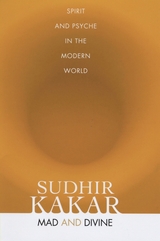
front cover of Mad and Divine
Mad and Divine
Spirit and Psyche in the Modern World
Sudhir Kakar
University of Chicago Press, 2009

Sudhir Kakar, India’s foremost practitioner of psychoanalysis, has focused his career on infusing this preeminently Western discipline with ideas and views from the East. In Mad and Divine, he takes on the separation of the spirit and the body favored by psychoanalysts, cautioning that a single-minded focus on the physical denies a person’s wholeness. Similarly, Kakar argues, to focus on the spirit alone is to hold in contempt the body that makes us human.

Mad and Divine looks at the interplay between spirit and psyche and the moments of creativity and transformation that occur when the spirit overcomes desire and narcissism. Kakar examines this relationship in religious rituals and healing traditions— both Eastern and Western—as well as in the lives of some extraordinary men: the mystic and guru Rajneesh, Gandhi, and the Buddhist saint Drukpa Kunley.

Enriched with a novelist’s felicity of language and an analyst’s piercing insights and startling interpretations, Mad and Divine is a valuable addition to the literature on the integration of the spirit and psyche in the evolving psychology of the individual.
[more]

front cover of Metaphor, Morality, and the Spirit in Romans 8
Metaphor, Morality, and the Spirit in Romans 8
1-17
William E. W. Robinson
SBL Press, 2016

Engage compelling arguments that challenge prominent positions in Pauline studies

In this innovative book, William E. W. Robinson takes the reader on a journey through Romans 8:1–17 using Conceptual Metaphor Theory and Conceptual Integration Theory. Robinson delineates the underlying cognitive metaphors, their structure, their function, what they mean, and how Paul’s audiences then and now are able to comprehend their meaning. He examines each metaphor in the light of relevant aspects of the Greco-Roman world and Paul’s Jewish background. Robinson contends that Paul portrays the Spirit as the principal agent in the religious-ethical life of believers. At the same time, his analysis demonstrates that the conceptual metaphors in Romans 8:1–17 convey the integral role of believers in ethical conduct. In the process, he addresses thorny theological issues such as whether Spirit and flesh signal an internal battle within believers or two conflicting ways of life. Finally, Robinson shows how this study is relevant to related Pauline passages and challenges scholars to incorporate these methods into their own investigation of biblical texts.

Features:

  • Sustained argument that sheds new light on how Paul communicates with his audiences
  • Substantial contribution to current debates about central theological concepts
  • Conceptual Metaphor Theory and Conceptual Integration Theory applied to the metaphors in Romans 8:1-17
[more]

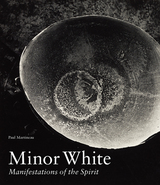
front cover of Minor White
Minor White
Manifestations of the Spirit
Paul Martineau
J. Paul Getty Trust, The, 2014
A beautifully illustrated tribute to one of the most influential photographers of the twentieth century.

Controversial, misunderstood, and sometimes overlooked, Minor White (1908–1976) is one of the great photographers of the twentieth century, whose ideas exerted a powerful influence on a generation of photographers and still resonate today. His photographic career began in 1938 in Portland, Oregon, with assignments for the WPA (Works Progress Administration). After serving in World War II and studying art history at Columbia University, White’s focus shifted toward the metaphorical. He began creating images charged with symbolism and a critical aspect called equivalency, referring to the invisible spiritual energy present in a photograph made visible to the viewer.

This book brings together White’s key biographical information—his evolution as a photographer, teacher of photography, and editor of Aperture, as well as particularly insightful quotations from his journals, which he kept for more than forty years. The result is an engaging narrative that weaves through the main threads of White’s life, his growth as an artist, as well as his spiritual search and ongoing struggle with his own sexuality and self-doubt. He sought comfort in a variety of religious practices that influenced his continually metamorphosing artistic philosophy.
[more]

logo for Catholic University of America Press
The Monastic In Each of Us
Heart, Mind, Body, Soul and Spirit
Tim Vivian
Catholic University of America Press, 2026
The Monastic in Each of Us offers eight chapters on early-monastic themes relevant for spiritual seekers today. In August 2024, at the invitation of Abbot James Wiseman, the author gave seven retreat talks for the brothers at St. Anselm’s Abbey in Washington, D.C., on early-monastic spirituality and its relevance for us today. The revised talks here, with an additional chapter, offer more accessible discussions both for a general non-monastic audience and monastic readers. Chapter 1, “The Desert Fathers and Mothers and the Ascetic Tradition,” offers an introduction to the early monastics and their teachings on asceticism and spirituality. Chapters 2 and 3 cover “Ego and Humility & The Path to Transformation” and “Some Monastic and Universal Virtues.” Chapter 4, “A Fire That Burns Without Consuming,” offers an imagined conversation with Mary Margaret Funk, O.S.B, author of Thoughts Matter: Discovering the Spiritual Tradition, on the importance of early-monastic spirituality for today. Chapters 5 and 6 discuss some major themes: asceticism, sin, the passions, thoughts, and the importance of community. Chapter 7 focuses on Poemen, an early monastic, and the theme of judging to discernment to compassion. The concerns these chapters look at, and the practices given and hope offered are human and still speak to us today. The final chapter offers brief discussions of what the early monastics call the eight “principal thoughts”: gluttony/greed, sexual immorality, love of money, gloominess, anger, acedia, self-importance, and excessive pride. Thoughts, and their discernment, are key in early monasticism, and can be for us. As John Chryssavgis stresses, “our thoughts” can “inhibit us in our relationships with others and with God. Disclosing our thoughts to a ‘physician’ is a step in the direction of trust and community. It is less a way of dealing with the past, than of directing our future.”
[more]

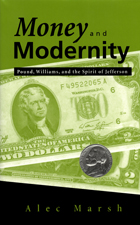
front cover of Money and Modernity
Money and Modernity
Pound, Williams, and the Spirit of Jefferson
Alec Marsh
University of Alabama Press, 1998
Marsh locates Pound and Williams firmly in the Jeffersonian tradition and examines their epic poems as manifestations of a Jeffersonian ideology in modernist terms.

The modernist poets William Carlos Williams and Ezra Pound were latter-day Jeffersonians whose politics and poetry were strongly marked by the populism of the late 19th century. They were sharply aware of the social contradictions of modernization and were committed to a highly politicized, often polemical poetry that criticized finance capitalism and its institutions--notably banks--in the strongest terms.

Providing a history of the aesthetics of Jeffersonianism and its collision with modernism in the works of Pound and Williams, Alec Marsh traces "the money question" from the republican period through the 1940s. Marsh can thus read two modernist epics--Pound's Cantos and Williams's Paterson--as the poets hoped they would be read, as attempts to break the hold of "false" financial values on the American imagination.

Marsh argues that Pound's and Williams's similar Jeffersonian outlooks were the direct result of the political battles of the 1890s concerning the meaning of money. Although Pound's interest in money and economics is well known, few people are aware that both poets were active in the Social Credit monetary-reform movement of the 1930s and 1940s, a movement shown by Marsh to have direct links to Jeffersonianism via American populism.  Ultimately, the two poets took divergent paths, with Pound swerving toward Italian fascism (as exemplified in his Jefferson and/or Mussolini) and Williams becoming deeply influenced by the American pragmatism of John Dewey. Thus, Marsh concludes, Pound embraced the fascist version of state-capitalism whereas his old friend proclaimed a pragmatic openness to the new selves engendered by corporate capitalism.

Money and Modernity exemplifies the best of recent literary criticism in its incorporation of American studies and cultural studies approaches to bring new insight to modern masterworks.
[more]

front cover of Montesquieu's Philosophy of Liberalism
Montesquieu's Philosophy of Liberalism
A Commentary on The Spirit of the Laws
Thomas L. Pangle
University of Chicago Press, 1973
This first comprehensive commentary on The Spirit of the Laws uncovers and explicates the plan of Montesquieu's famous but baffling treatise. Pangle brings to light Montesquieu's rethinking of the philosophical groundwork of liberalism, showing how The Spirit of the Laws enlarges and enriches the liberal conception of natural right by means of a new appeal to History as the source of basic norms.
[more]


Send via email Share on Facebook Share on Twitter