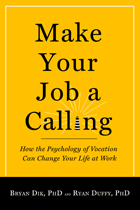
front cover of Make Your Job a Calling
Make Your Job a Calling
How the Psychology of Vocation Can Change Your Life at Work
Bryan J. Dik
Templeton Press, 2013
Do you ever feel sick of your job? Do you ever envy those people who seem to positively love what they do? While those people head off to work with a sense of joy and purpose, for the rest of us trudging back to the office on Monday morning or to the factory for the graveyard shift or to the job site on a hundred-degree day can be an exercise in soul crushing desperation. “If only we could change jobs,” we tell ourselves, “that would make it better.” But we don’t have the right education . . . or we don’t have enough experience . . . or the economy isn’t right . . . or we can’t afford the risk right now. So we keep going back to the same old unsatisfying jobs.
The wonderful truth, though, is that almost any kind of occupation can offer any one of us a sense of calling. Regardless of where we are in our careers, we can all find joy and meaning in the work we do, from the construction zone flagger who keeps his crew safe to the corporate executive who believes that her company’s products will change the world. In Make Your Job a Calling authors Bryan J. Dik and Ryan D. Duffy explore this powerful idea and help the reader navigate the many challenges—both internal and external—that may arise along the pathway to a sense of calling at work.
Over the course of four sections, the authors define the idea of calling, review cutting-edge research on the subject, provide practical guidelines for discerning a calling at all stages of work and life, and explore what calling will look like as workplace norms continue to evolve. They also take pains to present a realistic view of the subject by unpacking the perils and challenges of pursuing one’s higher purpose, especially in an uncertain economy.
The lessons presented will resound with anyone in any line of work and will show how the power of calling can beneficially shape individuals, organizations, and society as a whole.
[more]

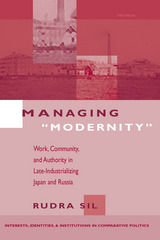
front cover of Managing
Managing "Modernity"
Work, Community, and Authority in Late-Industrializing Japan and Russia
Rudra Sil
University of Michigan Press, 2002
In Managing "Modernity," Rudra Sil examines how institution-builders respond to the competing influences of institutional models and inherited social legacies as they attempt to generate and sustain authority in late-industrializing societies. Through a historical and comparative study of large-scale enterprises in Japan and Russia, the book examines the impact of different institution-building strategies on managerial authority, invoking the experience of postwar Japan to highlight the benefits of a syncretic approach that selectively integrates adaptable features of borrowed institutions with portable norms inherited from preexisting communities.
Managing "Modernity" engages a variety of intellectual perspectives in the social sciences. The theoretical approach represents a conscious effort to overcome the contentious debates in political science and sociology among proponents of historical institutionalism, cultural analysis, and rational-choice theory. The substantive argument draws on, and partially integrates, concepts and findings from comparative politics, economic sociology, industrial relations, organization theory, business management, and the political economy of Japan and Russia.
In light of ongoing debates over the significance and impact of "globalization," the eclectic and integrative approach in Managing "Modernity" offers a fresh and provocative contribution that will interest scholars and graduate students across a variety of disciplines and subfields. It offers compelling insights to anyone generally concerned with the social forces that facilitate or hinder the diffusion of ideas and institutions across national boundaries.
Rudra Sil is Janice and Julian Bers Assistant Professor in the Social Sciences, Department of Political Science, University of Pennsylvania.
[more]

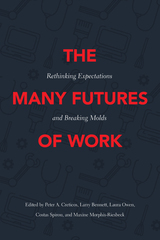
front cover of The Many Futures of Work
The Many Futures of Work
Rethinking Expectations and Breaking Molds
Edited by Peter A. Creticos, Larry Bennett, Laura Owen, Costas Spirou, and Maxine Morphis-Riesbeck
Temple University Press, 2021

What will work eventually look like? This is the question at the heart of this timely collection. The editors and contributors—a mix of policy experts, academics, and advocates—seek to reframe the typical projections of the “future” of work. They examine the impact of structural racism on work, the loss of family‑sustaining jobs, the new role of gig work, growing economic inequality, barriers to rewarding employment such as age, gender, disability, and immigration status, and the business policies driving these ongoing challenges. 

Together the essays present varied and practical insights into both U.S. and global trends, discuss the role of labor activism in furthering economic justice, and examine progressive strategies to improve the experience of work, wages, and the lives of workers. The Many Futures of Work offers a range of viable policies and practices that can promote rewarding employment and steer our course away from low-wage, unstable jobs toward jobs that lead to equitable prosperity and economic inclusion.

[more]

front cover of Max Weber
Max Weber
An Introduction to His Life and Work
Dirk Käsler
University of Chicago Press, 1988
Max Weber: An Introduction to His Life and Work has established itself as the standard short introduction in German to the work of Max Weber, and appears here for the first time in English translation. Sociologist Dirk Käsler has a profound sense of Weber's writings, yet manages to make Weber's ideas accessible to the beginner.

Käsler offers a comprehensive account of Weber's views, giving attention both to the context in which Weber produced his most significant contributions to social science, and to the changes involved in his work over the course of his career. This volume also serves as an introduction to the controversies that Weber's writings have stimulated, from the time of their first appearance to the present day.

This book will be of vital interest to anyone concerned with Max Weber and will undoubtedly become the leading student text on Weber in the English-speaking world.

[more]

front cover of Meaning, Decision, and Norms
Meaning, Decision, and Norms
Themes from the Work of Allan Gibbard
Eds. Billy Dunaway and David Plunkett
Michigan Publishing Services, 2021
It is not an exaggeration to say that Allan Gibbard is one of the most significant contributors to philosophy over the last five decades. Gibbard’s work covers an impressive number of subfields within philosophy, including ethics, philosophy of language, decision theory, epistemology, and metaphysics. It also engages with, and makes significant contributions to, work from the natural and social sciences.

This volume is not a collection of artifacts from past decades of philosophy. Instead, it is a collection of essays that each make a significant contribution to contemporary work in philosophy. This reflects the fact that Gibbard’s work has not only had a massive influence on past discussion in philosophy but also continues to influence new directions of philosophical research.

With contributions from:
Sara Aronowitz, Simon Blackburn, Paul Boghossian, David Braddon-Mitchell, Nate Charlow, Stephen Darwall, Jamie Dreier, Billy Dunaway, Melissa Fusco, Sona Ghosh, Allan Gibbard, Bill Harper, Paul Horwich, Zoë Johnson King, Tristram McPherson, Howard Nye, Lauren Olin, Caleb Perl, David Plunkett, Peter Railton, Connie Rosati, Mark Schroeder, Alex Silk, Daniel J. Singer, Brian Skyrms, and Seth Yalcin.

[more]

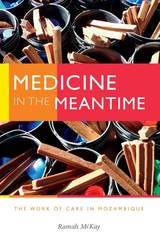
front cover of Medicine in the Meantime
Medicine in the Meantime
The Work of Care in Mozambique
Ramah McKay
Duke University Press, 2018
In Mozambique, where more than half of the national health care budget comes from foreign donors, NGOs and global health research projects have facilitated a dramatic expansion of medical services. At once temporary and unfolding over decades, these projects also enact deeply divergent understandings of what care means and who does it. In Medicine in the Meantime, Ramah McKay follows two medical projects in Mozambique through the day-to-day lives of patients and health care providers, showing how transnational medical resources and infrastructures give rise to diverse possibilities for work and care amid constraint. Paying careful attention to the specific postcolonial and postsocialist context of Mozambique, McKay considers how the presence of NGOs and the governing logics of the global health economy have transformed the relations—between and within bodies, medical technologies, friends, kin, and organizations—that care requires and how such transformations pose new challenges for ethnographic analysis and critique.
[more]

front cover of Memorializing Pearl Harbor
Memorializing Pearl Harbor
Unfinished Histories and the Work of Remembrance
Geoffrey M. White
Duke University Press, 2016
Memorializing Pearl Harbor examines the challenge of representing history at the site of the attack that brought America into World War II. Analyzing moments in which history is re-presented—in commemorative events, documentary films, museum design, and educational programming—Geoffrey M. White shows that the memorial to the Pearl Harbor bombing is not a fixed or singular institution. Rather, it has become a site in which many histories are performed, validated, and challenged. In addition to valorizing military service and sacrifice, the memorial has become a place where Japanese veterans have come to seek recognition and reconciliation, where Japanese Americans have sought to correct narratives of racial mistrust, and where Native Hawaiians have challenged their ongoing erasure from their own land. Drawing on extended ethnographic fieldwork, White maps these struggles onto larger controversies about public history, museum practices, and national memory.
[more]

front cover of Men, Women, and Work
Men, Women, and Work
Class, Gender, and Protest in the New England Shoe Industry, 1780-1910
Mary H. Blewett
University of Illinois Press, 1988
Mary H. Blewett's award-winning look at the men and women working in the shoe factories of Lynn, Massachusetts, explores the sexual division of labor and gender relationships in the workplace.
[more]

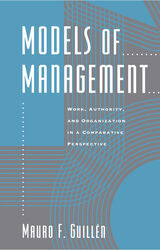
front cover of Models of Management
Models of Management
Work, Authority, and Organization in a Comparative Perspective
Mauro F. Guillén
University of Chicago Press, 1994
In this book, Mauro F. Guillén explores differing historical patterns in the adoption of the three major models of organizational management: scientific management, human relations, and structural analysis. Moving beyond Reinhard Bendix's classic Work and Authority, Models of Management takes a fresh look at how managers have used these models in four countries during the twentieth century.

Guillén's study of two liberal-democratic societies (the United States and Great Britain) and two corporatist societies (Germany and Spain) reveals significant differences in the way managerial elites and firms have adopted the three models. His data show that ideas themselves—independent of material interests and technology—can cause organizational change. Throughout the book, contrasts between modernist-technocratic and liberal-humanist mentalities, as well as between Protestant and Catholic religious backgrounds, emerge as decisive factors in determining managerial ideology and practice.

In addition to analyzing management methods in organizations, Guillén explores larger issues: the interaction among managerial, government, and labor elites; the impact of the state and the professions on managerial behavior; and the role that managers play in modern societies.
[more]

front cover of More Than Pretty Boxes
More Than Pretty Boxes
How the Rise of Professional Organizing Shows Us the Way We Work Isn’t Working
Carrie M. Lane
University of Chicago Press, 2024
This study of organizing and decluttering professionals helps us understand—and perhaps alleviate—the overwhelming demands society places on our time and energy.

For a widely dreaded, often mundane task, organizing one’s possessions has taken a surprising hold on our cultural imagination. Today, those with the means can hire professionals to help sort and declutter their homes. In More Than Pretty Boxes, Carrie M. Lane introduces us to this world of professional organizers and offers new insight into the domains of work and home, which are forever entangled—especially for women.

The female-dominated organizing profession didn’t have a name until the 1980s, but it is now the subject of countless reality shows, podcasts, and magazines. Lane draws on interviews with organizers, including many of the field’s founders, to trace the profession’s history and uncover its enduring appeal to those seeking meaningful, flexible, self-directed work. Taking readers behind the scenes of real-life organizing sessions, More Than Pretty Boxes details the strategies organizers use to help people part with their belongings, and it also explores the intimate, empathetic relationships that can form between clients and organizers.

But perhaps most importantly, More Than Pretty Boxes helps us think through an interconnected set of questions around neoliberal work arrangements, overconsumption, emotional connection, and the deeply gendered nature of paid and unpaid work. Ultimately, Lane situates organizing at the center of contemporary conversations around how work isn’t working anymore and makes a case for organizing’s radical potential to push back against the overwhelming demands of work and the home, too often placed on women’s shoulders. Organizers aren’t the sole answer to this crisis, but their work can help us better understand both the nature of the problem and the sorts of solace, support, and solutions that might help ease it.
[more]

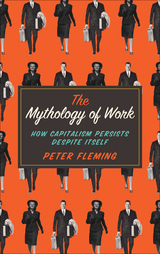
front cover of The Mythology of Work
The Mythology of Work
How Capitalism Persists Despite Itself
Peter Fleming
Pluto Press, 2015
Once, work was inextricably linked to survival and self-preservation: the farmer ploughed his land so that his family could eat. In contrast, today work has slowly morphed into a painful and meaningless ritual for many, colonizing almost every part of our day, endless and inescapable.
            In The Mythology of Work, Peter Fleming examines how neoliberal society uses the ritual of work—and the threat of its denial—to maintain the late capitalist class order. Work becomes a universal reference point, devoid of any moral or political worth, transforming our society into a factory that never sleeps. Blending critical theory with recent accounts of job-related suicides, office-induced paranoia, fear of relaxation, managerial sadism, and cynical corporate social responsibility campaigns, Fleming paints a bleak picture of a society in which economic and emotional disasters greatly outweigh any professed benefits.
[more]


Send via email Share on Facebook Share on Twitter