
 A SCHOLARLY BOOK REPOSITORY
214 books about Asian Studies and 4
start with N
214 books about Asian Studies and 4
214 books about Asian Studies
4 start with N start with N
4 start with N start with N
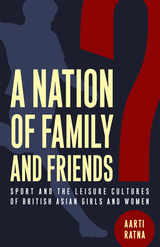
A Nation of Family and Friends?
Sport and the Leisure Cultures of British Asian Girls and Women
Aarti Ratna
Rutgers University Press, 2024
In A Nation of Family and Friends, sociologist Aarti Ratna examines the complex and dynamic relationships between South Asian women and sporting and leisure cultures. Mining autobiographical insights (as a South Asian scholar living in the UK) she links the chapters of this innovative book using the sociological concepts of family and friends, particularly as they relate to an analysis of wider debates about the complexities of race, gender, and the nation. Ratna underscores the importance of studying informal spaces of sport and leisure as friendly, familial, sociable, and political spaces. She simultaneously highlights the role of earlier sociological research in disseminating myths about South Asian women as too physically weak to play competitive sports; culturally passive victims of South Asian cultures and religions; and as sexually exotic women requiring saving through colonial and imperial projects led by white men and women.
Ratna also examines two key cultural objects - the popular films "Bend it Like Beckham" and “Dhan Dhana Dhan Goal” - to examine in detail the gendered representation of South Asian soccer players’ engagement in amateur and elite levels of the sport. She critiques studies of women’s football fandom and sport that fail to acknowledge social differences relating to race, class, age, disability, and sexuality. By linking the social forces (across time and space) that differentially affect their sporting choices and leisure lifestyles, Ratna portrays the women of the South Asian diaspora as active agents in the shaping of their life courses and as skilled navigators of the complexities affecting their own identities. Ultimately Ratna examines the intersections of class, caste, age, generation, gender, and sexuality, to provide a rich and critical exploration of British Asian women's sport and leisure choices, pleasures, and lived realities.
Ratna also examines two key cultural objects - the popular films "Bend it Like Beckham" and “Dhan Dhana Dhan Goal” - to examine in detail the gendered representation of South Asian soccer players’ engagement in amateur and elite levels of the sport. She critiques studies of women’s football fandom and sport that fail to acknowledge social differences relating to race, class, age, disability, and sexuality. By linking the social forces (across time and space) that differentially affect their sporting choices and leisure lifestyles, Ratna portrays the women of the South Asian diaspora as active agents in the shaping of their life courses and as skilled navigators of the complexities affecting their own identities. Ultimately Ratna examines the intersections of class, caste, age, generation, gender, and sexuality, to provide a rich and critical exploration of British Asian women's sport and leisure choices, pleasures, and lived realities.
[more]
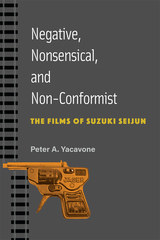
Negative, Nonsensical, and Non-Conformist
The Films of Suzuki Seijun
Peter A. Yacavone
University of Michigan Press, 2023
In the late 1950s, Suzuki Seijun was an unknown, anxious low-ranking film director churning out so-called program pictures for Japan’s most successful movie studio, Nikkatsu. In the early 1960s, he met with modest success in directing popular movies about yakuza gangsters and mild exploitation films featuring prostitutes and teenage rebels. In this book, Peter A. Yacavone argues that Suzuki became an unlikely cinematic rebel and, with hindsight, one of the most important voices in the global cinema of the 1960s. Working from within the studio system, Suzuki almost single-handedly rejected the restrictive filmmaking norms of the postwar period and expanded the form and language of popular cinema. This artistic rebellion proved costly when Suzuki was fired in 1967 and virtually blacklisted by the studios, but Suzuki returned triumphantly to the scene of world cinema in the 1980s and 1990s with a series of critically celebrated, avant-garde tales of the supernatural and the uncanny. This book provides a well-informed, philosophically oriented analysis of Suzuki’s 49 feature films.
[more]

The Neighborhood
Space, State, and Daily Life in a Manchurian City
Nianshen Song
University of Chicago Press, 2025
This masterful blend of history and urban storytelling brings to life the people and politics that shaped a single neighborhood in a Manchurian city across several centuries.
What can one neighborhood reveal about the making of a modern nation? The Neighborhood deciphers the unexpected significance of Xita, a half-square-mile quarter in Shenyang, in Northeast China. As the historian Nianshen Song shows, over nearly four centuries, Xita has been shaped and reshaped by empire, war, migration, and urban transformation. Remarkably, the history of this small area mirrors large-scale changes, including and especially China’s metamorphosis from a multiethnic Eurasian empire to a postindustrial society.
Song begins with Xita’s origins as a Qing-era Tibetan Buddhist center, following the lives of Mongol lamas and their imperial patrons. He tracks the neighborhood through the tumultuous twentieth century, when competing Russian and Japanese railway empires fueled its industrial growth, and Japanese colonizers turned it into a showcase for their imperial ambitions. Later, Xita became a vital enclave for Korea’s diaspora before emerging in the post-Mao era as a neon-lit hub of commerce and entertainment.
A thoroughly researched microhistory, The Neighborhood reveals how global forces play out in everyday spaces. By studying the emperors, warlords, merchants, laborers, and migrants who shaped Xita, Song presents a captivating and original perspective for understanding China’s past—not from the top down, but through the streets and people who lived it.
What can one neighborhood reveal about the making of a modern nation? The Neighborhood deciphers the unexpected significance of Xita, a half-square-mile quarter in Shenyang, in Northeast China. As the historian Nianshen Song shows, over nearly four centuries, Xita has been shaped and reshaped by empire, war, migration, and urban transformation. Remarkably, the history of this small area mirrors large-scale changes, including and especially China’s metamorphosis from a multiethnic Eurasian empire to a postindustrial society.
Song begins with Xita’s origins as a Qing-era Tibetan Buddhist center, following the lives of Mongol lamas and their imperial patrons. He tracks the neighborhood through the tumultuous twentieth century, when competing Russian and Japanese railway empires fueled its industrial growth, and Japanese colonizers turned it into a showcase for their imperial ambitions. Later, Xita became a vital enclave for Korea’s diaspora before emerging in the post-Mao era as a neon-lit hub of commerce and entertainment.
A thoroughly researched microhistory, The Neighborhood reveals how global forces play out in everyday spaces. By studying the emperors, warlords, merchants, laborers, and migrants who shaped Xita, Song presents a captivating and original perspective for understanding China’s past—not from the top down, but through the streets and people who lived it.
[more]
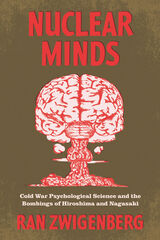
Nuclear Minds
Cold War Psychological Science and the Bombings of Hiroshima and Nagasaki
Ran Zwigenberg
University of Chicago Press, 2023
How researchers understood the atomic bomb’s effects on the human psyche before the recognition of Post-Traumatic Stress Disorder.
In 1945, researchers on a mission to Hiroshima with the United States Strategic Bombing Survey canvassed survivors of the nuclear attack. This marked the beginning of global efforts—by psychiatrists, psychologists, and other social scientists—to tackle the complex ways in which human minds were affected by the advent of the nuclear age. A trans-Pacific research network emerged that produced massive amounts of data about the dropping of the bomb and subsequent nuclear tests in and around the Pacific rim.
Ran Zwigenberg traces these efforts and the ways they were interpreted differently across communities of researchers and victims. He explores how the bomb’s psychological impact on survivors was understood before we had the concept of post-traumatic stress disorder. In fact, psychological and psychiatric research on Hiroshima and Nagasaki rarely referred to trauma or similar categories. Instead, institutional and political constraints—most notably the psychological sciences’ entanglement with Cold War science—led researchers to concentrate on short-term damage and somatic reactions or even, in some cases, on denial of victims’ suffering. As a result, very few doctors tried to ameliorate suffering.
But, Zwigenberg argues, it was not only that doctors “failed” to issue the right diagnosis; the victims’ experiences also did not necessarily conform to our contemporary expectations. As he shows, the category of trauma should not be used uncritically in a non-Western context. Consequently, this book sets out, first, to understand the historical, cultural, and scientific constraints in which researchers and victims were acting and, second, to explore how suffering was understood in different cultural contexts before PTSD was a category of analysis.
In 1945, researchers on a mission to Hiroshima with the United States Strategic Bombing Survey canvassed survivors of the nuclear attack. This marked the beginning of global efforts—by psychiatrists, psychologists, and other social scientists—to tackle the complex ways in which human minds were affected by the advent of the nuclear age. A trans-Pacific research network emerged that produced massive amounts of data about the dropping of the bomb and subsequent nuclear tests in and around the Pacific rim.
Ran Zwigenberg traces these efforts and the ways they were interpreted differently across communities of researchers and victims. He explores how the bomb’s psychological impact on survivors was understood before we had the concept of post-traumatic stress disorder. In fact, psychological and psychiatric research on Hiroshima and Nagasaki rarely referred to trauma or similar categories. Instead, institutional and political constraints—most notably the psychological sciences’ entanglement with Cold War science—led researchers to concentrate on short-term damage and somatic reactions or even, in some cases, on denial of victims’ suffering. As a result, very few doctors tried to ameliorate suffering.
But, Zwigenberg argues, it was not only that doctors “failed” to issue the right diagnosis; the victims’ experiences also did not necessarily conform to our contemporary expectations. As he shows, the category of trauma should not be used uncritically in a non-Western context. Consequently, this book sets out, first, to understand the historical, cultural, and scientific constraints in which researchers and victims were acting and, second, to explore how suffering was understood in different cultural contexts before PTSD was a category of analysis.
[more]
READERS
Browse our collection.
PUBLISHERS
See BiblioVault's publisher services.
STUDENT SERVICES
Files for college accessibility offices.
RECENTLY PUBLISHED



UChicago Accessibility Resources
home | accessibility | search | about | contact us
BiblioVault ® 2001 - 2025
The University of Chicago Press