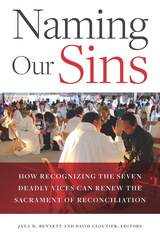
front cover of Naming Our Sins
Naming Our Sins
How Recognizing the Seven Deadly Vices can Renew the Sacrament of Reconciliation
Jana Bennett
Catholic University of America Press, 2019
What would it take to renew our ability to name our sins in a meaningful and pertinent way? Naming sins is a particularly important task for Catholic moral theology, but it is one that often falls back into a paradigm of simple violations of rules. While laws and commandments are essential, Vatican II’s universal call to holiness and the revival of virtue ethics require moving further. Yet in part because moral theologians today tend to be lay people, not priests, there has been a de-emphasis on the confession of sins. Contemporary questions like poverty, racism, and abortion are usually connected to questions about sin in some way, but they are disconnected from the idea of naming specific sins in the sacrament of penance. Lay moral theologians raise these issues in a way that makes clear their implications for a parish social justice committee (or the voting booth), but not their implications for the naming of sins in the sacrament of reconciliation. Naming Our Sins proposes to re-make that connection: the moral theologian’s task of helping people name individual sins needs to be restored, though in ways distinctive from dominant pre-Vatican II notions. In this volume, editors Jana Bennett and David Cloutier gather some of the best of the current generation of moral theologians in order to reflect on the classic tradition of the vices. It is crucial to the Christian understanding of sin that we recognize (a) we bear at least some responsibilities for injuries, and (b) God wants us to participate in the process of healing and conversion. Neither the sin itself nor the healing simply come from somewhere else; the task of naming sins enlists us as mature, growing disciples. Each chapter takes on a different classical vice, describing the vice, exploring its dimensions in contemporary experience, and moving the reader toward naming specific sins that arise from the vice. The concluding chapters from Catholic priests explore two basic dimensions of the sacrament of penance: liturgical and communal.
[more]

front cover of The Natural Depth in Man
The Natural Depth in Man
WILSON VAN DUSEN
Swedenborg Foundation Publishers, 1972

Psychologist Wilson Van Dusen explores the secret spaces of our inner world with clues drawn from his own personal experience, his work with psychiatric patients, and his study of Eastern and Western philosophy. Drawing from the insights of Swedish visionary Emanuel Swedenborg, Van Dusen discusses self-reflection, dreams, hallucinations, and the mystical experience.
[more]

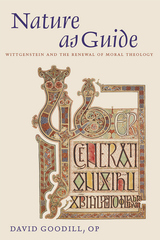
front cover of Nature as Guide
Nature as Guide
Wittgenstein and the Renewal of Moral Theology
David Goodill, OP
Catholic University of America Press, 2022
Wittgenstein influenced a generation of philosophers and theologians, with works such as Fergus Kerr’s Theology After Wittgenstein showing the relevance of Wittgenstein’s philosophy for contemporary questions in theology. Nature as Guide follows many of the insights of this earlier generation of Wittgenstein influenced scholars, to bring Wittgenstein into conversation with contemporary Catholic moral theology. The first four chapters of the book provides a reading of key themes in Wittgenstein’s philosophy, and draw among others on G.E.M. Anscombe to situate Wittgenstein in relation to the Platonic tradition. Understanding the relationship between grammar, metaphysics and nature is central to this tradition and these themes are examined through an account of Wittgenstein’s philosophical development. These four chapters also provides a critical perspective on Wittgenstein’s thought, engaging with the criticisms of Wittgenstein offered by philosophers such as Rhees Rush and William Charlton. Chapter five lays the groundwork for a dialogue between Wittgenstein and moral theology. Firstly, by examining how open Wittgenstein’s philosophy is to dialogue with theology, and secondly through proposing the use of Servais Pinckaers’ definition of moral theology to structure the conversation developed in subsequent chapters. Pinckaers’ definition is based upon St Thomas Aquinas’ presentation of the principles of human acts in the Prima Secundae of the Summa Theologiae and the final three chapters focus on the question of human acts and their basis in human nature. The reading of Wittgenstein developed in the first part of the book is brought into dialogue with the tradition of Catholic moral theology represented by Pinckaers and other students of St Thomas, such as Anscombe, Josef Pieper, Herbert McCabe, Jean Porter and Alasdair MacIntyre. The book finishes with McCabe’s account of the transformation of human nature through God’s Word, showing how Wittgenstein’s understanding of human practices can shed light on the life of grace.
[more]

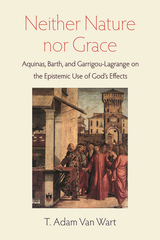
front cover of Neither Nature nor Grace
Neither Nature nor Grace
Aquinas, Barth, and Garrigou-Lagrance on the Epistemic Use of God's Effects
T. Adam Van Wart
Catholic University of America Press, 2021
Neither Nature nor Grace operates at the intersection of systematic and philosophical theology, exploring in particular how St. Thomas Aquinas variously uses the latter in service to the clarification and faithful advancement of the former. More specifically, Neither Nature nor Grace explores the overlooked logical difficulties that have followed the late modern debates in ecumenical Christian theology as to whether knowledge of God is available solely through God’s gracious self-revelation (e.g., Jesus Christ and Holy Scripture), or through revelation and the deliverances of natural reason. Van Wart takes the prominent French Dominican Reginald Garrigou-Lagrange as paradigmatic for the case that knowledge of God can be had by both revelation and natural reason. Representing the opposing position, that God can only be known through divine revelation, Van Wart highlights the work of influential Protestant theologian Karl Barth. By placing these two imposing 20th century theologians in conversation, and by providing a careful theo-philosophical analysis of the logical mechanics of each thinker’s respective arguments, Van Wart shows how both inadvertently overreach their self-professed epistemological bounds and just so run into significant problems maintaining the coherence of their relative theological positions. That is, against their expressed intentions to the contrary, both thinkers unwittingly evacuate the divine essence of the mystery Christian tradition has always previously claimed it to have, effectively reducing the being of God to mere creaturely being writ large. As a contrasting corrective to this problem, Van Wart proffers a constructive grammatical reading of Aquinas’s measured account of the crucial but often overlooked logical differences between what can be said of the divine, on the one hand, versus what can be known of God, on the other. While many recent works have attempted to solve the ongoing arguments which Garrigou-Lagrange and Barth epitomize regarding the epistemic use of God’s effects, Van Wart’s contribution constructively pushes the conversation to a different level in showing how Aquinas’s grammar of God provides a salutary means of dissolving and moving beyond these contentious debates altogether.
[more]

front cover of New Jerusalem
New Jerusalem
Emanuel Swedenborg
Swedenborg Foundation Publishers, 2016

Emanuel Swedenborg understood the city of New Jerusalem--as described in the book of Revelation--to mean not a physical city but an epoch of history, a new spiritual age that was just beginning to take shape during his lifetime in the eighteenth century.

This short work, presented as a series of teachings that characterize this spiritual age to come, is also one of Swedenborg's most concise and readable summaries of his own theology. Building on fundamental concepts such as good, truth, will, and understanding, he describes the importance of love and usefulness in spiritual growth. In the second half of the volume he focuses on how this new theology relates to the church of his day and to church teachings about the Bible, the Lord's incarnation on earth, and rites such as baptism and the Holy Supper. Each short chapter is followed by extensive references back to his theological magnum opus, Secrets of Heaven.

This volume is an excellent starting point for those who want an overview of Swedenborg's theology presented in his own words. 

[more]

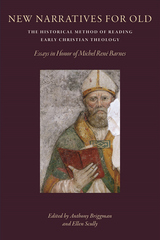
front cover of New Narratives for Old
New Narratives for Old
The Historical Method of Reading Early Christian Theology: Essays in Honor of Michel Rene Barnes
Anthony Briggman
Catholic University of America Press, 2022
Guilds and conferences have grown up around historical theology, yet no volume has ever been dedicated to the definition and illustration of the method undergirding historical theology. This volume both defines and illustrates the methodology of historical theology, especially as it relates to the study of early Christianity, and situates historical theology among other methodological approaches to early Christianity, including confessional apologetics, constructive theology, and socio-cultural history. Historical theology as a discipline stands in contrast to these other approaches to the study of early Christianity. In contrast to systematic or constructive approaches, it remains essentially historical, with a desire to elucidate the past rather than speak to the present. In contrast to socio-historical approaches, it remains essentially theological, with a concern to value and understand the full complexity of the abstract thought world that stands behind the textual tradition of early Christian theology. Moreover, historical theology is characterized by the methodological presupposition that, unless good reason exists to think otherwise, the theological accounts of the ancient church articulate the genuine beliefs of their authors. The significance of this volume lies in the methodological definition it offers. The strength of this volume lies in the fact that its definition of the historical method of studying theology is not the work of a single mind but that of over twenty respected scholars, many of whom are leaders in the field. The volume begins with an introductory essay that orients readers to various approaches to early Christian literature, it moves to two technical essays that define the historical method of studying early Christian theology, and then it illustrates the practice of this method with more than twenty essays that cover a period stretching from the first century to the dawn of the seventh.
[more]

front cover of Newman, Canon Law and Development
Newman, Canon Law and Development
Quarrying Granite Rocks with Razors
David P. Long
Catholic University of America Press, 2024
John Henry Newman is well-known as a theologian, philosopher, historian, writer, University rector, and poet, but can he also be associated with the field of canon law? When Newman first proposed the possibility of doctrinal development as proof that the Catholic faith was free from corruption and error, he claimed “the Church is declared to be the great and special support of the Truth, her various functionaries are said to be means towards the settlement of diversities and of uncertainty of doctrine, and securing unity of faith.” For Newman, these various functionaries included not only apostles, prophets, evangelists, and pastors, but also theologians and, as is argued in this work, canon lawyers. While Newman and doctrinal development have become well-explored topics in the field of theology, there has been little scholarship on how Newman’s thoughts on doctrinal development can influence current canon law and Church governance. David Long addresses that lacuna by offering a systematic analysis of Newman’s concept of development within current canonical practice. It starts by tracing Newman’s notions of personal judgment, public discussion, and episcopal moderation, followed by a presentation of the current canonical understanding of the theologian, and finally an application of the connection between Newman’s theory on development and present canonical legislation as it involves the role of the theologian. By undertaking such an application, and by creating a model for discussion that preserves both development and Tradition, this work humbly proposes a valuable model for understanding the theologian’s contribution within the life of the contemporary Church in ways not previously explored.
[more]

front cover of Nicholas I, Patriarch of Constantinople
Nicholas I, Patriarch of Constantinople
Letters
R. J. H. Jenkins and L. G. Westerink
Harvard University Press

Next to Photius and Michael Cerularius, Nicholas I is probably the most prominent of the patriarchs of Constantinople. He was the central figure in the “tetragamy” affair, the conflict over Leo VI’s fourth marriage, which divided the Church for nearly a century and resulted in Nicholas’s temporary deposition. He was also a major influence in both the domestic and foreign politics of the Eastern Empire throughout the first quarter of the tenth century. His correspondence with the Papal court and with Bulgarian, Caucasian, and Arab provinces, as well as with his own clergy, is a historical source of the first importance, collected in Nicholas I, Patriarch of Constantinople: Letters.

This volume is supplemented by Nicholas I, Patriarch of Constantinople: Miscellaneous Writings (CFHB XX, DOT VI).

[more]

front cover of Nicholas I, Patriarch of Constantinople
Nicholas I, Patriarch of Constantinople
Miscellaneous Writings
L. G. Westerink
Harvard University Press

Miscellaneous Writings is a supplement to Nicholas I, Patriarch of Constantinople: Letters. The two volumes together contain all the extant writings of a great Byzantine churchman, politician, and author of the first quarter of the tenth century.

Besides a few stray letters not preserved by the regular manuscript tradition, the Miscellaneous Writings include eight patriarchal documents, including the Tome of Union of 920; a brief but impressive sermon on the capture of Thessalonica in 904; extracts from a pamphlet on the famous controversy around Leo VI’s fourth marriage; and five hymns, three of which are attested as written by the patriarch, while the remaining two should more probably be assigned to a namesake.

[more]

logo for Harvard University Press
Nikephoros, Patriarch of Constantinople
Short History
Cyril Mango
Harvard University Press, 1990

The Short History or Breviarium of Nikephoros, patriarch of Constantinople (d. 828), covers the period 602–769 and is one of the two Greek historical texts that relate the fortunes of the Byzantine Empire and its neighbors during that difficult period. Despite its brevity, it is a source of primary importance for the study of events in medieval eastern Europe and the Near East, including the dramatic reign of Emperor Herakleios (610–641), the Arab conquests, the establishment of the Bulgarian state, and Byzantine iconoclasm. Not being an eyewitness to the events he describes, Nikephoros had to rely on earlier sources, now lost to us, which he paraphrastically rendered in ancient Greek so as to attain the stylistic elegance that was expected of a “history.”

The English translation is accompanied here by succinct commentary that sets out the basic problems posed by the Short History and provides essential guidance for the reader.

[more]

front cover of Nikephoros, Patriarch of Constantinople
Nikephoros, Patriarch of Constantinople
Short History
Cyril Mango
Harvard University Press

The Short History or Breviarium of Nikephoros, patriarch of Constantinople (d. 828), covers the period 602–769 and is one of the two Greek historical texts that relate the fortunes of the Byzantine Empire and its neighbors during that difficult period. Despite its brevity, it is a source of primary importance for the study of events in medieval eastern Europe and the Near East, including the dramatic reign of Emperor Herakleios (610–641), the Arab conquests, the establishment of the Bulgarian state, and Byzantine iconoclasm. Not being an eyewitness to the events he describes, Nikephoros had to rely on earlier sources, now lost to us, which he paraphrastically rendered in ancient Greek so as to attain the stylistic elegance that was expected of a “history.”

The English translation is accompanied here by succinct commentary that sets out the basic problems posed by the Short History and provides essential guidance for the reader.

[more]


Send via email Share on Facebook Share on Twitter