
 A SCHOLARLY BOOK REPOSITORY
8 start with N start with N

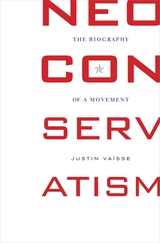
Neoconservatism has undergone a transformation that has made a clear identity almost impossible to capture. The Republican foreign policy operatives of the George W. Bush era seem far removed from the early liberal intellectuals who focused on domestic issues. Justin Vaïsse offers the first comprehensive history of neoconservatism, exploring the connections between a changing and multifaceted school of thought, a loose network of thinkers and activists, and American political life in turbulent times.
In an insightful portrait of the neoconservatives and their impact on public life, Vaïsse frames the movement in three distinct ages: the New York intellectuals who reacted against the 1960s leftists; the “Scoop Jackson Democrats,” who tried to preserve a mix of hawkish anticommunism abroad and social progress at home but failed to recapture the soul of the Democratic Party; and the “Neocons” of the 1990s and 2000s, who are no longer either liberals or Democrats. He covers neglected figures of this history such as Pat Moynihan, Eugene Rostow, Lane Kirkland, and Bayard Rustin, and offers new historical insight into two largely overlooked organizations, the Coalition for a Democratic Majority and the Committee on the Present Danger. He illuminates core developments, including the split of liberalism in the 1960s, and the shifting relationship between partisan affiliation and foreign policy positions.
Vaïsse gives neoconservatism its due as a complex movement and predicts it will remain an influential force in the American political landscape.
It is a powerful story: the relationship between the 1960s New Left and organized labor was summed up by hardhats confronting students and others over US involvement in Vietnam. But the real story goes beyond the "Love It or Leave It" signs and melees involving blue-collar types attacking protesters.
Peter B. Levy challenges these images by exploring the complex relationship between the two groups. Early in the 1960s, the New Left and labor had cooperated to fight for civil rights and anti-poverty programs. But diverging opinions on the Vietnam War created a schism that divided these one-time allies. Levy shows how the war, combined with the emergence of the black power movement and the blossoming of the counterculture, drove a permanent wedge between the two sides and produced the polarization that remains to this day.
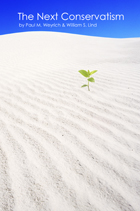
Since November’s election, conservative columnists have filled the op-ed pages with calls for a new conservative agenda. In The Next Conservatism, two of the conservative movement’s best-known thinkers, Paul M. Weyrich and William S. Lind, offer exactly that. More, they offer a new kind of conservative agenda, one that reaches far beyond politics to grapple with the sources of our nation’s cultural decay.
The Next Conservatism recognizes that culture is more powerful than politics. Nevertheless, it offers an engaging menu of political reforms, all under the rubric of “Restore the Republic!” No enthusiasts of Imperial America at home or abroad, Weyrich and Lind seek limited government, jealous guardianship of civil liberties, and a Washington liberated from the power of the New Class, the interests that feed off our nation’s decay. To these frequent conservative themes, Weyrich and Lind offer something new: a warning of a general crisis of legitimacy of the state itself, which can lead to a Hobbesian state of anarchy. How might we save the state while avoiding the jaws of Leviathan? The Next Conservatism offers innovative ways to thread that needle.
Meanwhile, what of America’s culture? Did its decay over the past half-century “just happen”? Weyrich and Lind argue no; rather, much of our degradation was deliberate, the work of the poisonous ideology of cultural Marxism, aka “Political Correctness.” The Next Conservatism takes the reader on a fascinating historical tour of the origins of Political Correctness in the infamous Frankfurt School, a gathering of heretical Marxists whose goal from the outset was the destruction of Western culture.
Weyrich and Lind then proceed to “deconstruct” the left’s program for America, debunking Feminism, “racism,” and environmentalism along the way. Reflecting the thought of Russell Kirk, The Next Conservatism condemns ideologies left and right, calling instead for a return to traditional ways of living, ways that reflect wisdom accumulated generation by generation. Only thus, they argue, can conservatives win a culture war many regard as hopelessly lost.
Old ways, in turn, lead to a Next Conservatism appropriate for hard times. Virtue, Weyrich and Lind offer, is to be found in modest living, not conspicuous consumption. The Next Conservative agenda rejects environmentalism but includes conservation, the return of the family farm, New Urbanism and the revival of such ‘oldies but goodies” as streetcars and passenger trains. A new theme, Retroculture, sums up a conservatism that recognizes that what worked in the past can work again today, and in the future as well. Our ancestors were no fools, the authors suggest, and “Back to the Future!” can serve as a powerful conservative rallying cry.
Having laid the political and cultural groundwork, The Next Conservatism then turns to conservative governance. In foreign policy, the authors call for minimizing foreign entanglements, though with a strong national defense and a military reform to adapt to face Fourth Generation warfare rather than the Second Generation America adheres to. For the economy, the authors call for repairing and expanding our national infrastructure, sound money, and protecting American industry, seeing labor as a potential ally. In both national security and economic security, the authors insist that good governance include moral security; drawing from the New Urbanism, they offer a “moral transect” that allows everyone to do what he wants, but not always where he wants. The public square, they suggest, should be safe for families.
Respecting the careful limits on government power a restored republic would embody, The Next Conservatism calls for redeeming America not through legislation but through a new conservative movement. Unlike the old movement, the next conservative movement would be a league of people who pledged to live their lives by the old rules. While conservatives would remain engaged in politics, they would rely on a vastly more powerful force of example, the examples of lives lived well in traditional ways. This next conservative movement would appeal far beyond the ranks of political conservatives, to all Americans who know that something has gone tragically wrong in the life of our nation.
The Next Conservatism offers a vision of vast sweep, far beyond anything coming out of Washington. At a time when most Americans find life growing more difficult, it proposes a path to a new America that is also the old America, the good, comfortable America we had and have lost.
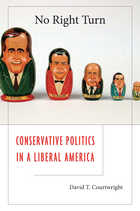
Few question the “right turn” America took after 1966, when liberal political power began to wane. But if they did, No Right Turn suggests, they might discover that all was not really “right” with the conservative golden age. A provocative overview of a half century of American politics, the book takes a hard look at the counterrevolutionary dreams of liberalism’s enemies—to overturn people’s reliance on expanding government, reverse the moral and sexual revolutions, and win the Culture War—and finds them largely unfulfilled.
David Courtwright deftly profiles celebrated and controversial figures, from Clare Boothe Luce, Barry Goldwater, and the Kennedy brothers to Jerry Falwell, David Stockman, and Lee Atwater. He shows us Richard Nixon’s keen talent for turning popular anxieties about morality and federal meddling to Republican advantage—and his inability to translate this advantage into reactionary policies. Corporate interests, boomer lifestyles, and the media weighed heavily against Nixon and his successors, who placated their base with high-profile attacks on crime, drugs, and welfare dependency. Meanwhile, religious conservatives floundered on abortion and school prayer, obscenity, gay rights, and legalized vices like gambling, and fiscal conservatives watched in dismay as the bills mounted.
We see how President Reagan’s mélange of big government, strong defense, lower taxes, higher deficits, mass imprisonment, and patriotic symbolism proved an illusory form of conservatism. Ultimately, conservatives themselves rebelled against George W. Bush’s profligate brand of Reaganism. Courtwright’s account is both surprising and compelling, a bracing argument against some of our most cherished clichés about recent American history.

Despite intense political debate, attitudes on abortion were remarkably stable for decades. However, after the 2022 Dobbs decision, Americans’ opinions began to change. Not Going Back explores the shifts in public opinion on this hot-button issue from the landmark passing of Roe v. Wade in 1973 through the 2024 election and into 2025.
The authors ask, “What role do Americans want their government to play in protecting, regulating, or restricting abortion access?” and, “How will changing attitudes on abortion reshape American politics?” They offer cohesive, theoretically grounded explanations for both the continuity and the change in Americans’ attitudes on this contentious topic. Using national data, they take a deep dive into the personal experiences and social forces behind these changes.
Not Going Back ends with an examination of the consequences of these changes for election outcomes. While there has been a striking reversal in the prioritization of abortion as an issue among Democrats and Republicans, the full impact of this shift in thinking will be influenced by future policies, court decisions, and party reactions.

In a compelling meditation on the ideas that shape our lives, one of the world’s most provocative and creative philosophers explains how his eccentric early years influenced his lifelong critique of liberalism.
Liberalism is so amorphous and pervasive that for most people in the West it is background noise, the natural state of affairs. But there are nooks and crannies in every society where the prevailing winds don’t blow. Raymond Geuss grew up some distance from the cultural mainstream and recounts here the unusual perspective he absorbed: one in which liberal capitalism was synonymous with moral emptiness and political complacency.
Not Thinking like a Liberal is a concise tour of diverse intellectual currents—from the Counter-Reformation and communism to pragmatism and critical theory—that shaped Geuss’s skeptical stance toward liberalism. The bright young son of a deeply Catholic steelworker, Geuss was admitted in 1959 to an unusual boarding school on the outskirts of Philadelphia. Outside was Eisenhower’s America. Inside Geuss was schooled by Hungarian priests who tried to immunize students against the twin dangers of oppressive communism and vapid liberal capitalism. From there Geuss went on to university in New York in the early days of the Vietnam War and to West Germany, where critical theory was experiencing a major revival.
This is not a repeatable journey. In tracing it, Geuss reminds us of the futility of abstracting lessons from context and of seeking a universal view from nowhere. At the same time, he examines the rise and fall of major political theories of the past sixty years. An incisive thinker attuned to both the history and the future of ideas, Geuss looks beyond the horrors of authoritarianism and the shallow freedom of liberalism to glimpse a world of genuinely new possibilities.
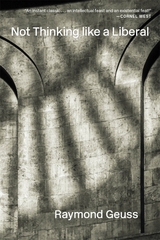
“An instant classic….an intellectual feast and an existential feat!” —Cornel West
“By intertwining autobiography and conceptual critique, Geuss underlines the idea that in order to gain a critical perspective on liberalism, it is necessary to become almost bilingual: able to speak the language of liberalism while also becoming fluent in the vocabulary of its critique.” —Times Literary Supplement
“Fascinating…deserves to be a classic. It is at once relatable and profound, humane and auspicious. In his best moments, Geuss offers his own life as a challenge to readers to think differently and more imaginatively.”—Matt McManus, Jacobin
“[Geuss’s] broad, skeptical account of human powers and interests that is aimed at challenging the hubris of abstract theorizers, is compelling. His account of the unusual formation of his own intellectual and political sensibility is both moving and illuminating.”—Richard Eldridge, Los Angeles Review of Books
Liberalism is so amorphous and pervasive that for many people it is background noise. But there are nooks and crannies in every society where the prevailing winds don’t blow. Raymond Geuss grew up some distance from the cultural mainstream and recounts here the unusual perspective he absorbed: one in which liberal capitalism was synonymous with moral emptiness and political complacency.
The bright son of a Catholic steelworker, Geuss was admitted in 1959 to an unusual boarding school on the outskirts of Philadelphia, where Hungarian priests sought to immunize students against the twin dangers of oppressive communism and vapid liberal capitalism. From there he went on to university in the early days of the Vietnam War and to West Germany, where critical theory was experiencing a major revival. An incisive thinker, Geuss looks beyond the horrors of authoritarianism and the shallow freedom of liberalism to glimpse a world of genuinely new possibilities.
READERS
Browse our collection.
PUBLISHERS
See BiblioVault's publisher services.
STUDENT SERVICES
Files for college accessibility offices.
RECENTLY PUBLISHED



UChicago Accessibility Resources
home | accessibility | search | about | contact us
BiblioVault ® 2001 - 2026
The University of Chicago Press