
 A SCHOLARLY BOOK REPOSITORY
7 start with N start with N

This is the epic story of how African-Americans, in the six decades following slavery, transformed themselves into a political people—an embryonic black nation. As Steven Hahn demonstrates, rural African-Americans were central political actors in the great events of disunion, emancipation, and nation-building. At the same time, Hahn asks us to think in more expansive ways about the nature and boundaries of politics and political practice.
Emphasizing the importance of kinship, labor, and networks of communication, A Nation under Our Feet explores the political relations and sensibilities that developed under slavery and shows how they set the stage for grassroots mobilization. Hahn introduces us to local leaders, and shows how political communities were built, defended, and rebuilt. He also identifies the quest for self-governance as an essential goal of black politics across the rural South, from contests for local power during Reconstruction, to emigrationism, biracial electoral alliances, social separatism, and, eventually, migration.
Hahn suggests that Garveyism and other popular forms of black nationalism absorbed and elaborated these earlier struggles, thus linking the first generation of migrants to the urban North with those who remained in the South. He offers a new framework—looking out from slavery—to understand twentieth-century forms of black political consciousness as well as emerging battles for civil rights. It is a powerful story, told here for the first time, and one that presents both an inspiring and a troubling perspective on American democracy.
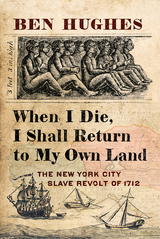
At 2 a.m. on April 7, 1712, a fire broke out in New York City’s North Ward. Unbeknown to the residents who roused themselves to combat the flames, the blaze had been started with murderous intent. A group of at least twenty-four enslaved West African men and women, mostly Akan from modern-day Ghana, had long plotted this moment. Armed with guns, daggers, swords, axes, and clubs, they fell upon their enslavers. In the next few frantic moments, eight Europeans were killed and seven were wounded. The perpetrators were rounded up, jailed, and put on public trial. Twenty enslaved men and one woman were executed or transported for carrying out the plot. As the first event of its kind to take place in the North American colonies, this revolt was the progenitor of those that followed—it inspired, the Stono Rebellion of 1739, the New York Conspiracy of 1741, and Nat Turner’s 1831 insurrection.
When I Die, I Shall Return to My Own Land: The 1712 New York City Slave Revolt is the first comprehensive investigation into this major event in the history of slavery in North America. Consulting court records, correspondence, and the minutes of the various colonial councils, as well as a wide range of sources related to eighteenth-century slavery, historian Ben Hughes vividly recreates early colonial New York, the lives of its enslaved inhabitants, the factionalism among the city’s Dutch and English elites, and their precarious hold on Manhattan Island in the face of French and Native American threats. Hughes traces the origins of the New York rebels, details how they came to be enslaved, and recreates the shadowy dealings that took place between African polities, European and American slavers, and New York merchants. The forerunners of a movement which continues to this day, the deeds of these original African American rebels have now been all but forgotten. Here, Hughes attempts to redress this imbalance by recovering their story.
A radical reconstruction of the founders’ debate over slavery and the Constitution.
Americans revere the Constitution even as they argue fiercely over its original toleration of slavery. Some historians have charged that slaveholders actually enshrined human bondage at the nation’s founding. The acclaimed political historian Sean Wilentz shares the dismay but sees the Constitution and slavery differently. Although the proslavery side won important concessions, he asserts, antislavery impulses also influenced the framers’ work. Far from covering up a crime against humanity, the Constitution restricted slavery’s legitimacy under the new national government. In time, that limitation would open the way for the creation of an antislavery politics that led to Southern secession, the Civil War, and Emancipation.
Wilentz’s controversial and timely reconsideration upends orthodox views of the Constitution. He describes the document as a tortured paradox that abided slavery without legitimizing it. This paradox lay behind the great political battles that fractured the nation over the next seventy years. As Southern Fire-eaters invented a proslavery version of the Constitution, antislavery advocates, including Abraham Lincoln and Frederick Douglass, proclaimed antislavery versions based on the framers’ refusal to validate what they called “property in man.”
No Property in Man invites fresh debate about the political and legal struggles over slavery that began during the Revolution and concluded with the Confederacy’s defeat. It drives straight to the heart of the most contentious and enduring issue in all of American history.
“Wilentz brings a lifetime of learning and a mastery of political history to this brilliant book.”
—David W. Blight, author of Frederick Douglass
A New York Times Book Review Editors’ Choice
A Foreign Affairs Best Book of the Year
Americans revere the Constitution even as they argue fiercely over its original toleration of slavery. In this essential reconsideration of the creation and legacy of our nation’s founding document, Sean Wilentz reveals the tortured compromises that led the Founders to abide slavery without legitimizing it, a deliberate ambiguity that fractured the nation seventy years later. Contesting the Southern proslavery version of the Constitution, Abraham Lincoln and Frederick Douglass pointed to the framers’ refusal to validate what they called “property in man.” No Property in Man has opened a fresh debate about the political and legal struggles over slavery that began during the Revolution and concluded with the Civil War. It drives straight to the heart of the single most contentious issue in all of American history.
“Revealing and passionately argued…[Wilentz] insists that because the framers did not sanction slavery as a matter of principle, the antislavery legacy of the Constitution has been…‘misconstrued’ for over 200 years.”
—Khalil Gibran Muhammad, New York Times
“Wilentz’s careful and insightful analysis helps us understand how Americans who hated slavery, such as Abraham Lincoln and Frederick Douglass, could come to see the Constitution as an ally in their struggle.”
—Eric Foner
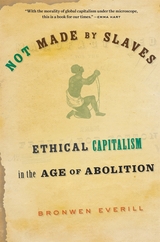
How abolitionist businesses marshaled intense moral outrage over slavery to shape a new ethics of international commerce.
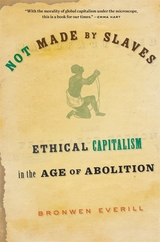
“East India Sugar Not Made By Slaves.” With these words on a sugar bowl, consumers of the early nineteenth century declared their power to change the global economy. Bronwen Everill examines how abolitionists from Europe to the United States to West Africa used new ideas of supply and demand, consumer credit, and branding to shape an argument for ethical capitalism.
Everill focuses on the everyday economy of the Atlantic world. Antislavery affected business operations, as companies in West Africa, including the British firm Macaulay & Babington and the American partnership of Brown & Ives, developed new tactics in order to make “legitimate” commerce pay. Everill explores how the dilemmas of conducting ethical commerce reshaped the larger moral discourse surrounding production and consumption, influencing how slavery and freedom came to be defined in the market economy. But ethical commerce was not without its ironies; the search for supplies of goods “not made by slaves”—including East India sugar—expanded the reach of colonial empires in the relentless pursuit of cheap but “free” labor.
Not Made by Slaves illuminates the early years of global consumer society, while placing the politics of antislavery firmly in the history of capitalism. It is also a stark reminder that the struggle to ensure fair trade and labor conditions continues.
“Impressive…[Readers] will be rewarded with greater understanding of historical developments that changed the relationship between consumers and producers in a global economy in ways that reverberate to this day.”
—Wall Street Journal
“Everill repositions West Africa as central to the broader Atlantic story of 18th and 19th century economic morality, its relationship with commercial ethics, and the expansion of capitalism.”
—Financial Times
“Offers a penetrating new perspective on abolition in the British Empire by spotlighting a particular cast of characters: the commercial abolitionists in West Africa who fashioned a consumer-focused, business-friendly antislavery ethics. These figures sought to prove the moral and economic superiority of non-slave labor while profiting from the transition away from slavery…Impressive.”
—Jacobin
“East India Sugar Not Made By Slaves.” With these words inscribed on a sugar bowl, nineteenth-century consumers were reminded of their power to change the global economy. Determined to strike at the heart of the slave trade, abolitionist businesses throughout the Atlantic used new ideas of supply and demand, consumer credit, and branding to make the case for ethical capitalism.
Consumers became the moral compass of capitalism as companies in West Africa, including Macaulay & Babington and Brown & Ives, developed clever new tactics to make “legitimate” commerce pay. Yet ethical trade was not without its problems. The search for goods “not made by slaves” unwittingly expanded the reach of colonial enterprises in the relentless pursuit of cheap labor. Not Made by Slaves captures the moral dilemmas roiling the early years of global consumer society and is a stark reminder of the unintended consequences of relying on consumer self-interest to transform global capitalism.
READERS
Browse our collection.
PUBLISHERS
See BiblioVault's publisher services.
STUDENT SERVICES
Files for college accessibility offices.
RECENTLY PUBLISHED





UChicago Accessibility Resources
home | accessibility | search | about | contact us
BiblioVault ® 2001 - 2026
The University of Chicago Press