front cover of Narratives of Adversity
Narratives of Adversity
Jesuits on the Eastern Peripheries of the Habsburg Realms (1640–1773)
Paul J. Shore
Central European University Press, 2012
Addresses the experience of Jesuit missionaries, teachers and writers along the peripheries of the Habsburg lands, which stretched to Moldavia, Ukraine, Serbia and Wallachia, and which were continually torn with ethnic tensions. The time scale of the study is from the "high tide" of the Society (often labeled "the first multinational corporation") in the fourth decade of the seventeenth century, until its suppression in 1773 by Pope Clement XIV. The book examines several of the communities situated along the periphery and the records that they left behind about their interactions with the local populations. It constructs a vivid picture of Jesuit life on the frontier that is built up in mosaic fashion and livened by compelling anecdotes. The Jesuits of Royal Hungary exercised a baroque expression modeled after the larger western cities of the Habsburg lands, which was a fragile splendor in part defined by the need to defend Catholicism from the hostility of Orthodox, Lutherans, Calvinists, and others.
[more]

front cover of Narratives Unbound
Narratives Unbound
Historical studies in post-communist Eastern Europe
Péter Apor
Central European University Press, 2007
The first work that covers the post-Communist development of historical studies in six Eastern European countries: Bulgaria, Czech Republic, Hungary, Poland, Romania, and Slovakia. A uniquely critical and qualitative analysis from a comparative and critical perspective, written by scholars from the region itself. Focusing on the first post-Communist decade, 1989–1999, the book offers a longer-term perspective that includes the immediate 'prehistory' of that momentous decade as well as its 'posthistoire'. The authors capture the spirit of 1989, that heady mix of elation, surprise, determination, and hope: l'ivresse du possible. This was the paradoxical beginning of Eastern European post-Communism: ushered in by 'anti-Utopian' revolutions, and slowly finding its course towards a bureaucratic, imitative, challenging, and anachronistic restoration of a capitalism that had changed almost beyond recognition when it had mutated into the negative double of Communism. Each individual chapter has numerous and detailed notes and references.
[more]

front cover of National Romanticism
National Romanticism
The Formation of National Movements
Miroslav Hroch
Central European University Press, 2007
67 texts, including hymns, manifestos, articles or extracts from lengthy studies exemplify the relation between Romanticism and the national movements in the cultural space ranging from Poland to the Ottoman Empire. Each text is accompanied by a presentation of the author, and by an analysis of the context in which the respective work was born.The end of the 18th century and first decades of the 19th were in many respects a watershed period in European history. The ideas of the Enlightenment and the dramatic convulsions of the French Revolution had shattered the old bonds and cast doubt upon the established moral and social norms of the old corporate society. In culture a new trend, Romanticism, was successfully asserting itself against Classicism and provided a new key for a growing number of activists to 're-imagine' their national community, reaching beyond the traditional frameworks of identification (such as the 'political nation', regional patriotism, or Christian universalism). The collection focuses on the interplay of Romantic cultural discourses and the shaping of national ideology throughout the 19th century, tracing the patterns of cultural transfer with Western Europe as well as the mimetic competition of national ideologies within the region.
[more]

logo for Georgetown University Press
NATO's Return to Europe
Engaging Ukraine, Russia, and Beyond
Rebecca R. Moore and Damon Coletta, Editors. Foreword by Nicholas Burns
Georgetown University Press

NATO’s 2010 Strategic Concept officially broadened the alliance’s mission beyond collective defense, reflecting a peaceful Europe and changes in alliance activities. NATO had become an international security facilitator, a crisis-manager even outside Europe, and a liberal democratic club as much as a mutual-defense organization. However, Russia’s re-entry into great power politics has changed NATO’s strategic calculus.

Russia’s aggressive annexation of Crimea in 2014 and its ongoing military support for Ukrainian separatists dramatically altered the strategic environment and called into question the liberal European security order. States bordering Russia, many of which are now NATO members, are worried, and the alliance is divided over assessments of Russia’s behavior.  Against the backdrop of Russia’s new assertiveness, an international group of scholars examines a broad range of issues in the interest of not only explaining recent alliance developments but also making recommendations about critical choices confronting the NATO allies. While a renewed emphasis on collective defense is clearly a priority, this volume’s contributors caution against an overcorrection, which would leave the alliance too inwardly focused, play into Russia’s hand, and exacerbate regional fault lines always just below the surface at NATO. This volume places rapid-fire events in theoretical perspective and will be useful to foreign policy students, scholars, and practitioners alike.
[more]

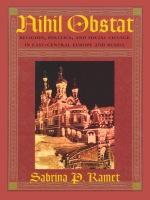
front cover of Nihil Obstat
Nihil Obstat
Religion, Politics, and Social Change in East-Central Europe and Russia
Sabrina P. Ramet
Duke University Press, 1998
Nihil Obstat—Latin for "nothing stands in the way"—examines the interplay between religion and politics in East-Central Europe and Russia. While focusing on the postcommunist, late twentieth century, Sabrina P. Ramet discusses developments as far back as the eleventh century to explain the patterns that have developed over time and to show how they still affect contemporary interecclesiastical relations as well as those among Church, state, and society.
Based on interview research in Germany, Austria, Slovenia, Croatia, Bosnia, Serbia, and Macedonia, and on materials published in German, Italian, Serbo-Croatian, Polish, Czech, Slovak, Russian, and English, Ramet paints a clear picture of the political and religious fragility of former communist states, which are experiencing some aspects of freedom and choice for the first time. With its comprehensive discussion of the largest religious institutions in the area, especially the Catholic and Orthodox Churches, and its extensive survey of nontraditional religious associations that have become active in the region since 1989, this study makes a distinct contribution to growing discussions about the rise of fundamentalism and the inner dilemmas of modernity. With its depth of information and thoughtful exploration of cultural traditions, Nihil Obstat uniquely presents the ramifications and complexities of European religion in a postcommunist world.
[more]


Send via email Share on Facebook Share on Twitter