
 A SCHOLARLY BOOK REPOSITORY
5 start with N start with N

This book examines five landmark Supreme Court cases involving national parks—Gettysburg, Yellowstone, Grand Canyon, Death Valley, and the National Mall. Each chapter blends legal analysis with historical context, tracing the origins of the parks and the disputes that brought them before the nation’s highest court. Spanning nearly a century, these cases reveal how the Court has shaped park policy, land use, Native American rights, water law, and free speech.
Through these pivotal decisions, National Parks and the Supreme Court offers a new lens on the contested terrain of the national parks, where legal, environmental, and cultural values collide. By exploring the courts’ influence on public lands, it deepens our understanding of the complexities of managing America’s most cherished landscapes.

The 1936 Olympic Games played a key role in the development of both Hitler’s Third Reich and international sporting competition. The Nazi Olympics gathers essays by modern scholars from prominent participating countries and lays out the issues--sporting as well as political--surrounding the involvement of individual nations.
The volume opens with an analysis of Germany’s preparations for the Games and the attempts by the Nazi regime to allay the international concerns about Hitler’s racist ideals and expansionist ambitions. Essays follow on the United States, Great Britain, and France--top-tier Olympian nations with misgivings about participation--as well as Germany's future Axis partners Italy and Japan. Other contributions examine the issues involved for Finland, Sweden, Norway, Denmark, and the Netherlands. Throughout, the authors reveal the high political stakes surrounding the Games and how the Nazi Olympics distilled critical geopolitical issues of the time into a spectacle of sport.

Beneath the surface of the seas and oceans lies a territory as important for human societies as the exposed land and the airspace above them: the seafloor. Our daily life is inextricably linked to the seafloor and its resources, from global telecommunications infrastructure to offshore oil and gas extraction to strategic mineral mining.
By focusing on France, a country with an underwater territory seventeen times larger than its emerged lands, New Deep Territories explains how the seafloor emerged as a territory during the second half of the twentieth century. Beatriz Martinez-Rius traces the evolution of the country’s seafloor exploration and the motivations that fueled it from the aftermath of World War I to the late 1970s. In the early 1960s, the seafloor, instead of colonial territories, came to be seen as a source of natural resources. The French government, corporations such as oil companies, and scientists all imagined future uses of the seafloor, and these ever-evolving aspirations drove the development of technologies, techniques, and scientific fields that built up the submerged territory. Government officers and industrial stakeholders massively invested in technoscientific development to prepare for a future reliant on seafloor resources, including oil, gas, and minerals, well before it was technologically possible, economically feasible, and legally acceptable to extract them. The future they envisioned did not arrive, but their investment resulted in an unprecedented understanding of the ocean’s crust. Today, once again, national governments, international organizations, and private stakeholders are turning their attention to the seafloor.
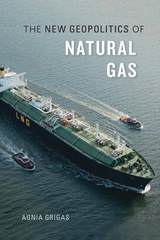
We are in the midst of an energy revolution, led by the United States. As the world’s greatest producer of natural gas moves aggressively to expand its exports of liquefied natural gas (LNG), America stands poised to become an energy superpower—an unanticipated development with far-reaching implications for the international order. Agnia Grigas drills deep into today’s gas markets to uncover the forces and trends transforming the geopolitics of gas.
The boom in shale gas production in the United States, the growth of global LNG trade, and the buildup of gas transport infrastructure worldwide have so transformed the traditional markets that natural gas appears to be on the verge of becoming a true global commodity. Traditional suppliers like Russia, whose energy-poor neighbors were dependent upon its gas exports and pipelines, are feeling the foundations of the old order shifting beneath their feet. Grigas examines how this new reality is rewriting the conventional rules of intercontinental gas trade and realigning strategic relations among the United States, the European Union, Russia, China, and beyond.
In the near term, Moscow’s political influence will erode as the Russian gas giant Gazprom loses share in its traditional markets while its efforts to pivot eastward to meet China’s voracious energy needs will largely depend on Beijing’s terms. In this new geopolitics of gas, the United States will enjoy opportunities but also face challenges in leveraging its newfound energy clout to reshape relations with both European states and rising Asian powers.
Contributors. Andrea Bachner, Luciano Damián Bolinaga, Nellie Chu, Rachel Cypher, Mingwei Huang, T. Tu Huynh, Yu-lin Lee, Ng Kim Chew, Lisa Rofel, Carlos Rojas, Shuang Shen, Derek Sheridan, Nicolai Volland
READERS
Browse our collection.
PUBLISHERS
See BiblioVault's publisher services.
STUDENT SERVICES
Files for college accessibility offices.
RECENTLY PUBLISHED






UChicago Accessibility Resources
home | accessibility | search | about | contact us
BiblioVault ® 2001 - 2025
The University of Chicago Press