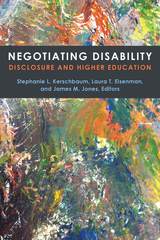
front cover of Negotiating Disability
Negotiating Disability
Disclosure and Higher Education
Stephanie L. Kerschbaum, Laura T. Eisenman, and James M. Jones, Editors
University of Michigan Press, 2017
Disability is not always central to claims about diversity and inclusion in higher education, but should be. This collection reveals the pervasiveness of disability issues and considerations within many higher education populations and settings, from classrooms to physical environments to policy impacts on students, faculty, administrators, and staff.  While disclosing one’s disability and identifying shared experiences can engender moments of solidarity, the situation is always complicated by the intersecting factors of race and ethnicity, gender, sexuality, and class. With disability disclosure as a central point of departure, this collection of essays builds on scholarship that highlights the deeply rhetorical nature of disclosure and embodied movement, emphasizing disability disclosure as a complex calculus in which degrees of perceptibility are dependent on contexts, types of interactions that are unfolding, interlocutors’ long- and short-term goals, disabilities, and disability experiences, and many other contingencies.


 
[more]

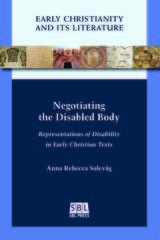
front cover of Negotiating the Disabled Body
Negotiating the Disabled Body
Representations of Disability in Early Christian Texts
Anna Rebecca Solevåg
SBL Press, 2018

An intersectional study of New Testament and noncanonical literature

Anna Rebecca Solevåg explores how nonnormative bodies are presented in early Christian literature through the lens of disability studies. In a number of case studies, Solevåg shows how early Christians struggled to come to terms with issues relating to body, health, and dis/ability in the gospel stories, apocryphal narratives, Pauline letters, and patristic expositions. Solevåg uses the concepts of narrative prosthesis, gaze and stare, stigma, monster theory, and crip theory to examine early Christian material to reveal the multiple, polyphonous, contradictory ways in which nonnormative bodies appear.

Features:

  • Case studies that reveal a variety of understandings, attitudes, medical frameworks, and taxonomies for how disabled bodies were interpreted
  • A methodology that uses disability as an analytical tool that contributes insights about cultural categories, ideas of otherness, and social groups’ access to or lack of power
  • An intersectional perspective drawing on feminist, gender, queer, race, class, and postcolonial studies
[more]


Send via email Share on Facebook Share on Twitter