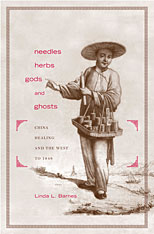
front cover of Needles, Herbs, Gods, and Ghosts
Needles, Herbs, Gods, and Ghosts
China, Healing, and the West to 1848
Linda L. Barnes
Harvard University Press, 2007

When did the West discover Chinese healing traditions? Most people might point to the "rediscovery" of Chinese acupuncture in the 1970s. In Needles, Herbs, Gods, and Ghosts, Linda Barnes leads us back, instead, to the thirteenth century to uncover the story of the West's earliest known encounters with Chinese understandings of illness and healing. As Westerners struggled to understand new peoples unfamiliar to them, how did they make sense of equally unfamiliar concepts and practices of healing? Barnes traces this story through the mid-nineteenth century, in both Europe and, eventually, the United States. She has unearthed numerous examples of Western missionaries, merchants, diplomats, and physicians in China, Europe, and America encountering and interpreting both Chinese people and their healing practices, and sometimes adopting their own versions of these practices.

A medical anthropologist with a degree in comparative religion, Barnes illuminates the way constructions of medicine, religion, race, and the body informed Westerners' understanding of the Chinese and their healing traditions.

[more]

front cover of Newton’s Apple and Other Myths about Science
Newton’s Apple and Other Myths about Science
Ronald L. Numbers
Harvard University Press, 2015

A Guardian “Favourite Reads—as Chosen by Scientists” Selection

“Tackles some of science’s most enduring misconceptions.”
Discover


A falling apple inspired Isaac Newton’s insight into the law of gravity—or did it really?

Among the many myths debunked in this refreshingly irreverent book are the idea that alchemy was a superstitious pursuit, that Darwin put off publishing his theory of evolution for fear of public reprisal, and that Gregor Mendel was ahead of his time as a pioneer of genetics. More recent myths about particle physics and Einstein’s theory of relativity are discredited too, and a number of dubious generalizations, like the notion that science and religion are antithetical, or that science can neatly be distinguished from pseudoscience, go under the microscope of history.

Newton’s Apple and Other Myths about Science brushes away popular fictions and refutes the widespread belief that science advances when individual geniuses experience “Eureka!” moments and suddenly grasp what those around them could never imagine.

“Delightful…thought-provoking…Every reader should find something to surprise them.”
—Jim Endersby, Science

“Better than just countering the myths, the book explains when they arose and why they stuck.”
The Guardian

[more]

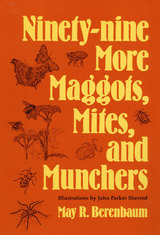
front cover of Ninety-nine More Maggots, Mites, and Munchers
Ninety-nine More Maggots, Mites, and Munchers
May R. Berenbaum
University of Illinois Press, 1993
What lives in a reindeer’s nose? Glad you asked. In this sequel to Ninety-nine Gnats, Nits, and Nibblers, National Medal of Science winner May Berenbaum offers another classic compendium of creepy-crawly cameos. Read up on our myriad arthropodan indignities and allies as Berenbaum reveals:
Why the rove beetle gives mind-altering drugs to ants
How the snail-killing fly enjoys its escargot
Why Piophila casei doesn’t care when you eat its larvae
What strange fate awaits a honey ant worker engorged with nectar
 
As lively as a fly in the buttermilk, Ninety-nine More Maggots, Mites, and Munchers is a who’s who and what’s THAT? guide to Lilliputian life-forms both familiar and obscure.
 
[more]

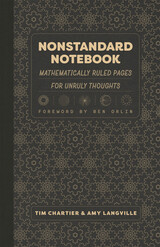
front cover of Nonstandard Notebook
Nonstandard Notebook
Mathematically Ruled Pages for Unruly Thoughts
Tim Chartier and Amy Langville
University of Chicago Press, 2024
A revolutionary notebook that challenges us to play outside (and with) the lines.
 
A standard notebook displays page after page of horizontal lines. But what if we break the pattern? What if the ruled pages grew unruly? In this Nonstandard Notebook, lines twist, fragment, curve, and crisscross in beautiful formations. Each sheet is a distinctive work of imagination, asking us to draw, doodle, and journal in the same spirit.
 
Page after page, as we journey from lines to parabolas to waves, deep questions arise—about form, art, and mathematics. How do we harness the infinite? Why do patterns permeate nature? What are the limitations and possibilities of human vision? Nonstandard Notebook explores these questions and more through its provocative and inspirational images, each displayed with the mathematics that generated it. We see how straight lines can form fractal crenellations, how circles can disrupt and unify, and how waves and scaling can form complex landscapes (or even famous faces). Created by mathematicians, educators, and math popularizers Tim Chartier and Amy Langville, and with a foreword from Ben Orlin (bestselling author of Math with Bad Drawings), Nonstandard Notebook shows that rules—both the rules of mathematics and the rules of a notebook—do not mark the end of creativity, but the beginning.
[more]


Send via email Share on Facebook Share on Twitter