
 A SCHOLARLY BOOK REPOSITORY
3 start with N start with N

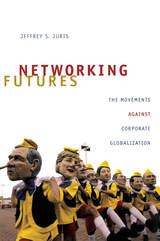
In an account full of activist voices and on-the-ground detail, Juris provides a history of anti–corporate globalization movements, an examination of their connections to local dynamics in Barcelona, and an analysis of movement-related politics, organizational forms, and decision-making. Depicting spectacular direct action protests in Barcelona and other cities, he describes how far-flung activist networks are embodied and how networking politics are performed. He further explores how activists have used e-mail lists, Web pages, and free software to organize actions, share information, coordinate at a distance, and stage “electronic civil disobedience.” Based on a powerful cultural logic, anti–corporate globalization networks have become models of and for emerging forms of radical, directly democratic politics. Activists are not only responding to growing poverty, inequality, and environmental devastation; they are also building social laboratories for the production of alternative values, discourses, and practices.
What form does the crisis of modernity take in Latin America when societies are politically demobilized and there is no revolutionary agenda in sight? How does postmodern criticism reflect on enlightenment and utopia in a region marked by incomplete modernization, new waves of privatization, great masses of excluded peoples, and profound sociocultural heterogeneity? In No Apocalypse, No Integration Martín Hopenhayn examines the social and philosophical implications of the triumph of neoliberalism and the collapse of leftist and state-sponsored social planning in Latin America.
With the failure of utopian movements that promised social change, the rupture of the link between the production of knowledge and practical intervention, and the defeat of modernization and development policy established after World War II, Latin American intellectuals and militants have been left at an impasse without a vital program of action. Hopenhayn analyzes these crises from a theoretical perspective and calls upon Latin American intellectuals to reevaluate their objects of study, their political reality, and their society’s cultural production, as well as to seek within their own history the elements for a new collective discourse. Challenging the notion that strict adherence to a single paradigm of action can rescue intellectual and cultural movements, Hopenhayn advocates a course of epistemological pluralism, arguing that such an approach values respect for difference and for cultural and theoretical diversity and heterodoxy.
This essay collection will appeal to readers of sociology, public policy, philosophy, cultural theory, and Latin American history and culture, as well as to those with an interest in Latin America’s current transition.
READERS
Browse our collection.
PUBLISHERS
See BiblioVault's publisher services.
STUDENT SERVICES
Files for college accessibility offices.
RECENTLY PUBLISHED







UChicago Accessibility Resources
home | accessibility | search | about | contact us
BiblioVault ® 2001 - 2026
The University of Chicago Press