
 A SCHOLARLY BOOK REPOSITORY
12 start with N start with N

involved in real-world managing are not always willing to reveal the intricacies of their
everyday muddles. Barbara Czarniawska argues that in order to understand these uncharted
territories, we need to gather local and concrete stories about organizational life and subject
them to abstract and metaphorical interpretation.
Using a narrative approach unique to organizational studies, Czarniawska employs literary
devices to uncover the hidden workings of organizations. She applies cultural metaphors to
public administration in Sweden to demonstrate, for example, how the dynamics of a
screenplay can illuminate the budget disputes of an organization. She shows how the
interpretive description of organizational worlds works as a distinct genre of social analysis,
and her investigations ultimately disclose the paradoxical nature of organizational life: we follow
routines in order to change, and decentralize in order to control. By confronting such
paradoxes, we bring crisis to existing institutions and enable them to change.
Assuming no prior knowledge of literary theory, Roe introduces the theoretical concepts and terminology from literary analysis through an examination of the budget crises of national governments. With a focus on several particularly intractable issues in the areas of the environment, science, and technology, he then develops the methodology of narrative policy analysis by showing how conflicting policy "stories" often tell a more policy-relevant meta-narrative. He shows the advantage of this approach to reading and analyzing stories by examining the ways in which the views of participants unfold and are told in representative case studies involving the California Medfly crisis, toxic irrigation in the San Joaquin Valley, global warming, animal rights, the controversy over the burial remains of Native Americans, and Third World development strategies.
Presenting a bold innovation in the interdisciplinary methodology of the policy sciences, Narrative Policy Analysis brings the social sciences and humanities together to better address real-world problems of public policy—particularly those issues characterized by extreme uncertainty, complexity, and polarization—which, if not more effectively managed now, will plague us well into the next century.
Part One: Articulating a Theory of Natural Law contains three sections in which Boyle defends the reality of free choice and the view that the basic reasons for action, or first principles of natural law, are incommensurable in goodness. Boyle identifies the basic moral standard for choice and action, and develops an account of human action that elucidates the important role played by intention and double effect in their moral evaluation.
The essays in Part Two: Natural Law Theory and Contemporary Moral Problems demonstrate the strength and scope of Boyle’s natural law account, as he brings it to bear upon just war theory, property and welfare rights, and issues in bioethics. The essays in bioethics address the difficult question of whether it is appropriate to tube-feed patients in persistent vegetative state, and include an unpublished essay, “Against Assisted Death,” which he delivered as the Anscombe Lecture at The Anscombe Bioethics Centre in Oxford about a year before he died.
This volume also includes a Foreword by Princeton’s Robert P. George; an Introduction by the editors that highlights Boyle’s contribution to the development of the new classical natural law theory; and a bibliography of Boyle’s publications.

Can there be universal moral principles in a culturally and religiously diverse world? Are such principles provided by a theory of natural law? Jacques' response to both questions is "yes".
These essays, selected from the writings of one of the most influential philosophers of the past hundred years, provide a clear statement of Maritain's theory of natural law and natural rights. Maritain's ethics and political philosophy occupies a middle ground between the extremes of individualism and collectivism. Written during a period when cultural diversity and pluralism were beginning to have an impact on ethics and politics, these essays provide a defense of natural law and natural right that continues to be timely.
The first essay introduces Maritain's theory of connatural knowledge -- knowledge by inclination -- that lies at the basis of his distinctive views on moral philosophy, aesthetics, and mystical belief. The second essay gives Maritain's principal metaphysical arguments for natural law as well as his account of how that law can be naturally known and universally held.
The third essay in this collection explains the roots of the natural law and shows how it provides a rational foundation for other kinds of law and for human rights. In the fourth essay, reflecting his personalism and integral humanism, Maritain indicates how he extends his understanding of human rights to include the rights of the civic and of the social or working person.
Provides a forum for leading economists to participate in important debates in macroeconomics and to report on major developments in macroeconomic analysis and policy.
This fortieth volume of the NBER Macroeconomics Annual includes four new papers on contemporary macroeconomic challenges and methodologies. Christopher Clayton, Matteo Maggiori, and Jesse Schreger examine how hegemonic powers use economic policies as tools of influence on target countries and show how the effectiveness of these policies depends on the target’s available alternatives and whether it can take advantage of those alternatives. José Luis Montiel Olea, Mikkel Plagborg-Møller, Eric Qian, and Christian Wolf provide essential guidance for practitioners choosing between vector autoregressions and local projections for estimating impulse response functions. Kristin Forbes, Jongrim Ha, and M. Ayhan Kose analyze inflation-output tradeoffs across rate cycles from the 1970s to the post-pandemic period using a new cross-country database that reveals how delayed but aggressive monetary responses can generate low-cost disinflation. Satyajit Chatterjee, Dean Corbae, Kyle Dempsey, and José-Victor Ríos-Rull explore the bidirectional relationship between credit scores and inequality over the life cycle, demonstrating through a dynamic general equilibrium model how full information credit scoring systems can improve welfare outcomes. In a keynote address commemorating the conference anniversary, Olivier Blanchard assesses the evolution of macroeconomic research over four decades, and finds substantial methodological convergence.

New Digital Worlds traces the formation of postcolonial studies and digital humanities as fields, identifying how they can intervene in knowledge production in the digital age. Roopika Risam examines the role of colonial violence in the development of digital archives and the possibilities of postcolonial digital archives for resisting this violence. Offering a reading of the colonialist dimensions of global organizations for digital humanities research, she explores efforts to decenter these institutions by emphasizing the local practices that subtend global formations and pedagogical approaches that support this decentering. Last, Risam attends to human futures in new digital worlds, evaluating both how algorithms and natural language processing software used in digital humanities projects produce universalist notions of the "human" and also how to resist this phenomenon.

A comprehensive survey of the evolution of market design over the past three decades.
In the mid-1990s, the first Federal Communications Commission spectrum auction and the redesign of the National Residency Matching Program collectively helped to jumpstart the field of market design. Since then, extensive research has improved auction design and broken new conceptual ground in addressing multi-agent matching problems. This volume summarizes key discoveries and advances in market design over the past three decades and explores contemporary challenges—from climate policy and electricity markets to AI-mediated exchanges and hospital resource allocation.
Contributors examine how to design efficient, incentive-compatible mechanisms that are robust to shifting conditions and increasing complexity. They consider a wide variety of applications that could benefit from the market design viewpoint, such as environmental markets, school choice, and organ exchange. Together, the chapters illustrate the important interactions between economic theory, computational tools, and institutional insight.

In The New Flatlanders, teacher, scientist, and chaplain Eric Middleton challenges traditional ways of looking at reality by engaging readers in a "voyage of discovery starting with questions." The book engagingly begins with a discussion group embarking on an exploratory conversation about the nature of the universe and the place of human beings in it. Daunting questions emerge, such as "How can there possibly be a tear or hole in three-dimensional space? And if there is a hole, can something fall through it? Where would it fall to?" In short order, students and teacher are on a quest to develop a "working theory of everything" that takes them from stone circles to quarks, superstrings, quantum theory, the anthropic principle, evolution, consciousness, miracles, chaos, and the spiritual universe.
The key to exploring these questions is finding a language with which to talk about the awe and wonder of today's science alongside the joy of experiencing the spiritual. This is done by interweaving into the discussions the philosophy of "Flatland," a nonreligious entry point to Jesus posited by nineteenth-century clergyman and educator Edwin A. Abbott in his classic parable Flatland: A Romance of Many Dimensions.

Several of these essays look at Keynes not simply as an economist, but more broadly as a philosopher. Special attention is directed to his views on aesthetics and moral philosophy, as well as his contributions as a probability theorist. The development of the Keynesian heritage is also considered: How did Keynesian ideas become assimilated and domesticated into the mainstream of economic thought—to the point of becoming dominant as the orthodoxy of the economics profession? What was the relationship between postwar British conservatives, Keynes’s work, and Britain’s relative economic decline? The archivist in charge of Keynes’s papers provides an additional vantage point on Keynes’s working methods and the broad range of scholars interested in his writings. Finally, all of the essays are followed by a responder’s comments, thus providing an exchange of viewpoints.
Contributors. A. W. Coats, Allin F. Cottrell, Jacqueline Cox, William Darity, John Davis, Robert Dimand, Peter Groenewegen, Kevin Hoover, Henry E. Kyburg Jr., David Laidler, Michael S. Lawlor, Greg Lilly, D. E. Moggridge, R. M. O’Donnell, Kerry Pearce, Jochen Runde, Teddy Seidenfeld, J. D. Tomlinson
Following on F. A. Hayek's previous work Studies in Philosophy, Politics, and Economics (1967), New Studies in Philosophy, Politics, Economics and the History of Ideas collects some of Hayek's most notable essays and lectures dealing with problems of philosophy, politics and economics, with many of the essays falling into more than one of these categories. Expanding upon the previous volume the present work also includes a fourth part collecting a series of Hayek's writings under the heading 'History of Ideas.'
Of the articles contained in this volume the lectures on 'The Errors of Constructivism' (chapter 1) and 'Competition as a Discovery Procedure' (chapter 12) have been published before only in German, while the article on 'Liberalism' (chapter 9) was written in English to be published in an Italian translation in the Enciclopedia del Novicento by the Istituto della Enciclopedia Italiana at Rome.
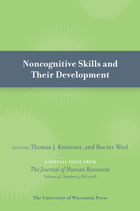
These articles include recent research on ways to incorporate the noncognitive side of ability in economic theory and to empirically assess and explain its role in labor market and behavioral outcomes. Contributions investigate the extent to which assignment of workers is determined by traditional cognitive variables and by personality traits. Also presented in this collection is research on the role of noncognitive skills in explaining the labor market position of underrepresented groups and research that integrates the economic and psychological theory and evidence on noncognitive skills.

READERS
Browse our collection.
PUBLISHERS
See BiblioVault's publisher services.
STUDENT SERVICES
Files for college accessibility offices.
RECENTLY PUBLISHED





UChicago Accessibility Resources
home | accessibility | search | about | contact us
BiblioVault ® 2001 - 2026
The University of Chicago Press