
 A SCHOLARLY BOOK REPOSITORY
7 start with O start with O
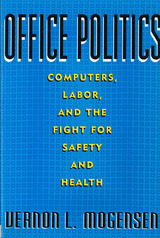
The desktop computer has transformed office work. Business and social forecasters claimed that the use of video display terminals (VDTs) in the “Office of the Future” would free workers from routine tasks, giving them more time for creative work and chances for career advancement. Office Politics argues that, for many VDT workers––most of whom are nonunionized women in low-paying, dead-end jobs––exactly the opposite has been true. VDTs have been used to routinize office tasks; export work via satellite to low-wage, nonunion offshore offices; to de-skill workers and monitor their productivity. And the nature of the work has led to widespread health and safety problems, including vision, musculoskeletal (repetitive motion), and stress-related illnesses. Many have also charged that the electromagnetic fields (EMFs) emitted by computer terminals are responsible for miscarriages, for birth defects, and for promoting cancer.
As office workers sought to protect themselves against these new occupational health and safety problems, they found little help from organized labor, business, or the government. Office Politics is the first book to explain why. It shows how corporate interests successfully redefined the VDT health and safety crisis as a “comfort” problem, how the government refused to collect data on the true scope of VDT-related illnesses or to regulate Information Age industries, and how labor unions ignored women workers.
Office Politics is key reading for everyone who works at a computer. It will be of special interest to students, academics, and professionals in political science, sociology, occupational and environmental health, business, labor and management issues, women’s studies, computing, and public policy.
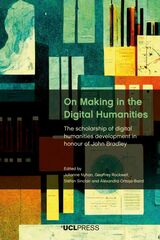
On Making in the Digital Humanities fills a gap in our understanding of digital humanities projects and craft by exploring the processes of making as much as the products that arise from it. Focusing on the interwoven layers of human and technological textures that constitute digital humanities scholarship, it assembles a group of well-known, experienced, and emerging scholars in the digital humanities to reflect on various forms of making. The chapters gathered here are individually important, but together provide a very human view of what it is to do the digital humanities, in the past, present, and future. This book will accordingly be of interest to researchers, teachers, and students of the digital humanities; creative humanities, including maker spaces and culture; information studies; the history of computing and technology; and the history of science and the humanities.
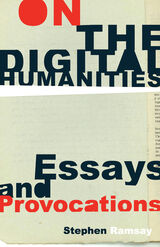
A witty and incisive exploration of the philosophical conundrums that animate the digital humanities
Since its inception, the digital humanities has been repeatedly attacked as a threat to the humanities: warnings from literary and cultural theorists of technology overtaking English departments and the mechanization of teaching have peppered popular media. Stephen Ramsay’s On the Digital Humanities, a collection of essays spanning the personal to the polemic, is a spirited defense of the field of digital humanities.
A founding figure in what was once known as “humanities computing,” Ramsay has a well-known and contentious relationship with what is now called the digital humanities (DH). Here Ramsay collects and updates his most influential and notorious essays and speeches from the past fifteen years, considering DH from an array of practical and theoretical perspectives. The essays pursue a broad variety of themes, including the nature of data and its place in more conventional notions of text and interpretation, the relationship between the constraints of computation and the more open-ended nature of the humanities, the positioning of practical skills and infrastructures in both research and pedagogical contexts, the status of DH as a program for political and social action, and personal reflections on the author’s journey into the field as both a theorist and a technologist.
These wide-ranging essays all center around one idea: that DH not forsake its connection to the humanities. While “digital humanities” may sound like an entirely new form of engagement with the artifacts of human culture, Ramsay argues that the field well reveals what is most essential to humanistic inquiry.

Online advertising will soon form the largest share of global advertisement revenues. Google and Facebook netted profits of US $29 billion in 2016. While these two giants control more than 66% of all online advertising revenues complex legal company structures have minimised their tax liabilities. This extended policy report considers where they should be taxed and where the value of their activities is actually created. It argues that tax paid by those platforms should be levied in the country where platform users are located when they click on or view an advertisement. Furthermore, the report examines the practical steps needed to ensure transparent accounting of taxed transactions in order to avoid long term negative effects for media and democracy.
Considering counter-arguments the author makes the case for an online advertising tax alongside a public service Internet strategy that could support other viable platforms and counter the dangers of duopoly or oligopoly and the high risks of financial bubbles in a world where advertising is the Internet's dominant business model.
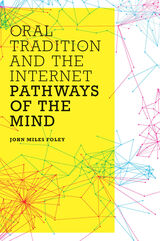
challenging the default medium of the linear book and page and all that they entail, Oral Tradition and the Internet shows readers that there are large, complex, wholly viable, alternative
worlds of media-technology out there--if only they are willing to explore, to think outside the usual, culturally constructed categories. This "brick-and-mortar" book exists as an extension of
The Pathways Project (http://pathwaysproject.org), an open-access online suite of chapter-nodes, linked websites, and multimedia all dedicated to exploring and demonstrating the
dynamic relationship between oral tradition and Internet technology

Out for a Walk offers toddlers their first look at signs for the world around them. As they follow our distinctively hatted youngster on a stroll, they encounter familiar animals and insects, among them a dog, cat, butterfly, and squirrel, and learn which ones can be pets. They’ll enjoy imaginative images of the senses, too—sight, smell, hearing, taste, and touch. Printed on robust cardboard stock, these delightful full-color books will engage toddlers in new topics as they discover more basic signs, proven to accelerate their grasp of language.
READERS
Browse our collection.
PUBLISHERS
See BiblioVault's publisher services.
STUDENT SERVICES
Files for college accessibility offices.
RECENTLY PUBLISHED






UChicago Accessibility Resources
home | accessibility | search | about | contact us
BiblioVault ® 2001 - 2026
The University of Chicago Press