
 A SCHOLARLY BOOK REPOSITORY
6 start with O start with O
From the author of The Missing Course, an essential guide to pedagogy that serves all members of an ever more diverse undergraduate population.
A century ago, a typical US college campus was a sanctuary of privilege, with white men of means constituting nearly the entire student population. Today, half of US undergraduates live at or near the poverty line, and universities are more diverse than ever. But teaching and curricula have not caught up, resulting in stark inequities. Black and Hispanic students graduate at lower rates than their white and Asian counterparts, economically insecure and disabled students face persistent disadvantages, and in STEM disciplines gender imbalances remain the norm.
One Classroom at a Time provides practical, research-based recommendations for teachers and administrators who want to narrow such academic gaps. David Gooblar explains the psychological hardships facing many marginalized students—including stereotype threat and belonging uncertainty—and provides detailed remedies. This wide-ranging guide also offers advice for mitigating burdens of financial insecurity and designing classes that work for all students regardless of disabilities. The emphasis throughout is on helping instructors and administrators understand not just the principles of equitable pedagogy but also the reasoning; not just what works, but why it works.
In the twenty-first century, college courses shouldn’t be built for imaginary students of yesteryear. One Classroom at a Time shows how we can tailor pedagogy to the students of today, so that all of them can secure the education and the success they deserve.

Can a university ever truly be neutral in today’s social and political climate? Pushing against the tide of universities increasingly pledging to stay neutral about contentious issues, law professor Brian Soucek argues that their promises are doomed to fail—universities can’t help being opinionated.
In The Opinionated University, Soucek shows that neutrality is a myth by taking a deep dive into several prominent campus controversies of the day, including diversity, equity, and inclusion (DEI) efforts and restrictions on campus speech and protest. Each issue requires universities to choose a side in what they do, if not also in what they say. In everything from curricular and admissions decisions to their response to outside rankings and their evaluation of faculty, universities express the values at the heart of their mission. Soucek argues that those pushing for neutrality are only preventing universities from standing up for their values, whether in today’s current moment of crisis or in periods of political calm.
Both timely and deeply engaging, The Opinionated University calls on universities to dispense with neutrality as a governing principle and focus instead on what their mission should be, and who should determine it.
For well over one hundred years, people have been attempting to make American colleges and universities more efficient and more accountable. Indeed, Ethan Ris argues in Other People’s Colleges, the reform impulse is baked into American higher education, the result of generations of elite reformers who have called for sweeping changes in the sector and raised existential questions about its sustainability. When that reform is beneficial, offering major rewards for minor changes, colleges and universities know how to assimilate it. When it is hostile, attacking autonomy or values, they know how to resist it. The result is a sector that has learned to accept top-down reform as part of its existence.
In the early twentieth century, the “academic engineers,” a cadre of elite, external reformers from foundations, businesses, and government, worked to reshape and reorganize the vast base of the higher education pyramid. Their reform efforts were largely directed at the lower tiers of higher education, but those efforts fell short, despite the wealth and power of their backers, leaving a legacy of successful resistance that affects every college and university in the United States. Today, another coalition of business leaders, philanthropists, and politicians is again demanding efficiency, accountability, and utility from American higher education. But, as Ris argues, top-down design is not destiny. Drawing on extensive and original archival research, Other People’s Colleges offers an account of higher education that sheds light on today’s reform agenda.
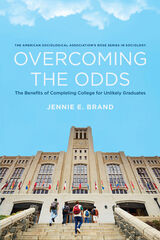
Drawing on two cohorts of nationally representative data from the Bureau of Labor Statistics National Longitudinal Surveys program, Brand uses matching and machine learning methods to estimate the effects of college completion across students with varying likelihoods of completing four-year degrees. To illustrate her findings, Brand describes outcomes using matched vignettes of college and non-college graduates. Brand shows that four-year college completion enables graduates to increase wages and household income, while also circumventing unemployment, low-wage work, job instability, poverty, and social assistance. Completing college also increases civic engagement. Most of these benefits are larger for disadvantaged than for more advantaged students, rendering arguments that college has limited benefits for unlikely graduates as flawed. Brand concludes that greater long-term earnings, and less job instability and unemployment, and thus more tax revenue, less reliance on public assistance, and high levels of volunteering indicate that public investment in higher education for students from disadvantaged backgrounds yields far-reaching collective benefits. She asserts that it is better for our society when more people complete college.
Overcoming the Odds is an innovative and enlightening exploration of how college can transform lives.
READERS
Browse our collection.
PUBLISHERS
See BiblioVault's publisher services.
STUDENT SERVICES
Files for college accessibility offices.
RECENTLY PUBLISHED



UChicago Accessibility Resources
home | accessibility | search | about | contact us
BiblioVault ® 2001 - 2026
The University of Chicago Press