front cover of Of Red Dragons and Evil Spirits
Of Red Dragons and Evil Spirits
Post-Communist Historiography between Democratization and the New Politics of History
Oto Luthar
Central European University Press, 2017
The collection of well-researched essays assesses the uses and misuses of history 25 years after the collapse of Soviet hegemony in Eastern Europe. As opposed to the revival of national histories that seemed to be the prevailing historiographical approach of the 1990s, the last decade has seen a particular set of narratives equating Nazism and Communism. This provides opportunities to exonerate wartime collaboration, casting the nation as victim even when its government was allied with Germany. While the Jewish Holocaust is acknowledged, its meaning and significance are obfuscated. In their comparative analysis the authors are also interested in new practices of ‘Europeanness’. Therefore their presentations of Slovak, Hungarian, Romanian, Bulgarian, Serbian, Bosnian, Croatian and Slovenian post-communist memory politics move beyond the common national myths in order to provide a new insight into transnational interactions and exchanges in Europe in general. The juxtaposition of these politics, the processes in other parts of Europe, the modes of remembering shaped by displacement and the transnational enable a close encounter with the divergences and assess the potential of the formation of common, European memory practices.
[more]

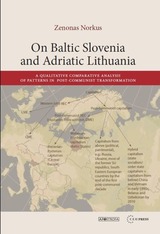
front cover of On Baltic Slovenia and Adriatic Lithuania
On Baltic Slovenia and Adriatic Lithuania
A Qualitative Comparative Analysis of Patterns in Post-Communist Transformation
Zenonas Norkus
Central European University Press, 2012
A unique application of social science software to generate typology and ranklist of transition models of twenty-nine countries in Europe and Asia, ranging from Estonia to Vietnam, Norkus provides a highly innovative internationally comparative causal analysis of the variation in political and economic outcomes after the first decade of post-communist transformations, using multi-value Qualitative Comparative Analysis and Tosmana programme. The analysis includes a critical revision of received dichotomies (e.g. on gradualism versus “shock therapy”), and contributes to current debates on the varieties of post-communist capitalism.This conceptual framework is applied in national case studies, searching for reasons behind successes and failures, with special consideration given to the possibility of alternatives to the Lithuanian way, and the challenges of populism in this country’s politics.
[more]

front cover of On the East-West Slope
On the East-West Slope
Globalization, Nationalism, Racism and Discourses on Eastern Europe
Attila Melegh
Central European University Press, 2006
Melegh's work offers a powerful analysis of the sociological and symbolic meanings of East-West in Europe after the end of the Cold War. Melegh exposes the underbelly of liberal characterizations of East-West, highlighting the polarizing effect of extreme nationalism and ethnic racism. The theoretical underpinnings of this work involve the ideas of preeminent theorists such as Karl Mannheim, Michel Foucault and more recently Maria Todorova and Iver Neumann. The importance of this work lies in its ability to cast into fine relief how the "East-West Slope" oriented negatively from West to East has emerged from liberal characterizations of this project. In addition this is one of the first attempts to link post-colonial analysis to developments in Eastern Europe.
[more]

front cover of On The Edge
On The Edge
Ukrainian - Central European - Russian Security Triangle
Margarita M. Balmaceda
Central European University Press, 2001

A new globally significant relationship arising after the break-up of the Soviet Union is the main topic of this unparalleled volume – the geopolitical link between Russia, Ukraine and the three bordering ‘Central European’ states, Hungary, Poland and Slovakia. On the Edge is a path-breaking analysis of this triangular relationship with an in-depth focus on economic, political and, more importantly, security issues.


The expansion of NATO up to Ukraine’s borders is likely to leave Ukraine in a delicate position vis-à-vis Russia. On the Edge addresses key questions, such as: how are events in Ukraine affecting the security calculations of the Central European states; Central European relations with Russia and NATO; and relations among Central European states themselves? The volume examines what Central European states can do to solidify Ukraine’s independence and help it avoid international isolation.


On the Edge gives a Central European perspective on all these issues and suggests concrete forms of co-operation.
[more]

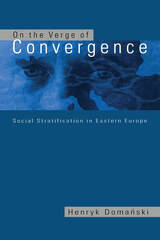
front cover of On the Verge of Convergence
On the Verge of Convergence
Social Stratification in Eastern Europe
Henryk Domanski
Central European University Press, 2000
Based on comparative surveys, the author presents a study of social transformation in Central and Eastern Europe after 1989. Focusing on Bulgaria, Czech Republic, Hungary, Poland, Russia and Slovakia, the author provides information relating to social structure, mobility, inequality, lifestyle and economic stratification. Applying the Erikson-Goldthorpe classification of class positions, Domanski effectively presents fully comparable data to enable political comparisons to be made with other countries, especially those with firmly established free market economies. As such, "On the Verge of Convergence" seeks to provide a clearer understanding of the on-going process of social transformation within developing capitalist societies.
[more]

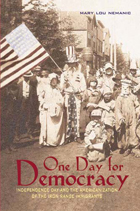
front cover of One Day for Democracy
One Day for Democracy
Independence Day and the Americanization of Iron Range Immigrants
Mary Lou Nemanic
Ohio University Press, 2007
Just before the turn of the twentieth century, immigrants from eastern and southern Europe who had settled in mining regions of Minnesota formed a subculture that combined elements of Old World traditions and American culture. Their unique pluralistic version of Americanism was expressed in Fourth of July celebrations rooted in European carnival traditions that included rough games, cross-dressing, and rowdiness.In One Day for Democracy, Mary Lou Nemanic traces the festive history of Independence Day from 1776 to the twentieth century. The author shows howthese diverse immigrant groups on the Minnesota Iron Range created their own version of the celebration, the Iron Range Fourth of July.As mass-mediated popular culture emerged in the twentieth century, Fourth of July celebrations in the Iron Range began to include such popular cultureelements as beauty queens and marching bands. Nemanic documents the enormous influence of these changes on this isolated region and highlights the complex interplay between popular culture and identity construction.But this is not a typical story of assimilation or ethnic separation. Instead, One Day for Democracy reveals how more than thirty different ethnic groupswho shared identities as both workers and new Americans came together in a remote mining region to create their own subculture.
[more]


Send via email Share on Facebook Share on Twitter