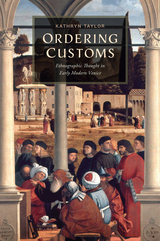
front cover of Ordering Customs
Ordering Customs
Ethnographic Thought in Early Modern Venice
Kathryn Taylor
University of Delaware Press, 2023
Ordering Customs explores how Renaissance Venetians sought to make sense of human difference in a period characterized by increasing global contact and a rapid acceleration of the circulation of information. Venice was at the center of both these developments. The book traces the emergence of a distinctive tradition of ethnographic writing that served as the basis for defining religious and cultural difference in new ways. Taylor draws on a trove of unpublished sources—diplomatic correspondence, court records, diaries, and inventories—to show that the study of customs, rituals, and ways of life not only became central in how Venetians sought to apprehend other peoples, but also had a very real impact at the level of policy, shaping how the Venetian state governed minority populations in the city and its empire. In contrast with the familiar image of ethnography as the product of overseas imperial and missionary encounters, the book points to a more complicated set of origins. 

 
[more]

front cover of The Other Renaissance
The Other Renaissance
Italian Humanism between Hegel and Heidegger
Rocco Rubini
University of Chicago Press, 2014
A natural heir of the Renaissance and once tightly conjoined to its study, continental philosophy broke from Renaissance studies around the time of World War II. In The Other Renaissance, Rocco Rubini achieves what many have attempted to do since: bring them back together. Telling the story of modern Italian philosophy through the lens of Renaissance scholarship, he recovers a strand of philosophic history that sought to reactivate the humanist ideals of the Renaissance, even as philosophy elsewhere progressed toward decidedly antihumanist sentiments.
           
Bookended by Giambattista Vico and Antonio Gramsci, this strand of Renaissance-influenced philosophy rose in reaction to the major revolutions of the time in Italy, such as national unity, fascism, and democracy. Exploring the ways its thinkers critically assimilated the thought of their northern counterparts, Rubini uncovers new possibilities in our intellectual history: that antihumanism could have been forestalled, and that our postmodern condition could have been entirely different. In doing so, he offers an important new way of thinking about the origins of modernity, one that renews a trust in human dignity and the Western legacy as a whole.

[more]


Send via email Share on Facebook Share on Twitter