
 A SCHOLARLY BOOK REPOSITORY
101 books about Naval and 2
start with O
101 books about Naval and 2
101 books about Naval
2 start with O start with O
2 start with O start with O
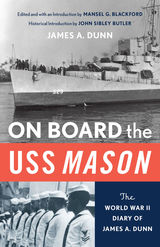
ON BOARD THE USS MASON
THE WORLD WAR II DIARY OF JAMES A. DUNN
MANSEL G. BLACKFORD
The Ohio State University Press, 2016
James A. Dunn was a signalman on the USS Mason, a destroyer escort during World War II, the only oceangoing warship in the navy to employ African Americans in positions other than cook or messmate. Manned by African American seamen (and commanded by white officers), the ship made ten crossings of the Atlantic from 1944 to 1945, escorting convoys of merchant ships to and from the United Kingdom and North Africa and operating in hunter-killer groups searching for German submarines.
Dunn kept a day-to-day diary during his spare time on board the Mason. Such diaries are a rarity, for the navy (and other armed services) forbade the keeping of diaries, fearful lest secret information fall into enemy hands. The diary chronicles the Mason’s wartime activities, from the first convoy to the final return to the United States. It captures the feeling and meaning of life on board with an immediacy not fully found in retrospective accounts. The diary accurately records the mortal danger Dunn and his shipmates were in while attacking enemy submarines or dealing with extreme weather conditions in the North Atlantic. It conveys the boredom the men encountered while confined on long, tedious convoys and the joy of shore leaves. Here is the daily life aboard ship—the duties and the pastimes that made shipboard life endurable.
Equally interesting, the diary reveals what it meant to be an African American in a white navy within a segregated American society, the shipboard tensions, and the shipboard cooperation and sense of unity. It also portrays the life of an African American onshore in the United States, Great Britain, and North Africa and the love story that unfolded between James and his wife, Jane.
Supplemented by additional sources, including interviews with Dunn, this diary is a personal view into an important part of American history. Like the Tuskegee airmen, the men of the USS Mason paved the way for desegregation in America’s armed forces, contributing to a civil rights movement that changed the face of a nation.
Dunn kept a day-to-day diary during his spare time on board the Mason. Such diaries are a rarity, for the navy (and other armed services) forbade the keeping of diaries, fearful lest secret information fall into enemy hands. The diary chronicles the Mason’s wartime activities, from the first convoy to the final return to the United States. It captures the feeling and meaning of life on board with an immediacy not fully found in retrospective accounts. The diary accurately records the mortal danger Dunn and his shipmates were in while attacking enemy submarines or dealing with extreme weather conditions in the North Atlantic. It conveys the boredom the men encountered while confined on long, tedious convoys and the joy of shore leaves. Here is the daily life aboard ship—the duties and the pastimes that made shipboard life endurable.
Equally interesting, the diary reveals what it meant to be an African American in a white navy within a segregated American society, the shipboard tensions, and the shipboard cooperation and sense of unity. It also portrays the life of an African American onshore in the United States, Great Britain, and North Africa and the love story that unfolded between James and his wife, Jane.
Supplemented by additional sources, including interviews with Dunn, this diary is a personal view into an important part of American history. Like the Tuskegee airmen, the men of the USS Mason paved the way for desegregation in America’s armed forces, contributing to a civil rights movement that changed the face of a nation.
[more]

On Wide Seas
The US Navy in the Jacksonian Era
Claude Berube
University of Alabama Press, 2022
A meticulously researched account of how the US Navy evolved between the War of 1812 and the Civil War
The 1830s is an overlooked period in American naval history and is usually overshadowed by the more dramatic War of 1812 and the Civil War. Nevertheless, the personnel, operations, technologies, policies, and vision of the Navy of that era, which was emerging from the “Age of Sail,” are important components of its evolution, setting it on the long path to its status as a global maritime power. On Wide Seas: The US Navy in the Jacksonian Era details the ways in which the US Navy transformed from an antiquated arm of the nation’s military infrastructure into a more dynamic and effective force that was soon to play a pivotal role in a number of national and international conflicts.
By Andrew Jackson’s inauguration in 1829, the Navy had engaged with two major powers, defended American shipping, conducted antipiracy operations, and provided a substantive, long-term overseas presence. The Navy began to transform during Jackson’s administration due in part to the policies of the administration and to the emerging officer corps, which sought to professionalize its own ranks, modernize the platforms on which it sailed, and define its own role within national affairs and in the broader global maritime commons. Jackson had built his reputation as a soldier, but he quickly recognized as president the necessity for a navy that could foster his policies. To expand American commerce, he needed a navy that could defend shipping as well as conduct punitive raids or deterrence missions.
Jackson developed a clear, concise naval strategy that policymakers and officers alike could seize and execute. He also provided a vision for the Navy, interceded to resolve naval disciplinary challenges, and directed naval operations. Also, given Jackson’s own politics, junior officers were emboldened by the populist era to challenge traditional, conservative thinking. They carried out a collective vision that coincided with the national literary movement that recognized America’s future would rely upon the Navy.
The 1830s is an overlooked period in American naval history and is usually overshadowed by the more dramatic War of 1812 and the Civil War. Nevertheless, the personnel, operations, technologies, policies, and vision of the Navy of that era, which was emerging from the “Age of Sail,” are important components of its evolution, setting it on the long path to its status as a global maritime power. On Wide Seas: The US Navy in the Jacksonian Era details the ways in which the US Navy transformed from an antiquated arm of the nation’s military infrastructure into a more dynamic and effective force that was soon to play a pivotal role in a number of national and international conflicts.
By Andrew Jackson’s inauguration in 1829, the Navy had engaged with two major powers, defended American shipping, conducted antipiracy operations, and provided a substantive, long-term overseas presence. The Navy began to transform during Jackson’s administration due in part to the policies of the administration and to the emerging officer corps, which sought to professionalize its own ranks, modernize the platforms on which it sailed, and define its own role within national affairs and in the broader global maritime commons. Jackson had built his reputation as a soldier, but he quickly recognized as president the necessity for a navy that could foster his policies. To expand American commerce, he needed a navy that could defend shipping as well as conduct punitive raids or deterrence missions.
Jackson developed a clear, concise naval strategy that policymakers and officers alike could seize and execute. He also provided a vision for the Navy, interceded to resolve naval disciplinary challenges, and directed naval operations. Also, given Jackson’s own politics, junior officers were emboldened by the populist era to challenge traditional, conservative thinking. They carried out a collective vision that coincided with the national literary movement that recognized America’s future would rely upon the Navy.
[more]
READERS
Browse our collection.
PUBLISHERS
See BiblioVault's publisher services.
STUDENT SERVICES
Files for college accessibility offices.
RECENTLY PUBLISHED







UChicago Accessibility Resources
home | accessibility | search | about | contact us
BiblioVault ® 2001 - 2025
The University of Chicago Press