logo for Duke University Press
Oeconomies in the Age of Newton
2003 Supplement, Volume 35
Margaret Schabas and Neil De Marchi
Duke University Press
While the history of early modern science is well-charted terrain, less has been recorded on the economic thinking of the same period and less still on the intersection of these fields. Addressing this gap in scholarship, Oeconomies in the Age of Newton offers a detailed account of economic concepts of the seventeenth and eighteenth centuries. The volume focuses on “oeconomics”—as “economics” was spelled at that time—which implies a view of economics as shaped by the Greek concept of the household. Examining a range of “oeconomic” curiosities, Oeconomies in the Age of Newton provides intriguing insights into a historical conceptualization of economic relations that differs markedly from the more narrowly defined economics of today.
[more]

front cover of On the East-West Slope
On the East-West Slope
Globalization, Nationalism, Racism and Discourses on Eastern Europe
Attila Melegh
Central European University Press, 2006
Melegh's work offers a powerful analysis of the sociological and symbolic meanings of East-West in Europe after the end of the Cold War. Melegh exposes the underbelly of liberal characterizations of East-West, highlighting the polarizing effect of extreme nationalism and ethnic racism. The theoretical underpinnings of this work involve the ideas of preeminent theorists such as Karl Mannheim, Michel Foucault and more recently Maria Todorova and Iver Neumann. The importance of this work lies in its ability to cast into fine relief how the "East-West Slope" oriented negatively from West to East has emerged from liberal characterizations of this project. In addition this is one of the first attempts to link post-colonial analysis to developments in Eastern Europe.
[more]

front cover of On the Rural
On the Rural
Economy, Sociology, Geography
Henri Lefebvre
University of Minnesota Press, 2022

A collection of previously untranslated writings by Henri Lefebvre on rural sociology, situating his research in relation to wider Marxist work

On the Rural is the first English collection to translate Lefebvre’s crucial but lesser-known writings on rural sociology and political economy, presenting a wide-ranging approach to understanding the historical and rural sociology of precapitalist social forms, their endurance today, and conditions of dispossession and uneven development.  

In On the Rural, Stuart Elden and Adam David Morton present Lefebvre’s key works on rural questions, including the first half of his book Du rural à l’urbain and supplementary texts, two of which are largely unknown conference presentations published outside France. On the Rural offers methodological orientations for addressing questions of economy, sociology, and geography by deploying insights from spatial political economy to decipher the rural as a terrain and stake of capitalist transformation. By doing so, it reveals the production of the rural as a key site of capitalist development and as a space of struggle. 

This volume delivers a careful translation—supplemented with extensive notes and a substantive introduction—to cement Lefebvre’s central contribution to the political economy of rural sociology and geography. 

[more]

front cover of One Belt One Road
One Belt One Road
Chinese Power Meets the World
Eyck Freymann
Harvard University Press, 2021

In 2013, Chinese leader Xi Jinping announced a campaign for national rejuvenation. The One Belt One Road initiative, or OBOR, has become the largest infrastructure program in history. Nearly every Chinese province, city, major business, bank, and university have been mobilized to serve it, spending hundreds of billions of dollars overseas building ports and railroads, laying fiber cables, and launching satellites. Using a trove of Chinese sources, author Eyck Freymann argues these infrastructure projects are a sideshow. OBOR is primarily a campaign to restore an ancient model in which foreign emissaries paid tribute to the Chinese emperor, offering gifts in exchange for political patronage. Xi sees himself as a sort of modern-day emperor, determined to restore China’s past greatness.

Many experts assume that Xi’s nakedly neo-imperial scheme couldn’t possibly work. Freymann shows how wrong they are. China isn’t preying on victims, Freymann argues. It’s attracting willing partners—including Western allies—from Latin America to Southeast Asia to the Persian Gulf. Even in countries where OBOR megaprojects fail, Freymann finds that political leaders still want closer ties with China.

Freymann tells the monumental story of Xi’s project on the global stage. Drawing on primary documents in five languages, interviews with senior officials, and on-the-ground case studies from Malaysia to Greece, Russia to Iran, Freymann pulls back the veil of propaganda about OBOR, giving readers a page-turning world tour of the burgeoning Chinese empire, a guide for understanding China’s motives and tactics, and clear recommendations for how the West can compete.
[more]

front cover of Open Marxism 4
Open Marxism 4
Against a Closing World
Ana Cecilia Dinerstein
Pluto Press, 2019
The publication of the first three volumes of Open Marxism in the 1990s has had a transformative impact on how we think about Marxism in the twenty-first century. 'Open Marxism' aims to think of Marxism as a theory of struggle, not as an objective analysis of capitalist domination, arguing that money, capital and the state are forms of struggle from above and therefore open to resistance and rebellion. As critical thought is squeezed out of universities and geographical shifts shape the terrain of theoretical discussion, the editors argue now is the time for a new volume that reflects the work that has been carried out during the past decade. Emphasising the contemporary relevance of 'open Marxism' in our moment of political and economic uncertainty, the collection shines a light on its significance for activists and academics today.
[more]

front cover of Open Marxism 4
Open Marxism 4
Against a Closing World
Ana Cecilia Dinerstein
Pluto Press, 2019
The publication of the first three volumes of Open Marxism in the 1990s has had a transformative impact on how we think about Marxism in the twenty-first century. 'Open Marxism' aims to think of Marxism as a theory of struggle, not as an objective analysis of capitalist domination, arguing that money, capital and the state are forms of struggle from above and therefore open to resistance and rebellion. As critical thought is squeezed out of universities and geographical shifts shape the terrain of theoretical discussion, the editors argue now is the time for a new volume that reflects the work that has been carried out during the past decade. Emphasising the contemporary relevance of 'open Marxism' in our moment of political and economic uncertainty, the collection shines a light on its significance for activists and academics today.
[more]

front cover of Opposition by Imitation
Opposition by Imitation
The Economics of Italian Anti-Mafia Activism
Christina Jerne
University of Minnesota Press, 2025

Defying the mafia with everyday acts of resistance


For more than 150 years, Italy has been home to a resilient and evolving resistance against the pervasive influence of mafias. While these criminal organizations are renowned for their vast international business enterprises, the collective actions taken to oppose them are less known. In Opposition by Imitation, Christina Jerne explores anti-mafia activism, revealing how ordinary people resist, counter, and prevent criminal economies from proliferating.


Drawing on ethnographic fieldwork among anti-mafia alliances in Campania, Sicily, and other parts of Italy, Jerne details a particular aspect of mafia activities: providing cash relief and other forms of patronage to individuals and groups. Her research shows how activism has evolved to imitate this sustaining role. Activists are increasingly challenging mafia control both by creating alternative economies—from producing food that interrupts mafia labor practices to organizing tourism that supports anti-mafia hospitality—and by subversively adopting business tactics similar to the mafia’s to compete with their social influence and legitimacy. Exposing the political implications of this mimetic opposition, Jerne points to its potential impact on crime prevention and criminalization, both in Italy and globally.


Opposition by Imitation shows how these modern-day Robin Hoods are redefining collective action, taking what was controlled by the mafias and returning it to the collective. This contentious economic turn, against the backdrop of broader social movements, reveals significant political possibilities afforded by imitative opposition.


Retail e-book files for this title are screen-reader friendly with images accompanied by short alt text and/or extended descriptions.

[more]

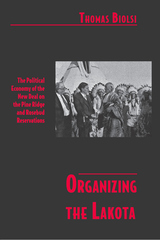
front cover of Organizing the Lakota
Organizing the Lakota
The Political Economy of the New Deal on the Pine Ridge and Rosebud Reservations
Thomas Biolsi
University of Arizona Press, 1992
In 1933 the United States Office of Indian Affairs began a major reform of Indian policy, organizing tribal governments under the provisions of the Indian Reorganization Act and turning over the administration of reservations to these new bodies. Organizing the Lakota considers the implementation of this act among the Lakota (Western Sioux or Teton Dakota) from 1933 through 1945.

Biolsi pays particular attention to the administrative means by which the OIA retained the power to design and implement tribal "self-government" as well as the power to control the flow of critical resources—rations, relief employment, credit—to the reservations. He also shows how this imbalance of power between the tribes and the federal bureaucracy influenced politics on the reservations, and argues that the crisis of authority faced by the Lakota tribal governments among their own would-be constituents—most dramatically demonstrated by the 1973 Wounded Knee occupation—is a direct result of their disempowerment by the United States.
[more]

logo for Pluto Press
Overripe Economy
American Capitalism and the Crisis of Democracy
Alan Nasser
Pluto Press, 2018
Capitalism is in crisis. Overripe Economy uses a historical view to explain how we got here and why. Taking readers through the history of American capitalism--from the ruthless competition of the nineteenth century to the maturation of industrial capitalism in the early part of the twentieth and on into today’s finance-ridden decline--Alan Nasser lays out here in damning detail why the persistent austerity of financialized capitalism is the inevitable outcome of the evolution of the American economy. Capitalism, he argues, ultimately presents us with two alternatives: persistent austerity, declining democracy, and a privatized state, or a polity and economy characterized by genuine economic democracy.
[more]


Send via email Share on Facebook Share on Twitter