
 A SCHOLARLY BOOK REPOSITORY
11 start with O start with O
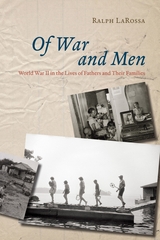
Fathers in the fifties tend to be portrayed as wise and genial pipe-smokers or distant, emotionless patriarchs. This common but limited stereotype obscures the remarkable diversity of their experiences and those of their children. To uncover the real story of fatherhood during this transformative era, Ralph LaRossa takes the long view—from the attack on Pearl Harbor up to the election of John F. Kennedy—revealing the myriad ways that World War II and its aftermath shaped men.
Offering compelling accounts of people both ordinary and extraordinary, Of War and Men digs deep into the terrain of fatherhood. LaRossa explores the nature and aftereffects of combat, the culture of fear during the Cold War, the ways that fear altered the lives of racial and sexual minorities, and how the civil rights movement affected families both black and white. Overturning some calcified myths, LaRossa also analyzes the impact of suburbanization on fathers and their kids, discovering that living in the suburbs often strengthened their bond. And finally, looking beyond the idealized dad enshrined in TV sitcoms, Of War and Men explores the brutal side of family life in the postwar years. LaRossa’s richly researched book dismantles stereotypes while offering up a fascinating and incisive chronicle of fatherhood in all its complexity.

A comprehensive challenge to prevailing understanding of international implications of oil wealth that shows why it can create bad actors
In a world where oil-rich states are more likely to start war than their oil-dependent counterparts, it’s surprising how little attention is still paid to these so-called petrostates. These states’ wealth props up the global arms trade, provides diplomatic leverage, and allows them to support violent and nonviolent proxies. In Oil, the State, and War, Emma Ashford explores the many potential links between domestic oil production and foreign policy behavior and how oil production influences global politics.
Not all petrostates have the same characteristics or capabilities. To help us conceptualize these differences, Ashford creates an original classification of three types of petrostates: oil-dependent states (those weakened by the resource curse), oil-wealthy states (those made rich by oil exports), and super-producer states (those that form the backbone of the global oil market). Through a combination of case studies and analysis, she illustrates how oil shapes petrostates’ behavior, filling a major gap in our understanding of the international implications of oil wealth. Experts have too often treated oil-rich states as passive objects, subject to the energy security needs of Western importing states. Instead, this book highlights the agency and power enjoyed by petrostates.
As the oil market undergoes a period of rapid change, Oil, the State, and War sheds light on the diversity of petrostates and how they shape international affairs.

In 2014 Sonya Bilocerkowycz is a tourist at a deadly revolution. At first she is enamored with the Ukrainians’ idealism, which reminds her of her own patriotic family. But when the romantic revolution melts into a war with Russia, she becomes disillusioned, prompting a return home to the US and the diaspora community that raised her. As the daughter of a man who studies Ukrainian dissidents for a living, the granddaughter of war refugees, and the great-granddaughter of a gulag victim, Bilocerkowycz has inherited a legacy of political oppression. But what does it mean when she discovers a missing page from her family’s survival story—one that raises questions about her own guilt?
In these linked essays, Bilocerkowycz invites readers to meet a swirling cast of post-Soviet characters, including a Russian intelligence officer who finds Osama bin Laden a few weeks after 9/11; a Ukrainian poet whose nose gets broken by Russian separatists; and a long-lost relative who drives a bus into the heart of Chernobyl. On Our Way Home from the Revolution muddles our easy distinctions between innocence and culpability, agency and fate.
Samuel Hynes knows war personally: he served as a Marine Corps pilot in the Pacific Theater during World War II, receiving the Distinguished Flying Cross. He has spent his life balancing two careers: pilot and professor of literature. Hynes has written a number of major works of literary criticism, as well as a war-memoir, Flights of Passage, and several books about the World Wars. His writing is sharp, lucid, and has provided some of the most expert, detailed, and empathetic accounts of a disappearing generation of fighters and writers.
On War and Writing offers for the first time a selection of Hynes’s essays and introductions that explore the traditions of war writing from the twentieth century to the present. Hynes takes as a given that war itself—the battlefield uproar of actual combat—is unimaginable for those who weren’t there, yet we have never been able to turn away from it. We want to know what war is really like: for a soldier on the Somme; a submariner in the Pacific; a bomber pilot over Germany; a tank commander in the Libyan desert. To learn, we turn again and again to the memories of those who were there, and to the imaginations of those who weren’t, but are poets, or filmmakers, or painters, who give us a sense of these experiences that we can’t possibly know.
The essays in this book range from the personal (Hynes’s experience working with documentary master Ken Burns, his recollections of his own days as a combat pilot) to the critical (explorations of the works of writers and artists such as Thomas Hardy, E. E. Cummings, and Cecil Day-Lewis). What we ultimately see in On War and Writing is not military history, not the plans of generals, but the feelings of war, as young men expressed them in journals and poems, and old men remembered them in later years—men like Samuel Hynes.

In the spring of 1846 James K. Polk announced that the Mexican Army had invaded United States territory and had “shed American blood upon the American soil.” This political rhetoric, as Glenn W. Price establishes in Origins of the War with Mexico: The Polk-Stockton Intrigue, is part of the myth of American innocence. It represents the “internal contradiction between professed values and patterns of action,” perpetuated by American historical writing that emphasizes national consequences of the acquisition of foreign territory and minimizes both its international significance and the importance of the diplomatic and military methods used.
A conflict with Mexico, leading to territorial expansion of the United States, was not unwanted. California was Polk’s prime objective from the beginning of his administration, and this Mexican province was to be acquired by conquest in a war initiated on the Texas-Mexican border. To this end Polk sent several agents to Texas, but the man at the center of the war intrigue was Commodore Robert F. Stockton, independently wealthy, prominent in politics, and the head of great business enterprises.
Sufficient evidence exists to substantiate in every important particular the steps in Polk’s path of intrigue: his attempts to bribe Mexican officials; his efforts to encourage revolutionary forces in the Mexican provinces; his use of the threat of force to frighten Mexico into selling California; his attempt to initiate a war by proxy through the government of Texas and Anson Jones.
If Polk was unwilling to assume responsibility for aggressive war, Stockton was not; he arrived in Galveston with a squadron of naval vessels in May of 1845, prepared to finance an army of three thousand men from his personal funds to avoid the overt involvement of the government of the United States. But, says Price, for all the internationally dangerous implications of such a maneuver, the two men who played the chief roles in the war intrigue of 1845 are representative in their written and spoken expression of faith in American righteousness of action and in the American tradition of the divine mission.
Based on extensive research into the written and spoken words of the people who were involved, directly and indirectly, in the events, this analysis (which will be considered revisionist) of the origins of the War with Mexico is the result of the kind of objective approach to national history for which the author makes a plea in his preface and conclusion and in his interpretive comments throughout the work. The historian, Price believes, “has the extraordinary advantage of being able to examine mankind from that distance and elevation and detachment which so often reveals, as it is designed to reveal, the gulf between pretension and performance.”
Debate rages within the Catholic Church about the ethics of war and peace, but the simple question of why wars begin is too often neglected. Catholics’ assumptions about the causes of conflict are almost always drawn uncritically from international relations theory—a field dominated by liberalism, realism, and Marxism—which is not always consistent with Catholic theology.
In The Origins of War, Matthew A. Shadle examines several sources to better understand why war happens. His retrieval of biblical literature and the teachings of figures from church tradition sets the course for the book. Shadle then explores the growing awareness of historical consciousness within the Catholic tradition—the way beliefs and actions are shaped by time, place, and culture. He examines the work of contemporary Catholic thinkers like Pope John Paul II, Jacques Maritain, John Courtney Murray, Dorothy Day, Brian Hehir, and George Weigel. In the constructive part of the book, Shadle analyzes the movement within international relations theory known as constructivism—which proposes that war is largely governed by a set of socially constructed and cultural influences. Constructivism, Shadle claims, presents a way of interpreting international politics that is highly amenable to a Catholic worldview and can provide a new direction for the Christian vocation of peacemaking.
from "Ozone Journal"
Bach’s cantata in B-flat minor in the cassette,
we lounged under the greenhouse-sky, the UVBs hacking
at the acids and oxides and then I could hear the difference
between an oboe and a bassoon
at the river’s edge under cover—
trees breathed in our respiration;
there was something on the other side of the river,
something both of us were itching toward—
radical bonds were broken, history became science.
We were never the same.
The title poem of Peter Balakian's Ozone Journal is a sequence of fifty-four short sections, each a poem in itself, recounting the speaker's memory of excavating the bones of Armenian genocide victims in the Syrian desert with a crew of television journalists in 2009. These memories spark others—the dissolution of his marriage, his life as a young single parent in Manhattan in the nineties, visits and conversations with a cousin dying of AIDS—creating a montage that has the feel of history as lived experience. Bookending this sequence are shorter lyrics that span times and locations, from Nairobi to the Native American villages of New Mexico. In the dynamic, sensual language of these poems, we are reminded that the history of atrocity, trauma, and forgetting is both global and ancient; but we are reminded, too, of the beauty and richness of culture and the resilience of love.
READERS
Browse our collection.
PUBLISHERS
See BiblioVault's publisher services.
STUDENT SERVICES
Files for college accessibility offices.
RECENTLY PUBLISHED


UChicago Accessibility Resources
home | accessibility | search | about | contact us
BiblioVault ® 2001 - 2026
The University of Chicago Press