logo for Tupelo Press
The Pact
Jennifer Militello
Tupelo Press, 2021
In her newest collection, award-winning poet and memoirist Jennifer Militello confronts obsession, intimacy, and abuse. Through love poems inspired by such disparate spaces as a British art museum and the reptile house of a local zoo, poems comparing a romantic affair to the religious cult at Jonestown and a mother’s role to a Congolese power figure bristling with nails, The Pact offers an indictment against affection and a portent against zeal. This book places pleasure alongside pain, even as it delivers Militello’s trademark talent for innovation and ritualization of the strange.
[more]

logo for Tupelo Press
The Perfect Life
Lyric Essays
Peter Stitt
Tupelo Press, 2013
Poet and essayist Peter Stitt describes not a perfect life achieved, but his search for that ideal, writing of books he has loved and of the often difficult lives of writers, including his teachers John Berryman and James Wright. Generous and alert in his fascinations, Stitt explores the quest for freedom in thought and action among the Amish, the French partisans, and the “heretical” Cathars, and he offers a fresh perspective on parenting, meditating on the life of an adopted stepdaughter.
[more]

front cover of Perishable
Perishable
Stelios Mormoris
Tupelo Press, 2025
Poems exploring the relationship between joy and elegy.

In Perishable, Stelios Mormoris asks incisive questions about the nature of human connection: Where does memory live—in the body, in the mind, or elsewhere? What happens when the objects that surround us—a wedding ring, an empty purse, a harp—reveal necessary truths about ourselves and those we love? As the book unfolds, lush sensory details and unmatched lyricism are brought to bear on these lingering concerns in a style as neoclassical as it is contemporary. In poems that radiate with intelligence, Mormoris combines understated elegance with finely tuned music and evocative imagery.
[more]

logo for Tupelo Press
Personal Science
Lillian-Yvonne Bertram
Tupelo Press, 2017
What happens when the imagined life and the stories we tell ourselves become terrifying, given our human ability to inhabit both mental and physical worlds? Bertram’s third full-length collection pivots on an extended piece of creative nonfiction, “Forecast,” which shows how obsessive thinking can begin in actual occurrences that are then exploded in the imagination. The science is personal, as the factual is tinted and stylized, filtered through a self grappling with the difficulty of knowing what is “real.”
[more]

front cover of Phantom Number
Phantom Number
An Abecedarium for April
Spring Ulmer
Tupelo Press, 2025
Poems that ask an urgent question:  how might a white friend write in protest of intimate Black death without becoming complicit in the commodification of Black trauma? 

Phantom Number listens for an absent voice. To survive and answer to her best friend and fellow poet April Freely’s death, Spring Ulmer rips meaning apart in her poems, then repairs it, only to rip it up again. Words bend, meaning shifts—abstraction a tool Ulmer wields to better get at the question at the heart of Phantom Number: How might a white friend write in protest of intimate Black death at a time when the push is to write Black joy as antidote to the commodification of Black trauma? Ulmer understands her position is suspect yet cannot shirk her love or rage. Ulmer asks the reader to do the work or else. Her abstracted poems vibrate, emotion emerging from a poem made rag. Ulmer’s abecedarium long form holds these fragments, inviting lines into an order of alliteration and words into an otherwise coherence, a belonging that has nothing to do with their origin. Phantom Number finds in abstraction a radical wail.
[more]

logo for Tupelo Press
Phyla of Joy
Karen An-hwei Lee
Tupelo Press, 2012
“Karen An-hwei Lee’s third book is a beautiful and sustained meditation on the impermanence of humanity’s essential components: memory, spirituality, emotion, thought….Contemplative and linguistically sophisticated,Phyla of Joy is simply exquisite —‘ink and stanza / flow like wind on grass.’” — Rigoberto González

There’s an undeniable audacity in a poet using the word “joy” in our beleaguered world. In her new book, Karen An-hwei Lee combines scientific precision and an appetite for far-flung vocabularies with a fascination for the sources of rapturous emotion.

In poems that roam from the intimacy of prayer to the art of brewing tea, from bamboo-related famine to quasars, the globe’s minor seas, and the nuptial flight of ants, Phyla of Joy reaches toward ecstasy.
[more]

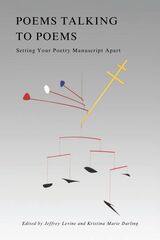
front cover of Poems Talking to Poems
Poems Talking to Poems
Setting Your Poetry Manuscript Apart
Edited by Jeffrey Levine and Kristina Marie Darling
Tupelo Press, 2025
This handbook demystifies the process of crafting a full-length poetry collection. 

Poems Talking to Poems presents practical guidance for sequencing, structure and architecture, revision, and choosing titles for sections as well as the poetry manuscript as a whole. This guide also includes insider tips about how contests work, the literary marketplace, and how you can set your work apart. 

With essays by such literary luminaries as Ilya Kaminsky, Katie Farris, Kristina Marie Darling, Jeffrey Levine, and many other distinguished contributors, this anthology is a concise and comprehensive field guide to perfecting your book and getting it into print.
 
[more]

logo for Tupelo Press
The Posthumous Affair
James Friel
Tupelo Press, 2012
In the late nineteenth century, in Washington Square, two children play with a red balloon… and so begins the strange romance between Daniel, beautiful and tiny, and Grace, known as The Fat Princess, an orphaned girl whose enormous girth matches her wealth. Each wishes for a life of the mind, for artistic mastery, to be read and to be understood — most of all by each other — but through their lives, the couple only occasionally meet, until Daniel uncovers Grace’s great secret in her House of Death.
[more]

logo for Tupelo Press
Poverty Creek Journal
Thomas Gardner
Tupelo Press, 2014
That rush in between when it all comes undone. Knowing its edge like your own pulse and breathing. As I knew them this morning, racing a 10K in late-spring heat, the taste of panic in the last two miles as everything slipped away, losing time and barely finishing. A tingling in my limbs as if I were driving on ice, the road beneath me suddenly gone, the feeling of that in my hands. Deeper than words, being lost for a moment and then being done. Left with a pounding, stiff-legged stagger. Spiritual improvisations, radiant acts of attention: echoing Thoreau's Walden, the meditations of Guy Davenport, and Kenny Moore's groundbreaking articles for Sports Illustrated, Thomas Gardner strides through inner and outer landscapes. Freed by disciplined effort, the runner's mind here roams and mourns and remembers.
[more]

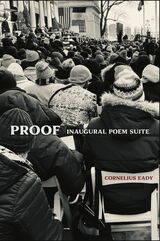
front cover of Proof
Proof
Inaugural Poem Suite
Cornelius Eady
Tupelo Press, 2026

Cornelius Eady turns the inaugural poem into an instrument of reckoning.

First delivered to mark the historic inauguration of New York City’s mayor Zohran Mamdani on January 1, 2026, the title poem is not ceremony—it is summons. “You have to imagine it,” Eady insists, and from that insistence rises a chorus: those called too dark, too queer, too poor, too loud; those renamed invisible; those told “not now.” What if joy could wear down the rock of no? What if imagination were not escape, but evidence?

Moving from Robert Frost squinting into winter glare, to Elizabeth Alexander straightening her back before history, to Aretha Franklin beneath her church-crown hat, Eady braids civic pageantry with private memory. He summons the Colored Conventions of 1830, the 911 call that ricocheted through racial panic, the mock rifles on a Brooklyn rooftop, the “knife in sheep’s clothes.” Each poem widens the frame. Each poem refuses to look away.


[more]

logo for Tupelo Press
Pulp Sonnets
Tony Barnstone
Tupelo Press, 2015
Improvising on the tropes of classic pulp fiction, including genres like crime noir, horror, sci-fi, superhero, espionage, and vigilante, Tony Barnstone’s audacious new poems are counterpointed by the mischievous (and blood-splattered) ink drawings of Iranian artist Amin Mansouri. At times reinventing the sonnet tradition, Barnstone’s linked sequences evoke serial-format comics and cinema, as each series breaks into discrete frames propelled by action. The ancient gods and epics have been high-jacked by animations and video games, but pulp remains unconquerable — ghastly, shameless, outrageous — and fun!
[more]


Send via email Share on Facebook Share on Twitter