
 A SCHOLARLY BOOK REPOSITORY
7 start with P start with P

The people of Colombia have, for the last fifty years, been subject to a specific form of violence: paramilitarism. An embodiment of the underbelly of global capitalist accumulation, this form of pervasive violence expresses the exacerbation of social inequalities and class formation under capitalism. In Paramilitarism and Neoliberalism, Jasmin Hristov theorises this extreme expression in light of forced displacement, labour repression, subjugation of social movements, decentralisation of violence, drug trafficking and the emergence of a variety of para-institutional armed actors across Latin America.
The activities of paramilitary groups in the postdemobilisation era, their involvement in human rights violations, and their multilevel support networks inside major state institutions are documented, with a particular emphasis on violent dispossession and illegal land appropriation that has benefited agroindustries and mining enterprises. Hristov engages in a Marxist political economy approach, combined with a global sociological perspective, allowing for an expansive and deep-reaching understanding of paramilitarism as a phenomenon with many faces, ultimately illustrating how it is increasingly becoming the coercive counterpart of global capital.
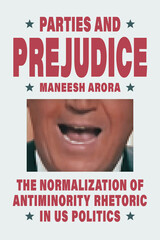
An essential guide to how the interactions between social norms, party politics, and expressions of prejudice are driving contemporary politics.
Antiminority rhetoric in American politics has grown more overt. What were once fringe comments on Stormfront have now become typical campaign appeals from many mainstream politicians. If there was ever a doubt, this is a poignant reminder that the boundaries of what is “acceptable” and “unacceptable” to say and do are fluid and socially enforced.
In Parties and Prejudice, Maneesh Arora offers a broad framework for understanding this new political terrain. Arora argues that the interaction between social norms and party politics determines what the political consequence of prejudicial speech will be. He illuminates this nuanced relationship by showing that norms vary based on the targeted minority group and the intended audience.
Drawing on experiments, survey data, news coverage, and real-world examples, Parties and Prejudice examines the distinctive ways that egalitarian/inegalitarian norms have developed—within each party—for Black, Muslim, and LGBTQ+ Americans. It is essential reading for understanding Donald Trump’s rise to power, the modern conservative agenda (including opposition to critical race theory and transgender rights), and threats to the development of a multiracial democracy.
An unflinching examination of the effects and boundaries of partisan animosity.
For generations, experts argued that American politics needed cohesive parties to function effectively. Now many fear that strong partisan views, particularly hostility to the opposing party, are damaging democracy. Is partisanship as dangerous as we fear it is?
To provide an answer, this book offers a nuanced evaluation of when and how partisan animosity matters in today’s highly charged, dynamic political environment, drawing on panel data from some of the most tumultuous years in recent American history, 2019 through 2021. The authors show that partisanship powerfully shapes political behaviors, but its effects are conditional, not constant. Instead, it is most powerful when politicians send clear signals and when an issue is unlikely to bring direct personal consequences. In the absence of these conditions, other factors often dominate decision-making.
The authors argue that while partisan hostility has degraded US politics—for example, politicizing previously non-political issues and undermining compromise—it is not in itself an existential threat. As their research shows, the future of American democracy depends on how politicians, more than ordinary voters, behave.
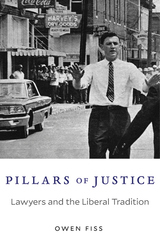
Pillars of Justice explores the purpose and possibilities of life in the law through moving accounts of thirteen lawyers who shaped the legal world during the past half century.
Some, such as Thurgood Marshall, were Supreme Court Justices. Others, like John Doar and Burke Marshall, set the civil rights policies of the federal government during the 1960s. Some, including Harry Kalven and Catharine MacKinnon, have taught at the greatest law schools of the nation and nourished the liberalism rooted in the civil rights era. Jurists from abroad—Aharon Barak, for example—were responsible for the rise of the human rights movement that today carries the burden of advancing liberal values. These lawyers came from diverse backgrounds and held various political views. What unites them is a deep, abiding commitment to Brown v. Board of Education as an exceptional moment in the life of the law—a willingness to move mountains, if need be, to ensure that we are living up to our best selves. In tracing how these lawyers over a period of fifty years used the Brown ruling and its spirit as a beacon to guide their endeavors, this history tells the epic story of the liberal tradition in the law.
For Owen Fiss, one of the country’s leading constitutional theorists, the people described were mentors, colleagues, friends. In his portraits, Fiss tries to identify the unique qualities of mind and character that made these individuals so important to the institutions and legal principles they served.
Based on original research, participant observation at events, and data collection, Wilson follows the money to provide a meticulous analysis of how Christian Right political elites operate. She traces the evolutionary development of the Christian Right’s political professionalism and their allegiance to a grand vision that articulates a grammar of war to fulfill their Biblical worldview.
The Politics of Hate demonstrates how Christian Right organizations educate and train networks of soldiers to tactically engage the enemy in local, state, and national legal and political battles. Wilson carefully documents their history of co-belligerency, their strategies of political warfare, and, importantly, the impact of this war that has, over the past fifty years, forever changed American politics.
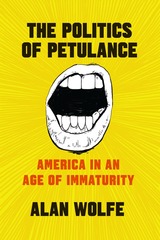
Alan Wolfe has an answer. In The Politics of Petulance he argues that the core of our problem isn’t Trump himself—it’s that we are mired in an age of political immaturity. That immaturity is not grounded in any one ideology, nor is it a function of age or education. It’s in an abdication of valuing the character of would-be leaders; it’s in a failure to acknowledge, even welcome the complexity of government and society; and it’s in a loss of the ability to be skeptical without being suspicious. In 2016, many Americans were offered tantalizingly simple answers to complicated problems, and, like children being offered a lunch of Pop Rocks and Coke, they reflexively—and mindlessly—accepted.
The good news, such as it is, is that we’ve been here before. Wolfe reminds us that we know how to grow up and face down Trump and other demagogues. Wolfe reinvigorates the tradition of public engagement exemplified by midcentury intellectuals such as Richard Hofstadter, Reinhold Niebuhr, and Lionel Trilling—and he draws lessons from their battles with McCarthyism and conspiratorial paranoia. Wolfe mounts a powerful case that we can learn from them to forge a new path for political intervention today.
Wolfe has been thinking and writing about American life and politics for decades. He sees this moment as one of real risk. But he’s not throwing up his hands; he’s bracing us. We’ve faced demagogues before. We can find the intellectual maturity to fight back. Yes we can.
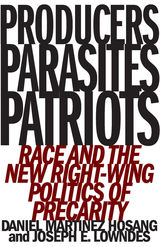
The shifting meaning of race and class in the age of Trump
The profound concentration of economic power in the United States in recent decades has produced surprising new forms of racialization. In Producers, Parasites, Patriots, Daniel Martinez HoSang and Joseph E. Lowndes show that while racial subordination is an enduring feature of U.S. political history, it continually changes in response to shifting economic and political conditions, interests, and structures.
The authors document the changing politics of race and class in the age of Trump across a broad range of phenomena, showing how new forms of racialization work to alter the economic protections of whiteness while promoting some conservatives of color as models of the neoliberal regime. Through careful analyses of diverse political sites and conflicts—racially charged elections, attacks on public-sector unions, new forms of white precarity, the rise of black and brown political elites, militia uprisings, multiculturalism on the far right—they highlight new, interwoven deployments of race in the ascendant age of inequality. Using the concept of “racial transposition,” the authors demonstrate how racial meanings and signification can be transferred from one group to another to shore up both neoliberalism and racial hierarchy.
From the militia movement to the Alt-Right to the mainstream Republican Party, Producers, Parasites, Patriots brings to light the changing role of race in right-wing politics.
READERS
Browse our collection.
PUBLISHERS
See BiblioVault's publisher services.
STUDENT SERVICES
Files for college accessibility offices.
RECENTLY PUBLISHED





UChicago Accessibility Resources
home | accessibility | search | about | contact us
BiblioVault ® 2001 - 2026
The University of Chicago Press