
 A SCHOLARLY BOOK REPOSITORY
5 start with P start with P
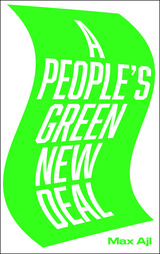
'Hands-down the best book yet on the Green New Deal' - Jason Hickel
The idea of a Green New Deal was launched into popular consciousness by US Congressperson Alexandria Ocasio-Cortez in 2018. It has become a watchword in the current era of global climate crisis. But what - and for whom - is the Green New Deal?
In this concise and urgent book, Max Ajl provides an overview of the various mainstream Green New Deals. Critically engaging with their proponents, ideological underpinnings and limitations, he goes on to sketch out a radical alternative: a 'People's Green New Deal' committed to decommodification, working-class power, anti-imperialism and agro-ecology.
Ajl diagnoses the roots of the current socio-ecological crisis as emerging from a world-system dominated by the logics of capitalism and imperialism. Resolving this crisis, he argues, requires nothing less than an infrastructural and agricultural transformation in the Global North, and the industrial convergence between North and South. As the climate crisis deepens and the literature on the subject grows, A People's Green New Deal contributes a distinctive perspective to the debate.
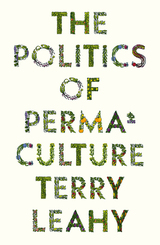
Permaculture is an environmental movement that makes us revaluate what it means to be sustainable. Through innovative agriculture and settlement design, the movement creates new communities that are harmonious with nature. It has grown from humble origins on a farm in 1970s Australia and flourished into a worldwide movement that confronts industrial capitalism.
The Politics of Permaculture is one of the first books to unpack the theory and practice of this social movement that looks to challenge the status quo. Drawing upon the rich seam of publications and online communities from the movement as well as extensive interviews with permaculture practitioners and organizations from around the world, Leahy explains the ways permaculture is understood and practiced in different contexts.
In the face of extreme environmental degradation and catastrophic climate change, we urgently need a new way of living.

Permaculture is an environmental movement that makes us revaluate what it means to be sustainable. Through innovative agriculture and settlement design, the movement creates new communities that are harmonious with nature. It has grown from humble origins on a farm in 1970s Australia and flourished into a worldwide movement that confronts industrial capitalism.
The Politics of Permaculture is one of the first books to unpack the theory and practice of this social movement that looks to challenge the status quo. Drawing upon the rich seam of publications and online communities from the movement as well as extensive interviews with permaculture practitioners and organizations from around the world, Leahy explains the ways permaculture is understood and practiced in different contexts.
In the face of extreme environmental degradation and catastrophic climate change, we urgently need a new way of living.
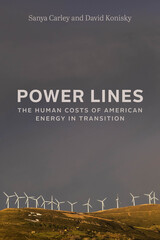
On American energy and its persisting power to destroy.
In the United States, the promise of a green-energy future is complicated by its realities. The country’s legacy energy systems are decrepit; the rollout of new technologies is unequal and piecemeal; households find themselves increasingly without reliable or affordable access; and Americans are excluded from the decisions that shape their energy futures. Having power in America has become an exercise in race, class, and wealth—in more ways than one.
Power Lines is a sweeping portrait of American energy in the twenty-first century, rendered in terms of its increasing—and inevitable—human costs. Coal miners in West Virginia lose their livelihoods as energy markets change; historically marginalized households cannot easily access new technologies; children in “sacrifice zones” adjacent to mineral-mining sites suffer health problems and limited resources; and cities and towns are burdened from the production of alternative energies.
Sanya Carley and David Konisky show current challenges and an uncertain future of America’s greatest policy imperative. The result is not only sobering but also essential for planning and pursuing a clean-energy transition that improves on the errors of the past.
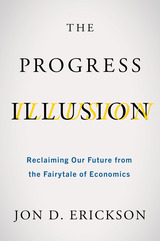
In The Progress Illusion, Erickson charts the rise of the economic worldview and its infiltration into our daily lives as a theory of everything. Drawing on his own experience as a young economist inoculated in the 1980s era of “greed is good,” Erickson shows how pseudoscience came to dominate economic thought. He pokes holes in the conventional wisdom of neo-classical economics, illustrating how flawed theories about financial decision-making and maximizing efficiency ignore human psychology and morality. Most importantly, he demonstrates how that thinking shaped our politics and determined the course of American public policy. The result has been a system that perpetually concentrates wealth in the hands of a few, while depleting the natural resources on which economies are based.
While the history of economics is dismal indeed, Erickson is part of a vigorous reform effort grounded in the realities of life on a finite planet. This new brand of economics is both gaining steam in academia and supporting social activism. The goal is people over profit, community over consumption, and resilience over recklessness. Erickson shows crafting a new economic story is the first step toward turning away from endless growth and towards enduring prosperity.
READERS
Browse our collection.
PUBLISHERS
See BiblioVault's publisher services.
STUDENT SERVICES
Files for college accessibility offices.
RECENTLY PUBLISHED



UChicago Accessibility Resources
home | accessibility | search | about | contact us
BiblioVault ® 2001 - 2026
The University of Chicago Press