front cover of Painting the Town Red
Painting the Town Red
Politics and the Arts During the 1919 Hungarian Soviet Republic
Bob Dent
Pluto Press, 2018
In 1919, in the wake of World War I, for a brief period Hungary was a Soviet Republic. The republic didn’t last, but the incredible effusion of art, music, film, theater, and literature that it generated did. Painting the Town Red offers an in-depth exploration of the incredible artistic flourishing brought about by the 1919 republic, showing how art and politics were intertwined—and how, for a brief time, artists saw themselves as playing a crucial part in the establishment of a new way of living and governing. Through close analyses of the works of a number of creators and a careful recounting of the history and politics of the 1919 republic, Bob Dent brings a largely forgotten moment back to life, with all its glory and, ultimately, disillusion.
 
[more]

front cover of Parlor and Kitchen
Parlor and Kitchen
Housing and Domestic Culture in Budapest, 1870-1940
Gábor Gyáni
Central European University Press, 2002

Besides Berlin, Budapest was the fastest-growing capital city in Europe at the end of the nineteenth century. Parlor and Kitchen, the work of a microhistorian and historical anthropologist, describes the development of private spaces in this newly emerged metropolis.

Author Gábor Gyáni has chosen two distinct groups of contemporary society: the upper middle class and the working class, to present their homes, domestic culture and attitudes. At the same time the book offers a panoramic view of the everyday life of the entire society, on social segregation and mobility. Behind the visual details the author reveals a great deal about the value systems of the groups of society investigated.

Reconstructing minute details as well as case studies, the author has relied on archival sources, private documents, and statistical data. The text is accompanied by contemporary photographs, maps and blueprints.

This enlightening and interesting volume will be of interest not only to historians, anthropologists and sociologists, but also to the general reader with an interest in urban history.

Gábor Gyáni is founder and editor of the quarterly Budapest Review of Books. He is President of the Hungarian-American Historians' Committee and Secretary of the Urban History Workshop of the Hungarian Academy of Sciences.

A student of the late professor Péter Hanák, Gyáni is active in research into the urban and social history of modern Hungary and the theory and methodology of history writing. 

[more]

front cover of Patrick Leigh Fermor
Patrick Leigh Fermor
Noble Encounters between Budapest and Transylvania
Michael O'Sullivan
Central European University Press, 2018
This book revisits the trajectory of one section of Patrick Leigh Fermor's famous excursion on foot from the Hook of Holland to Constantinople in the 1930s. The highly regarded British travel writer and heroic wartime Special Operations Executive officer walked into Hungary as a youth of 19 at Easter and left Transylvania in August 1934. This intrepid traveler, "a cross between Indiana Jones, James Bond and Graham Greene" as the New York Times obituary put it in 2011, published his experiences half a century later. Between the Woods and the Water, that covers the part of the epic foot journey from the middle Danube to the Iron Gates, has been a bestseller since it was first published in 1986. In the present volume Michael O'Sullivan reveals the identity of the interesting characters in the travelogue, interviewing several of them eyetoeye. The many counts and barons among his 1934 contacts are a proof of Leigh Fermor's lifelong attraction to the aristocracy. Rich with photos and other documents on places and persons both from the thirties and today, the book offers a compelling social and political history of the period and the area. It provides a particular portrait of Hungary and Transylvania when they were on the brink of momentous change.
[more]

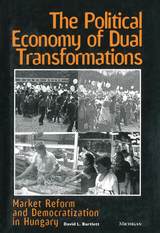
front cover of The Political Economy of Dual Transformations
The Political Economy of Dual Transformations
Market Reform and Democratization in Hungary
David L. Bartlett
University of Michigan Press, 1997
In the early 1990s, scholars voiced skepticism about the capacity of Eastern Europe's new democracies to manage simultaneous political and economic reform. They argued that the surge of popular participation following democratization would thwart efforts by successor governments to enact market reforms that imposed high costs on major elements of post-Communist society. David Bartlett challenges the conventional wisdom regarding the hazards of "dual transformations": far from hindering marketization, democratization facilitated it. Bartlett argues that the transition to democracy in East Central Europe lowered the political barriers to market reforms by weakening the ability of actors most vulnerable to marketization to manipulate the existing institutional structure to stop or slow down the process.
Although the analysis focuses on Hungary, whose long history of market reforms makes it an ideal vehicle for assessing the impact of institutional change on reform policy, the author shows how his findings call into question the use of "shock therapy" and arguments, based on the experience in East Asia, that economic development and democratization are incompatible.
This book will appeal to economists, political scientists, and others interested in transition problems in formerly communist countries, democratic transitions, and the politics of stabilization and adjustment.
David L. Bartlett is Assistant Professor of Political Science, Vanderbilt University.
[more]

front cover of Political Justice in Budapest after World War II
Political Justice in Budapest after World War II
Andrea Peto
Central European University Press, 2015

In Hungary, which fell under Soviet influence at the end of World War II, those who had participated in the wartime atrocities were tried by so called people’s courts. This book analyses this process in an objective, quantitative way, contributing to the present timely discussion on the Hungarian war guilt. The authors apply a special focus on the gender aspect of the trials.

Political justice had a specific nature in Hungary. War criminals began to be brought to trial while fighting was still underway in the western part of the country, well before the Nuremberg trials. Not only crimes committed during the war were tried in the same frame but also post-war ones. As far as the post-war period is concerned, legal proceedings regarding these crimes were most often launched on the basis of Act VII of 1946. This act of law concerned “the criminal law protection of the democratic constitutional order and the republic” and its basic aim was to facilitate the creation of a communist dictatorship and to deal with perceived or real enemies of the regime.

[more]

front cover of Politics and Policies in Post-Communist Transition
Politics and Policies in Post-Communist Transition
Primary and Secondary Privatisation in Central Europe and the Former Soviet Union
Károly Attila Soós
Central European University Press, 2011
Discusses the policies, practices and outcomes of privatization in six transition economies: the Czech Republic, Hungary, Poland, Russia, Slovenia and Ukraine, paying particular attention to cross-country differences and to interrelations between the processes of privatisation and the political transition from communism to a new system.The analysis is restricted to the privatisation in those fields where its methods have been strongly different from privatisations in advanced market economies and where differences of privatisation principles and techniques among our six countries were also rather various. This is basically the privatisation of middle-sized and large enterprises, not including banks, non-bank financial companies, natural monopolies and agricultural entities.
[more]

front cover of Post-Communist Mafia State
Post-Communist Mafia State
The Case of Hungary
Bálint Magyar
Central European University Press, 2016
In an article in 2001 the author analyzed the way Fidesz, the party on government for the first time then, was eliminating the institutional system of the rule of law. At that time, many readers doubted the legitimacy of the new approach, whose key categories were the 'organized over-world', the 'state employing mafia methods' and the 'adopted political family'. Critics considered these categories metaphors rather than elements of a coherent conceptual framework. Ten years later Fidesz won a two-third majority in Parliament at the 2010 elections: the institutional obstacles of exerting power were thus largely removed. Just like the party, the state itself was placed under the control of a single individual, who since then has applied the techniques used within his party to enforce submission and obedience onto society as a whole. While in many post-communist systems a segment of the party and secret service became the elite in possession of not only political power but also of wealth, Fidesz, as a late-coming new political predator, was able to occupy this position through an aggressive change of elite. The actions of the post-communist mafia state model are led by the logic of power and wealth concentration in the hands of the clan. But while the classical mafia channeled wealth and economic players into its spheres of interest by means of direct coercion, the mafia state does the same by means of parliamentary legislation, legal prosecution, tax authority, police forces and secret service. The new conceptual framework is important and timely not only for Hungary, but also for other post-communist countries subjected to autocratic rules.
[more]

front cover of Pressed by a Double Loyalty
Pressed by a Double Loyalty
Hungarian Attendance at the Second Vatican Council, 1959-1965
András Fejérdy
Central European University Press, 2017
The Second Vatican Council is the single most influential event in the 20th century history of the Catholic Church. The book analyzes the relationship between the Council and the "Ostpolitik" of the Vatican through the history of the Hungarian presence at Vatican II. Pope John XXIII, elected in 1958, was a catalyst. The pope thought that his most urgent task was to renew contacts with the Church behind the iron curtain. Hungarian participation at the Council was also made possible by the new, pragmatic model in Hungarian church politics. After the crushing of the 1956 Revolution, churches in Hungary thought that the regime would last and were willing to compromise. Vatican II – in the perspective of Hungary – was not primarily an ecclesial event, but it remained closely joined to the negotiations between the Holy See and the Kádár regime: during the Council Hungary became the experimental laboratory of the Vatican's new eastern policy. Was it a Vatican decision or a Soviet instruction? Fejérdy suggests that it was a decision of the Holy See.
[more]

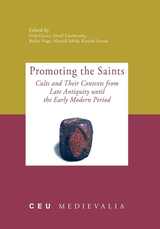
front cover of Promoting the Saints
Promoting the Saints
Cults and Their Contexts from Late Antiquity until the Early Modern Period
Ottó Gecser
Central European University Press, 2010
The studies in this volume concentrate on a complex set of socio-cultural phenomena, the cult of saints, in a variety of regions from Egypt to Poland, with a focus on Italy and Central Europe. The subjects of the contributions range in time from the fourth until the eighteenth century. The diversity of approaches adopted by the contributors—from literary analysis and historical anthropology to archaeology and art history—represents that open and multidisciplinary historical research that characterizes the work of Gábor Klaniczay to whom these essays are dedicated.
[more]

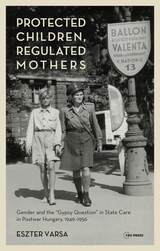
front cover of Protected Children, Regulated Mothers
Protected Children, Regulated Mothers
Gender and the "Gypsy Question" in State Care in Postwar Hungary, 1949–1956
Eszter Varsa
Central European University Press, 2021

Protected Children, Regulated Mothers examines child protection in Stalinist Hungary as a part of twentieth-century East Central, Eastern, and Southeastern European history. Across the communist bloc, the prewar foster care system was increasingly replaced after 1945 by institutionalization in residential homes. This shift was often interpreted as a further attempt to establish totalitarian control. However, this study—based on hundreds of children's case files and interviews with institution leaders, teachers, and people formerly in state care—provides a new perspective. Rather than being merely a tool of political repression, state care in postwar Hungary was often shaped by the efforts of policy actors and educators to address the myriad of problems engendered by the social and economic transformations that emerged after World War II. This response built on, rather than broke with, earlier models of reform and reformatory education. Yet child protection went beyond safeguarding and educating children; it also focused on parents, particularly lone mothers, regulating not only their entrance to paid work but also their sexuality. In so doing, children's homes both reinforced and changed existing cultural and social patterns, whether about gendered division of work or the assimilation of minorities. Indeed, a major finding of the book is that state socialist child protection continued a centuries-long national project of seeking a “solution to the Gypsy question,” rooted in efforts to eliminate the perceived “workshyness” of Roma.

[more]


Send via email Share on Facebook Share on Twitter