front cover of Q. Aurelius Symmachus
Q. Aurelius Symmachus
A Political Biography
Cristiana Sogno
University of Michigan Press, 2010
[more]

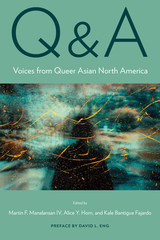
front cover of Q&A
Q&A
Voices from Queer Asian North America
Edited by Martin F. Manalansan IV, Alice Y. Hom, and Kale Bantigue Fajardo
Temple University Press, 2021

First published in 1998, Q & A: Queer in Asian America, edited by David L. Eng and Alice Y. Hom, became a canonical work in Asian American studies and queer studies. This new edition of Q & A is neither a sequel nor an update, but an entirely new work borne out of the progressive political and cultural advances of the queer experiences of Asian North American communities. 

The artists, activists, community organizers, creative writers, poets, scholars, and visual artists that contribute to this exciting new volume make visible the complicated intertwining of sexuality with race, class, gender, and ethnicity. Sections address activism, radicalism, and social justice; transformations in the meaning of Asian-ness and queerness in various mass media issues of queerness in relation to settler colonialism and diaspora; and issues of bodies, health, disability, gender transitions, death, healing, and resilience.

The visual art, autobiographical writings, poetry, scholarly essays, meditations, and analyses of histories and popular culture in the new Q & Agesture to enduring everyday racial-gender-sexual experiences of mis-recognition, micro-aggressions, loss, and trauma when racialized Asian bodies are questioned, pathologized, marginalized, or violated. This anthology seeks to expand the idea of Asian and American in LGBTQ studies.

Contributors: Marsha Aizumi, Kimberly Alidio, Paul Michael (Mike) Leonardo Atienza, Long T. Bui, John Paul (JP) Catungal, Ching-In Chen, Jih-Fei Cheng, Kim Compoc, Sony Coráñez Bolton, D’Lo, Patti Duncan, Chris A. Eng, May Farrales, Joyce Gabiola, C. Winter Han, Douglas S. Ishii, traci kato-kiriyama, Jennifer Lynn Kelly, Mimi Khúc, Anthony Yooshin Kim, Việt Lê, Danni Lin, Glenn D. Magpantay, Leslie Mah, Casey Mecija, Maiana Minahal, Sung Won Park, Thea Quiray Tagle, Emily Raymundo, Vanita Reddy, Eric Estuar Reyes, Margaret Rhee, Thomas Xavier Sarmiento, Pahole Sookkasikon, Amy Sueyoshi, Karen Tongson, Kim Tran, Kay Ulanday Barrett, Reid Uratani, Eric C. Wat, Sasha Wijeyeratne, Syd Yang, Xine Yao, and the editors
[more]

front cover of QRB vol 88 num 3
QRB vol 88 num 3
The University of Chicago Press
University of Chicago Press Journals, 2013

logo for University of Chicago Press Journals
QRB vol 89 num 3
The University of Chicago Press
University of Chicago Press Journals, 2014

logo for University of Chicago Press Journals
QRB vol 90 num 3
The University of Chicago Press
University of Chicago Press Journals, 2015

logo for University of Chicago Press Journals
QRB vol 91 num 3
The University of Chicago Press
University of Chicago Press Journals, 2016

front cover of QRB vol 92 num 3
QRB vol 92 num 3
The University of Chicago Press
University of Chicago Press Journals, 2017

front cover of QRB vol 93 num 3
QRB vol 93 num 3
The University of Chicago Press
University of Chicago Press Journals, 2018

logo for University of Chicago Press Journals
QRB vol 94 num 3
The University of Chicago Press
University of Chicago Press Journals, 2019

front cover of QRB vol 95 num 3
QRB vol 95 num 3
The University of Chicago Press
University of Chicago Press Journals, 2020
This is volume 95 issue 3 of The Quarterly Review of Biology. The Quarterly Review of Biology (QRB) has presented insightful historical, philosophical, and technical treatments of important biological topics since 1926. As the premier review journal in biology, the QRB publishes outstanding review articles of generous length that are guided by an expansive, inclusive, and often humanistic understanding of biology. Beyond the core biological sciences, the QRB is also an important review journal for scholars in related areas, including policy studies and the history and philosophy of science. A comprehensive section of reviews on new biological books provides educators and researchers with information on the latest publications in the life sciences.
[more]

front cover of The Quarterly Review of Biology, volume 100 number 3 (September 2025)
The Quarterly Review of Biology, volume 100 number 3 (September 2025)
The University of Chicago Press
University of Chicago Press Journals, 2025
This is volume 100 issue 3 of The Quarterly Review of Biology. The Quarterly Review of Biology (QRB) has presented insightful historical, philosophical, and technical treatments of important biological topics since 1926. As the premier review journal in biology, the QRB publishes outstanding review articles of generous length that are guided by an expansive, inclusive, and often humanistic understanding of biology. Beyond the core biological sciences, the QRB is also an important review journal for scholars in related areas, including policy studies and the history and philosophy of science. A comprehensive section of reviews on new biological books provides educators and researchers with information on the latest publications in the life sciences.
[more]

front cover of The Quarterly Review of Biology, volume 101 number 3 (September 2026)
The Quarterly Review of Biology, volume 101 number 3 (September 2026)
The University of Chicago Press
University of Chicago Press Journals, 2026
This is volume 101 issue 3 of The Quarterly Review of Biology. The Quarterly Review of Biology (QRB) has presented insightful historical, philosophical, and technical treatments of important biological topics since 1926. As the premier review journal in biology, the QRB publishes outstanding review articles of generous length that are guided by an expansive, inclusive, and often humanistic understanding of biology. Beyond the core biological sciences, the QRB is also an important review journal for scholars in related areas, including policy studies and the history and philosophy of science. A comprehensive section of reviews on new biological books provides educators and researchers with information on the latest publications in the life sciences.
[more]

front cover of The Quarterly Review of Biology, volume 96 number 3 (September 2021)
The Quarterly Review of Biology, volume 96 number 3 (September 2021)
The University of Chicago Press
University of Chicago Press Journals, 2021
This is volume 96 issue 3 of The Quarterly Review of Biology. The Quarterly Review of Biology (QRB) has presented insightful historical, philosophical, and technical treatments of important biological topics since 1926. As the premier review journal in biology, the QRB publishes outstanding review articles of generous length that are guided by an expansive, inclusive, and often humanistic understanding of biology. Beyond the core biological sciences, the QRB is also an important review journal for scholars in related areas, including policy studies and the history and philosophy of science. A comprehensive section of reviews on new biological books provides educators and researchers with information on the latest publications in the life sciences.
[more]

front cover of The Quarterly Review of Biology, volume 97 number 3 (September 2022)
The Quarterly Review of Biology, volume 97 number 3 (September 2022)
The University of Chicago Press
University of Chicago Press Journals, 2022
This is volume 97 issue 3 of The Quarterly Review of Biology. The Quarterly Review of Biology (QRB) has presented insightful historical, philosophical, and technical treatments of important biological topics since 1926. As the premier review journal in biology, the QRB publishes outstanding review articles of generous length that are guided by an expansive, inclusive, and often humanistic understanding of biology. Beyond the core biological sciences, the QRB is also an important review journal for scholars in related areas, including policy studies and the history and philosophy of science. A comprehensive section of reviews on new biological books provides educators and researchers with information on the latest publications in the life sciences.
[more]

front cover of The Quarterly Review of Biology, volume 98 number 3 (September 2023)
The Quarterly Review of Biology, volume 98 number 3 (September 2023)
The University of Chicago Press
University of Chicago Press Journals, 2023
This is volume 98 issue 3 of The Quarterly Review of Biology. The Quarterly Review of Biology (QRB) has presented insightful historical, philosophical, and technical treatments of important biological topics since 1926. As the premier review journal in biology, the QRB publishes outstanding review articles of generous length that are guided by an expansive, inclusive, and often humanistic understanding of biology. Beyond the core biological sciences, the QRB is also an important review journal for scholars in related areas, including policy studies and the history and philosophy of science. A comprehensive section of reviews on new biological books provides educators and researchers with information on the latest publications in the life sciences.
[more]

front cover of The Quarterly Review of Biology, volume 99 number 3 (September 2024)
The Quarterly Review of Biology, volume 99 number 3 (September 2024)
The University of Chicago Press
University of Chicago Press Journals, 2024
This is volume 99 issue 3 of The Quarterly Review of Biology. The Quarterly Review of Biology (QRB) has presented insightful historical, philosophical, and technical treatments of important biological topics since 1926. As the premier review journal in biology, the QRB publishes outstanding review articles of generous length that are guided by an expansive, inclusive, and often humanistic understanding of biology. Beyond the core biological sciences, the QRB is also an important review journal for scholars in related areas, including policy studies and the history and philosophy of science. A comprehensive section of reviews on new biological books provides educators and researchers with information on the latest publications in the life sciences.
[more]

front cover of The Quay Brothers
The Quay Brothers
Into a Metaphysical Playroom
Suzanne Buchan
University of Minnesota Press, 2010
This work is the first thorough analysis of the creative oeuvre of the Quay Brothers. Known for their animation shorts that rely on puppetry, miniatures, and stop-motion techniques, their fiercely idiosyncratic films are fertile fields for Suzanne Buchan's engaging descriptions and provocative insights into the Quays' art-and into the art of independent puppet animation.

Buchan's aesthetic investigation stems from extensive access to the Quay Brothers' artistic practices and work, which spans animation and live-action film, stage design and illustration. She also draws on a long acquaintance with them and on interviews with collaborators essential to their productions, as well as archival sources. Discussions of their films' literary origins, space, puppets, montage, and the often-overlooked world of sound and music in animation shed new light on the expressive world that the Quay Brothers generate out of their materials to create the poetic alchemy of their films.

At once a biography of the Quays' artistic trajectory and a detailed examination of one of their best-known films, Street of Crocodiles, this book goes further and provides interdisciplinary methodologies and tools for the analysis of animation.
[more]

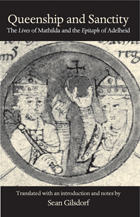
front cover of Queenship and Sanctity
Queenship and Sanctity
The Lives of Mathilda and the Epitaph of Adelheid (Medieval Texts in Translation)
Sean Gilsdorf
Catholic University of America Press, 2004
Queenship and Sanctity brings together for the first time in English the anonymous Lives of Mathilda and Odilo of Cluny's Epitaph of Adelheid. Richly annotated, with an extensive introduction placing the texts and their subjects in historical and hagiographical context, it provides teachers and students with a crucial set of sources for the history of Europe (particularly Germany) in the tenth and eleventh centuries, for the development of sacred biography and medieval notions of sanctity, and for the life of aristocratic and royal women in the early Middle Ages.
[more]

front cover of Queer Game Studies
Queer Game Studies
Bonnie Ruberg
University of Minnesota Press, 2017

Video games have developed into a rich, growing field at many top universities, but they have rarely been considered from a queer perspective. Immersion in new worlds, video games seem to offer the perfect opportunity to explore the alterity that queer culture longs for, but often sexism and discrimination in gamer culture steal the spotlight. Queer Game Studies provides a welcome corrective, revealing the capacious albeit underappreciated communities that are making, playing, and studying queer games.

These in-depth, diverse, and accessible essays use queerness to challenge the ideas that have dominated gaming discussions. Demonstrating the centrality of LGBTQ issues to the gamer world, they establish an alternative lens for examining this increasingly important culture. Queer Game Studies covers important subjects such as the representation of queer bodies, the casual misogyny prevalent in video games, the need for greater diversity in gamer culture, and reading popular games like Bayonetta, Mass Effect, and Metal Gear Solid from a queer perspective. 

Perfect for both everyday readers and instructors looking to add diversity to their courses, Queer Game Studies is the ideal introduction to the vast and vibrant realm of queer gaming. 

Contributors: Leigh Alexander; Gregory L. Bagnall, U of Rhode Island; Hanna Brady; Mattie Brice; Derek Burrill, U of California, Riverside; Edmond Y. Chang, U of Oregon; Naomi M. Clark; Katherine Cross, CUNY; Kim d’Amazing, Royal Melbourne Institute of Technology; Aubrey Gabel, U of California, Berkeley; Christopher Goetz, U of Iowa; Jack Halberstam, U of Southern California; Todd Harper, U of Baltimore; Larissa Hjorth, Royal Melbourne Institute of Technology; Chelsea Howe; Jesper Juul, Royal Danish Academy of Fine Arts; merritt kopas; Colleen Macklin, Parsons School of Design; Amanda Phillips, Georgetown U; Gabriela T. Richard, Pennsylvania State U; Toni Rocca; Sarah Schoemann, Georgia Institute of Technology; Kathryn Bond Stockton, U of Utah; Zoya Street, U of Lancaster; Peter Wonica; Robert Yang, Parsons School of Design; Jordan Youngblood, Eastern Connecticut State U.
[more]

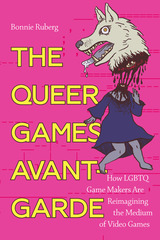
front cover of The Queer Games Avant-Garde
The Queer Games Avant-Garde
How LGBTQ Game Makers Are Reimagining the Medium of Video Games
Bonnie Ruberg
Duke University Press, 2020
In The Queer Games Avant-Garde, Bonnie Ruberg presents twenty interviews with twenty-two queer video game developers whose radical, experimental, vibrant, and deeply queer work is driving a momentous shift in the medium of video games. Speaking with insight and candor about their creative practices as well as their politics and passions, these influential and innovative game makers tell stories about their lives and inspirations, the challenges they face, and the ways they understand their places within the wider terrain of video game culture. Their insights go beyond typical conversations about LGBTQ representation in video games or how to improve “diversity” in digital media. Instead, they explore queer game-making practices, the politics of queer independent video games, how queerness can be expressed as an aesthetic practice, the influence of feminist art on their work, and the future of queer video games and technology. These engaging conversations offer a portrait of an influential community that is subverting and redefining the medium of video games by placing queerness front and center.

Interviewees:
Ryan Rose Aceae, Avery Alder, Jimmy Andrews, Santo Aveiro-Ojeda, Aevee Bee, Tonia B******, Mattie Brice, Nicky Case, Naomi Clark, Mo Cohen, Heather Flowers, Nina Freeman, Jerome Hagen, Kat Jones, Jess Marcotte, Andi McClure, Llaura McGee, Seanna Musgrave, Liz Ryerson, Elizabeth Sampat, Loren Schmidt, Sarah Schoemann, Dietrich Squinkifer, Kara Stone, Emilia Yang, Robert Yang
[more]

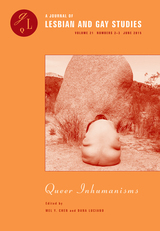
front cover of Queer Inhumanisms
Queer Inhumanisms
Mel Y. Chen and Dana Luciano, special issue editors
Duke University Press
This issue features a group of leading theorists from multiple disciplines who decenter the human in queer theory, exploring what it means to treat “the human” as simply one of many elements in a queer critical assemblage. Contributors examine the queer dimensions of recent moves to think apart from or beyond the human in affect theory, disability studies, critical race theory, animal studies, science studies, ecocriticism, and other new materialisms. Essay topics include race, fabulation, and ecology; parasitology, humans, and mosquitoes; the racialization of advocacy for pit bulls; and queer kinship in Korean films when humans become indistinguishable from weapons. The contributors argue that a nonhuman critical turn in queer theory can and should refocus the field’s founding attention to social structures of dehumanization and oppression. They find new critical energies that allow considerations of justice to operate alongside and through their questioning of the human-nonhuman boundary.

Mel Y. Chen, Associate Professor of Gender and Women’s Studies at the University of California, Berkeley, is the author of Animacies: Biopolitics, Racial Mattering, and Queer Affect, also published by Duke University Press. Dana Luciano is Associate Professor of English at Georgetown University. She is the author of Arranging Grief: Sacred Time and the Body in Nineteenth-Century America and editor, with Ivy G. Wilson, of Unsettled States: Nineteenth-Century American Literary Studies.

Contributors: Neel Ahuja, Karen Barad, Jayna Brown, Mel Y. Chen, Jack Halberstam, Jinthana Haritaworn, Myra Hird, Zakiyyah Iman Jackson, Eileen Joy, Eunjung Kim, Dana Luciano, Uri McMillan, José Esteban Muñoz, Tavia Nyong’o, ​Jasbir K. Puar, Susan Stryker, Kimberly Tallbear, Jeanne Vaccaro, Harlan Weaver, Jami Weinstein
[more]

front cover of Queer Traffic
Queer Traffic
Sex, Panic, Free Trade
Jennifer Tyburczy
Duke University Press, 2025
In Queer Traffic, Jennifer Tyburczy traces how sexual dissidents across the Mexico-Canada-US borderlands transport the objects and experiences that nourish their sexual and social lives. She situates the North American Free Trade Agreement (NAFTA) as a pivot point in the formation of panics aimed at stamping out these outlaw sex practices. Highlighting NAFTA’s erotic investments in hetero- and homonormativity, racial capitalism, markets of dispossession, and neocolonialism, Tyburczy directly engages with art, activism, and archives to revisit the struggles of people who invented circuits of sexual exchange through four decades of violence and criminalization. In conversing with actors from bureaucrats to pornographers and in studying choreographies, social movements, and street vocabularies, she examines an array of tactics that undermine the market logics of trade law and policy. Dreaming of other forms of living that go beyond mere survival, Queer Traffic guides us through the renegade pathways that circumvent the seemingly endless reach of free-trade capitalism toward other routes to pleasure.
[more]

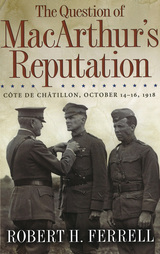
front cover of The Question of MacArthur's Reputation
The Question of MacArthur's Reputation
Côte De Châtillon, October 14-16, 1918
Robert H. Ferrell
University of Missouri Press, 2008
Perhaps the best known of all American five-star generals, Douglas MacArthur established his military reputation at the hill of Châtillon during the great battle of the Meuse-Argonne in World War I. The thirty-eight-year-old brigadier general in command of the Eighty-fourth Infantry Brigade boasted to a fellow general that he had inspired his troops by example, taking the hill and breaking the main German line in northern France. Ever since, historical accounts and biographies have celebrated his leadership and bravery.
            That MacArthur’s forces prevailed is beyond question, as military historians have shown. Yet in all the annals of the Great War there is no detailed description of what happened at Châtillon, nor of what MacArthur had to do with it. Robert Ferrell examines those events and comes to a startling conclusion—one that will revise how we view this archetypal American hero.
            After sifting through the inexact accounts of the battle found in regimental and divisional histories—and through the many biographies of MacArthur that assert his leadership at Châtillon but do not describe it—Ferrell has gone into Army records to determine if what MacArthur claimed was true. In a moment-by-moment account of the battle, he reconstructs the movements of troops and the decisions of officers to show in detail how MacArthur’s subordinates were the true heroes.
Ferrell describes how the taking of Côte de Châtillon could have been a disaster had the Eighty-fourth Brigade followed MacArthur's original plan, a bayonet charge at night. Wiser heads prevailed, and the attack of the Iowa and Alabama regiments was a great success.
            Ferrell has completed a chapter in the history of World War I that has stood unfinished for years, showing in masterly fashion how MacArthur exaggerated his reputation at Châtillon. The Question of MacArthur’s Reputation will reward historians seeking to fill gaps in the record, engage readers who enjoy descriptions of battle, and startle all who take their heroes for granted.
[more]

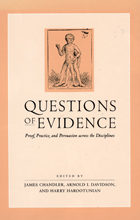
front cover of Questions of Evidence
Questions of Evidence
Proof, Practice, and Persuasion across the Disciplines
Edited by James Chandler, Arnold I. Davidson, and Harry D. Harootunian
University of Chicago Press, 1994
Biologists, historians, lawyers, art historians, and literary critics all voice arguments in the critical dialogue about what constitutes evidence in research and scholarship. They examine not only the constitution and "blurring" of disciplinary boundaries, but also the configuration of the fact-evidence distinctions made in different disciplines and historical moments; the relative function of such concepts as "self-evidence," "experience," "test," "testimony," and "textuality" in varied academic discourses; and the way "rules of evidence" are themselves products of historical developments.

The essays and rejoinders are by Terry Castle, Lorraine Daston, Carlo Ginzburg, Ian Hacking, Mark Kelman, R. C. Lewontin, Pierre Vidal-Naquet, Mary Poovey, Donald Preziosi, Simon Schaffer, Joan W. Scott, Eve Kosofsky Sedgwick, and Barbara Herrnstein Smith.

The critical responses are by Lauren Berlant, James Chandler, Jean Comaroff, Arnold I. Davidson, Harry D. harootunian, Elizabeth Helsinger, Thomas C. Holt, Francoise Meltzer, Robert J. Richards, Lawrence Rothfield, Joel Snyder, Cass R. Sunstein, and William Wimsatt.
[more]

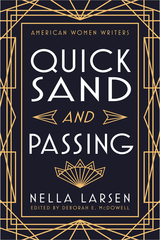
front cover of Quicksand and Passing
Quicksand and Passing
Larsen, Nella
Rutgers University Press, 1986

"Quicksand and Passing are novels I will never forget. They open up a whole world of experience and struggle that seemed to me, when I first read them years  ago, absolutely absorbing, fascinating, and indispensable." —Alice Walker

"A tantalizing mix of moral fable and sensuous colorful narrative, exploring female sexuality and racial solidarity."—Women's Studies International Forum

Rutgers' all-time bestselling book, Nella Larsen's novels Quicksand (1928) and Passing (1929) document the historical realities of Harlem in the 1920s and shed a bright light on the social world of the black bourgeoisie. The novels' greatest appeal and achievement, however, is not sociological, but psychological. As noted in the editor's comprehensive introduction, Larsen takes the theme of psychic dualism, so popular in Harlem Renaissance fiction, to a higher and more complex level, displaying a sophisticated understanding and penetrating analysis of black female psychology.

Passing is now a major motion picture written, produced, and directed by Rebecca Hall. It premiered at Sundance in 2021 and is available on Netflix.

[more]


Send via email Share on Facebook Share on Twitter