
 A SCHOLARLY BOOK REPOSITORY
7 start with Q start with Q
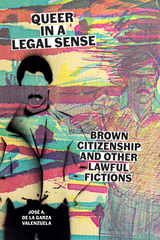
Contrasting works by queer Chicano writers against the legal landscape of sexuality and migration to interrogate the “lawful fiction” that denies queer migrants citizenship and community.
Activists for immigrants and queer people under assault by US authorities focus overwhelmingly on protections presumed to be afforded by citizenship through narratives that have rarely had a place for queer immigrants, who have consistently faced special obstacles to legal entry and citizenship that only recently are being applied more widely. Queer in a Legal Sense studies literary works by gay Chicanx writers alongside instruments of law, showing through this juxtaposition how racialized queer people have been imagined as nonviable from the standpoint of citizenship. In stories by John Rechy, Arturo Islas, Rigoberto González, Michael Nava, and Jaime Cortez, José de la Garza Valenzuela finds what has gone missing in the migrant movement’s pursuit of gendered avenues to civic participation. Further, these works illuminate the production of fictions in canons of law, like those announced by the Florida legislature’s “Purple Pamphlet” and by the US Supreme Court in Boutilier v. INS and Bowers v. Hardwick. Queer in a Legal Sense argues that, through selective ommissions and inclusions, legal fictions place queerness outside the boundaries of citizenship and powerfully undermine queer representation in pro-migrant advocacy.
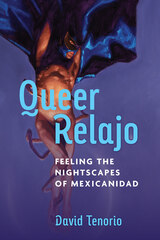
Combining readings of film, digital media, and performance with drag autoethnography, Queer Relajo quite literally plays with how relajo (or playfulness) structures the spaces of queer nightlife in urban contexts by revealing how nighttime intimacy can minimize the paralyzing effects of violence and precarity in a neoliberal Mexico. Considering the political implications of when a queer/trans person is present at night, Tenorio argues that queer feelings of play are not only essential to sexual liberation, but also resist neoliberal commodification and heteronormative extraction.

Highlighting cultural and political resistance within Puerto Rico’s gay, lesbian, bisexual, and transgender subcultures, La Fountain-Stokes pays close attention to differences of gender, historical moment, and generation, arguing that Puerto Rican queer identity changes over time and is experienced in very different ways. He traces an arc from 1960s Puerto Rico and the writings of Luis Rafael Sánchez to New York City in the 1970s and 1980s (Manuel Ramos Otero), Philadelphia and New Jersey in the 1980s and 1990s (Luz María Umpierre and Frances Negrón-Muntaner), and Chicago (Rose Troche) and San Francisco (Erika López) in the 1990s, culminating with a discussion of Arthur Avilés and Elizabeth Marrero’s recent dance-theater work in the Bronx.
Proposing a radical new conceptualization of Puerto Rican migration, this work reveals how sexuality has shaped and defined the Puerto Rican experience in the United States.
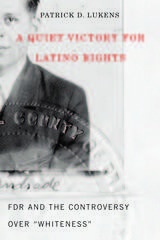
In 1935 a federal court judge handed down a ruling that could have been disastrous for Mexicans, Mexican Americans, and all Latinos in the United States. However, in an unprecedented move, the Roosevelt administration wielded the power of "administrative law" to neutralize the decision and thereby dealt a severe blow to the nativist movement. A Quiet Victory for Latino Rights recounts this important but little-known story.
To the dismay of some nativist groups, the Immigration Act of 1924, which limited the number of immigrants who could be admitted annually, did not apply to immigrants from Latin America. In response to nativist legal maneuverings, the 1935 decision said that the act could be applied to Mexican immigrants. That decision, which ruled that the Mexican petitioners were not "free white person[s]," might have paved the road to segregation for all Latinos.
The League of United Latin American Citizens (LULAC), founded in 1929, had worked to sensitize the Roosevelt administration to the tenuous position of Latinos in the United States. Advised by LULAC, the Mexican government, and the US State Department, the administration used its authority under administrative law to have all Mexican immigrants—and Mexican Americans—classified as "white." It implemented the policy when the federal judiciary "acquiesced" to the New Deal, which in effect prevented further rulings.
In recounting this story, complete with colorful characters and unlikely bedfellows, Patrick D. Lukens adds a significant chapter to the racial history of the United States.
Winner of the Emily Toth Award for Best Single Work in Women's Studies, Popular Culture Association
Co-winner of the Elli Kongas Maranda Prize, Women's Section of the American Folklore Society (AFS)
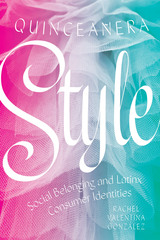
A dynamic study of social negotiation and consumerism in the coming-of-age quinceañera celebration and the impact of normalizing spectacles of luxury.
Quinceañera celebrations, which recognize a girl’s transition to young womanhood at age fifteen, are practiced in Latinx communities throughout the Americas. But in the consumer-driven United States, the ritual has evolved from a largely religious ceremony to an elaborate party where social status takes center stage. Examining the many facets of this contemporary debut experience, Quinceañera Style reports on ethnographic fieldwork in California, Texas, the Midwest, and Mexico City to reveal a complex, compelling story. Along the way, we meet a self-identified transwoman who uses the quinceañera as an intellectual space in her activist performance art. We explore the economic empowerment of women who own barrio boutiques specializing in the quinceañera’s many accessories and made-in-China gowns. And, of course, we meet teens themselves, including a vlogger whose quince-planning tips have made her an online sensation.
Disrupting assumptions, such as the belief that Latino communities in the United States can’t desire upward mobility without abandoning ethnoracial cultural legacies, Quinceañera Style also underscores the performative nature of class and the process of constructing a self in the public, digital sphere.
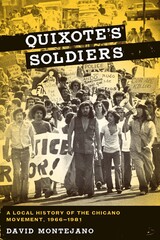

For Latina/o adolescents who already find life challenging, the borderland is a place that presents continual affirmations of and contradictions about identity—questions of who is more Mexican than American or vice versa. This book analyzes the construction of Mexicana/o and Chicana/o identities through a four-year ethnographic study in a representative American high school. It reveals how identity politics impacts young people’s forms of communication and the cultural spaces they occupy in the school setting. By showing how identities are created and directly influenced by the complexities of geopolitics and sociocultural influences, it stresses the largely unexplored divisions among youths whose identities are located along a wide continuum of “Mexicanness.”
Through in-depth interviews and focus groups with both Mexicana/o and Chicana/o students, Cynthia Bejarano explores such topics as the creation of distinct styles that reinforce differences between the two groups; the use of language to further distinguish themselves from one another; and social stratification perpetuated by internal colonialism and the “Othering” process. These and other issues are shown to complicate how Latinas/os ethnically identify as Mexicanas/os or Chicanas/os and help explain how they get to this point.
In contrast to research that views identity as a reflection of immigration or educational experiences, this study embraces border theory to frame the complex and conflicted relations of adolescents as a result of their identity-making processes. This intimate glimpse into their lives provides valuable information about the diversity among youths and their constant efforts to create, define, and shape their identities according to cultural and social structures.
READERS
Browse our collection.
PUBLISHERS
See BiblioVault's publisher services.
STUDENT SERVICES
Files for college accessibility offices.
RECENTLY PUBLISHED





UChicago Accessibility Resources
home | accessibility | search | about | contact us
BiblioVault ® 2001 - 2026
The University of Chicago Press