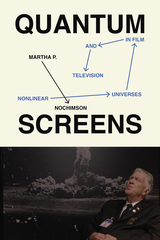
front cover of Quantum Screens
Quantum Screens
Nonlinear Universes in Film and Television
Martha P. Nochimson
University of Texas Press, 2026

An exploration of how nonlinear storytelling opens a post-Newtonian reality and changes both the hero’s journey and how we understand history in film and television.

Begin at the beginning and keep going until the end. That’s the cardinal rule of conventional storytelling. But ever since the modernists of the early twentieth century, popular narratives have occasionally eschewed this linear approach to temporality. It’s as though our stories, formerly unfolding in the stable, predictable universe of Newtonian physics, can now take place in multidimensional time where anything and anyone can be as incalculable as Schrödinger’s cat.

Quantum Screens is a journey through the past and present of nonlinear time in film and television. Moving beyond the early experiments of Luis Buñuel and the first nonlinear commercial films, such as 2001: A Space Odyssey, Martha Nochimson shows how risk-taking auteurs David Lynch, Damon Lindelof, and Terrence Malik have opened new horizons and a new concept of beauty in storytelling through their revelatory creations. Quantum Screens takes us deep into the audience’s experience of nonlinearity, exploring the emotional dislocations such storytelling creates, using television programs such as Twin Peaks, Westworld, and Watchmen, and films including The Tree of Life, BlacKkKlansman, and Arrival. Indeed, viewers are at the heart of a changing aesthetics of nonlinearity, Nochimson argues. Amid innovations like on-demand viewing, unlimited replay, and binge-watching, the experience of real time is more malleable than ever, and creators are responding by structuring their stories in compelling new ways.


[more]

logo for Harvard University Press
The Quattrocento Dialogue
Classical Tradition and Humanist Innovation
David Marsh
Harvard University Press, 1980

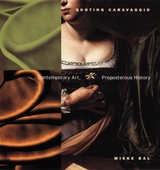
front cover of Quoting Caravaggio
Quoting Caravaggio
Contemporary Art, Preposterous History
Mieke Bal
University of Chicago Press, 1999
As period, as style, as sensibility, the Baroque remains elusive, its definition subject to dispute. Perhaps this is so in part because baroque vision resists separation of mind and body, form and matter, line and color, image and discourse. In Quoting Caravaggio, Mieke Bal deploys this insight of entanglement as a form of art analysis, exploring its consequences for both contemporary and historical art, as well as for current conceptions of history.

Mieke Bal’s primary object of investigation in Quoting Caravaggio is not the great seventeenth-century painter, but rather the issue of temporality in art. In order to retheorize linear notions of influence in cultural production, Bal analyzes the productive relationship between Caravaggio and a number of late-twentieth-century artists who "quote" the baroque master in their own works. These artists include Andres Serrano, Carrie Mae Weems, Ken Aptekar, David Reed, and Ana Mendieta, among others. Each chapter of Quoting Caravaggio shows particular ways in which quotation is vital to the new art but also to the source from which it is derived. Through such dialogue between present and past, Bal argues for a notion of "preposterous history" where works that appear chronologically first operate as an aftereffect caused by the images of subsequent artists.

Quoting Caravaggio is a rigorous, rewarding work: it is at once a meditation on history as creative, nonlinear process; a study of the work of Caravaggio and the Baroque; and, not least, a brilliant critical exposition of contemporary artistic representation and practice.


"[A] profoundly enlivening exercise in art criticism, in which the lens of theory magnifies rather than diminishes its object. . . . [A] remarkable book. . . . The power of Quoting Caravaggio resides in the intelligence and authority of the writer."—Roger Malbert, Times Literary Supplement
[more]


Send via email Share on Facebook Share on Twitter