
 A SCHOLARLY BOOK REPOSITORY
4 start with Q start with Q

The Queer Fantasies of the American Family Sitcom examines the evasive depictions of sexuality in domestic and family-friendly sitcoms. Tison Pugh charts the history of increasing sexual depiction in this genre while also unpacking how sitcoms use sexuality as a source of power, as a kind of camouflage, and as a foundation for family building. The book examines how queerness, at first latent, became a vibrant yet continually conflicted part of the family-sitcom tradition.
Taking into account elements such as the casting of child actors, the use of and experimentation with plot traditions, the contradictory interpretive valences of comedy, and the subtle subversions of moral standards by writers and directors, Pugh points out how innocence and sexuality conflict on television. As older sitcoms often sit on a pedestal of nostalgia as representative of the Golden Age of the American Family, television history reveals a deeper, queerer vision of family bonds.
Download open access ebook here.
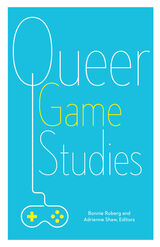
Video games have developed into a rich, growing field at many top universities, but they have rarely been considered from a queer perspective. Immersion in new worlds, video games seem to offer the perfect opportunity to explore the alterity that queer culture longs for, but often sexism and discrimination in gamer culture steal the spotlight. Queer Game Studies provides a welcome corrective, revealing the capacious albeit underappreciated communities that are making, playing, and studying queer games.
These in-depth, diverse, and accessible essays use queerness to challenge the ideas that have dominated gaming discussions. Demonstrating the centrality of LGBTQ issues to the gamer world, they establish an alternative lens for examining this increasingly important culture. Queer Game Studies covers important subjects such as the representation of queer bodies, the casual misogyny prevalent in video games, the need for greater diversity in gamer culture, and reading popular games like Bayonetta, Mass Effect, and Metal Gear Solid from a queer perspective.
Perfect for both everyday readers and instructors looking to add diversity to their courses, Queer Game Studies is the ideal introduction to the vast and vibrant realm of queer gaming.
Contributors: Leigh Alexander; Gregory L. Bagnall, U of Rhode Island; Hanna Brady; Mattie Brice; Derek Burrill, U of California, Riverside; Edmond Y. Chang, U of Oregon; Naomi M. Clark; Katherine Cross, CUNY; Kim d’Amazing, Royal Melbourne Institute of Technology; Aubrey Gabel, U of California, Berkeley; Christopher Goetz, U of Iowa; Jack Halberstam, U of Southern California; Todd Harper, U of Baltimore; Larissa Hjorth, Royal Melbourne Institute of Technology; Chelsea Howe; Jesper Juul, Royal Danish Academy of Fine Arts; merritt kopas; Colleen Macklin, Parsons School of Design; Amanda Phillips, Georgetown U; Gabriela T. Richard, Pennsylvania State U; Toni Rocca; Sarah Schoemann, Georgia Institute of Technology; Kathryn Bond Stockton, U of Utah; Zoya Street, U of Lancaster; Peter Wonica; Robert Yang, Parsons School of Design; Jordan Youngblood, Eastern Connecticut State U.
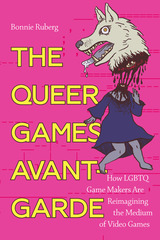
Interviewees:
Ryan Rose Aceae, Avery Alder, Jimmy Andrews, Santo Aveiro-Ojeda, Aevee Bee, Tonia B******, Mattie Brice, Nicky Case, Naomi Clark, Mo Cohen, Heather Flowers, Nina Freeman, Jerome Hagen, Kat Jones, Jess Marcotte, Andi McClure, Llaura McGee, Seanna Musgrave, Liz Ryerson, Elizabeth Sampat, Loren Schmidt, Sarah Schoemann, Dietrich Squinkifer, Kara Stone, Emilia Yang, Robert Yang
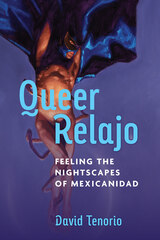
Combining readings of film, digital media, and performance with drag autoethnography, Queer Relajo quite literally plays with how relajo (or playfulness) structures the spaces of queer nightlife in urban contexts by revealing how nighttime intimacy can minimize the paralyzing effects of violence and precarity in a neoliberal Mexico. Considering the political implications of when a queer/trans person is present at night, Tenorio argues that queer feelings of play are not only essential to sexual liberation, but also resist neoliberal commodification and heteronormative extraction.
READERS
Browse our collection.
PUBLISHERS
See BiblioVault's publisher services.
STUDENT SERVICES
Files for college accessibility offices.
RECENTLY PUBLISHED




UChicago Accessibility Resources
home | accessibility | search | about | contact us
BiblioVault ® 2001 - 2026
The University of Chicago Press