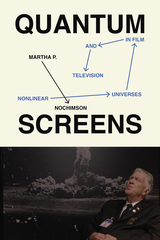
front cover of Quantum Screens
Quantum Screens
Nonlinear Universes in Film and Television
Martha P. Nochimson
University of Texas Press, 2026

An exploration of how nonlinear storytelling opens a post-Newtonian reality and changes both the hero’s journey and how we understand history in film and television.

Begin at the beginning and keep going until the end. That’s the cardinal rule of conventional storytelling. But ever since the modernists of the early twentieth century, popular narratives have occasionally eschewed this linear approach to temporality. It’s as though our stories, formerly unfolding in the stable, predictable universe of Newtonian physics, can now take place in multidimensional time where anything and anyone can be as incalculable as Schrödinger’s cat.

Quantum Screens is a journey through the past and present of nonlinear time in film and television. Moving beyond the early experiments of Luis Buñuel and the first nonlinear commercial films, such as 2001: A Space Odyssey, Martha Nochimson shows how risk-taking auteurs David Lynch, Damon Lindelof, and Terrence Malik have opened new horizons and a new concept of beauty in storytelling through their revelatory creations. Quantum Screens takes us deep into the audience’s experience of nonlinearity, exploring the emotional dislocations such storytelling creates, using television programs such as Twin Peaks, Westworld, and Watchmen, and films including The Tree of Life, BlacKkKlansman, and Arrival. Indeed, viewers are at the heart of a changing aesthetics of nonlinearity, Nochimson argues. Amid innovations like on-demand viewing, unlimited replay, and binge-watching, the experience of real time is more malleable than ever, and creators are responding by structuring their stories in compelling new ways.


[more]

front cover of Questions About Questions
Questions About Questions
Inquiries into the Cognitive Bases of Surveys
Judith M. Tanur
Russell Sage Foundation, 1992
The social survey has become an essential tool in modern society, providing crucial measurements of social change, describing social life, and guiding government policy. But the validity of surveys is fragile and depends ultimately upon the accuracy of answers to survey questions. As our dependence on surveys grows, so too have questions about the accuracy of survey responses. Authored by a group of experts in cognitive psychology, linguistics, and survey research, Questions About Questions provides a broad review of the survey response problem. Examining the cognitive and social processes that influence the answers to questions, the book first takes up the problem of meaning and demonstrates that a respondent must share the survey researcher's intended meaning of a question if the response is to be revealing and informative. The book then turns to an examination of memory. It provides a framework for understanding the processes that can introduce errors into retrospective reports, useful guidance on when those reports are more or less trustworthy, and investigates techniques for the improvement of such reports. Questions about the rigid standardization imposed on the survey interview receive a thorough airing as the authors show how traditional survey formats violate the usual norms of conversational behavior and potentially endanger the validity of the data collected. Synthesizing the work of the Social Science Research Council's Committee on Cognition and Survey Research, Questions About Questions emphasizes the reciprocal gains to be achieved when insights and techniques from the cognitive sciences and survey research are exchanged. "these chapters provide a good sense of the range of survey problems investigated by the cognitive movement, the methods and ideas it draws upon, and the results it has yielded." —American Journal of Sociology
[more]


Send via email Share on Facebook Share on Twitter