
 A SCHOLARLY BOOK REPOSITORY
13 start with R start with R

Redefining Heresy and Tolerance demonstrates how the political philosophies of toleration developed in the context of late Imperial China were different from the theories that emerged in the West during their time. Focusing on religious policy in the Qing Empire, Hung attempts to clarify the Qing toleration policies and the reasoning behind them. He also demonstrates how the Qing government prevented Confucian bureaucrats from interfering in the religious life of Christians and Muslims, and how the Confucians’ understanding of “religion” was reshaped in the period.
The volume uses a wide variety of ethnographic and historical sources to support its analysis, beginning with two detailed case studies of the religions practiced by Navajo Indians and Arab villagers. An intriguing comparison of these two systems of faith reveals the difficulty of finding one definition of religion. William Adams explores this problem of definition, suggesting that religion and science actually share the role of providing logical explanations in human society. In subsequent chapters, he considers the development of religious systems, the growth of religious consciousness in the individual, and the dynamics of religious change. The book ultimately aims to be a purely empirical study that probes the reasons for the existence of religion and its role as a moral and stabilizing force in human societies.
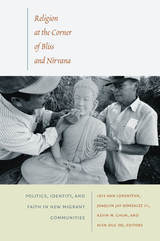
As they conducted research, the contributors not only visited churches and temples but also single-room-occupancy hotels, brothels, tattoo-removal clinics, and the streets of San Francisco, El Salvador, Mexico, and Vietnam. Their essays include an exploration of how faith-based organizations can help LGBT migrants surmount legal and social complexities, an examination of transgendered sex workers’ relationship with the unofficial saint Santisima Muerte, a comparison of how a Presbyterian mission and a Buddhist temple in San Francisco help Chinese immigrants to acculturate, and an analysis of the transformation of baptismal rites performed by Mayan migrants. The voices of gang members, Chinese and Vietnamese Buddhist nuns, members of Pentecostal churches, and many others animate this collection. In the process of giving voice to these communities, the contributors interrogate theories about acculturation, class, political and social capital, gender and sexuality, the sociology of religion, transnationalism, and globalization. The collection includes twenty-one photographs by Jerry Berndt.
Contributors. Luis Enrique Bazan, Kevin M. Chun, Hien Duc Do, Patricia Fortuny Loret de Mola, Joaquin Jay Gonzalez III, Sarah Horton, Cymene Howe, Mimi Khúc, Jonathan H. X. Lee, Lois Ann Lorentzen, Andrea Maison, Dennis Marzan, Rosalina Mira, Claudine del Rosario, Susanna Zaraysky
As the contributors to this work suggest, a crucial component of globalization—the breakdown of familiar boundaries and power balances—may open a space in which religion can be deployed to help refabricate new communities. Examples of such deployments can be found in the workings of liberation theology in Latin America. In other cases, however, the operations of globalization have provided a space for strident religious nationalism and identity disputes to flourish. Is there in fact a dialectical tension between religion and globalization, a codependence and codeterminism? While religion can be seen as a globalizing force, it has also been transformed and even victimized by globalization.
A provocative assessment of a contemporary phenomenon with both cultural and political dimensions, Religions/Globalizations will interest not only scholars in religious studies but also those studying Latin America, the Middle East, South Asia, and Africa.
Contributors. David Batstone, Berit Bretthauer, Enrique Dussel, Dwight N. Hopkins, Mark Juergensmeyer, Lois Ann Lorentzen, Eduardo Mendieta, Vijaya Rettakudi Nagarajan, Kathryn Poethig, Lamin Sanneh, Linda E. Thomas
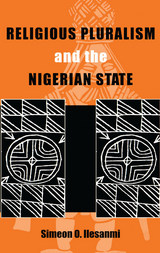
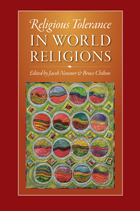
Today, and historically, religions often seem to be intolerant, narrow-minded, and zealous. But the record is not so one-sided. In Religious Tolerance in World Religions, numerous scholars offer perspectives on the "what" and "why" traditions of tolerance in world religions, beginning with the pre-Christian West, Greco-Roman paganism, and ancient Israelite Monotheism and moving into modern religions such as Christianity, Judaism, Islam, Buddhism, and Hinduism. By tolerance the authors mean "the capacity to live with religious difference, and by toleration, the theory that permits a majority religion to accommodate the presence of a minority religion."
The volume is introduced with a summary of a recent survey that sought to identify the capacity of religions to tolerate one another in theory and in practice. Eleven religious communities in seven nations were polled on questions that ranged from equality of religious practitioners to consequences of disobedience. The essays frame the provocative analysis of how a religious system in its political statement produces categories of tolerance that can be explained in that system’s logical context. Past and present beliefs, practices, and definitions of social order are examined in terms of how they support tolerance for other religious groups as a matter of public policy.
Religious Tolerance in World Religions focuses attention on the attitude "that the ’infidel’ or non-believer may be accorded an honorable position within the social order defined by Islam or Christianity or Judaism or Buddhism or Hinduism, and so on." It is a timely reference for colleges and universities and for makers of public policy.

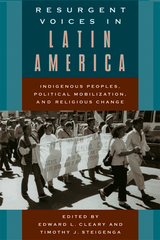
After more than 500 years of marginalization, Latin America’s forty million Indians have recently made major strides in gaining political recognition and civil rights. In this book, social scientists explore the important role of religion in indigenous activism, showing the ways that religion has strengthened indigenous identity and contributed to the struggle for indigenous rights in the region.
Drawing on case studies from Bolivia, Peru, Guatemala, Ecuador, Paraguay, and Mexico, the contributors explore four key questions. How have traditional religions interacted with Christianity to produce new practices and beliefs? What resources, motivations, and ideological legitimacies do religious institutions provide for indigenous social movements? How effective are these movements in achieving their goals? Finally, as new religious groups continue to compete for adherents in the region, how will individuals’ religious choices affect political outcomes?
Resurgent Voices in Latin America offers new insight into the dynamics of indigenous social movements and into the complex and changing world of Latin American religions. The essays show that religious beliefs, practices, and institutions have both affected and been affected by political activism.
Expanding the scope of religious rhetoric
Over the past twenty-five years, the intersection of rhetoric and religion has become one of the most dynamic areas of inquiry in rhetoric and writing studies. One of few volumes to include multiple traditions in one conversation, Rhetoric and Religion in the Twenty-First Century engages with religious discourses and issues that continue to shape public life in the United States.
This collection of essays centralizes the study of religious persuasion and pluralism, considers religion’s place in U.S. society, and expands the study of rhetoric and religion in generative ways. The volume showcases a wide range of religious traditions and challenges the very concepts of rhetoric and religion. The book’s eight essays explore African American, Buddhist, Christian, Indigenous, Islamic, and Jewish rhetoric and discuss the intersection of religion with feminism, race, and queer rhetoric—along with offering reflections on how to approach religious traditions through research and teaching. In addition, the volume includes seven short interludes in which some of the field’s most accomplished scholars recount their experiences exploring religious rhetorics and invite readers to engage these exigent lines of inquiry.
By featuring these diverse religious perspectives, Rhetoric and Religion in the Twenty-First Century complicates the field’s emphasis on Western, Hellenistic, and Christian ideologies. The collection also offers teachers of writing and rhetoric a range of valuable approaches for preparing today’s students for public citizenship in our religiously diverse global context.
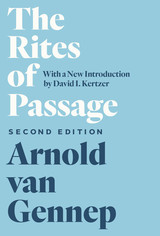
With a new introduction by Pulitzer Prize–winner David I. Kertzer
Arnold van Gennep’s masterwork, The Rites of Passage, has been a staple of anthropological education for more than a century. First published in French in 1909, and translated into English by the University of Chicago Press in 1960, this landmark book explores how the life of an individual in any society can be understood as a succession of transitions: birth, puberty, marriage, parenthood, old age, and, finally, death. Van Gennep’s great insight was discerning a common structure in each of these seemingly different transitions, involving rituals of separation, liminality, and incorporation. With compelling precision, he set out the terms that would both define twentieth-century ritual theory and become a part of our everyday lexicon.
This new edition of his work demonstrates how we can still make use of its enduring critical tools to understand our own social, religious, and political worlds, and even our personal and professional lives. In his new introduction, Pulitzer Prize–winning historian and anthropologist David I. Kertzer sheds new light on van Gennep, on the battles he fought, and on the huge impact the book has had since publication of the first English edition.
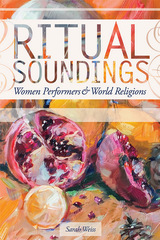
In Ritual Soundings, Sarah Weiss reads deeply into and across the ethnographic details of multiple studies while offering a robust framework for studying music and world religion. Her meta-ethnography reveals surprising patterns of similarity between unrelated cultures. Deftly blending ethnomusicology, the study of gender in religion, and sacred music studies, she invites ethnomusicologists back into comparative work, offering them encouragement to think across disciplinary boundaries. As Weiss delves into a number of less-studied rituals, she offers a forceful narrative of how women assert agency within institutional religious structures while remaining faithful to the local cultural practices the rituals represent.
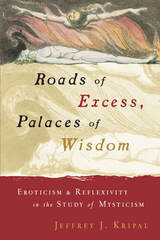
In his new book, Kripal addresses the twentieth-century study of mysticism as a kind of mystical tradition in its own right, with its own unique histories, discourses, sociological dynamics, and rhetorics of secrecy. Fluidly combining autobiography and biography with scholarly exploration, Kripal takes us on a tour of comparative mystical thought by examining the lives and works of five major historians of mysticism—Evelyn Underhill, Louis Massignon, R. C. Zaehner, Agehananda Bharati, and Elliot Wolfson—as well as relating his own mystical experiences. The result, Kripal finds, is seven "palaces of wisdom": the religious power of excess, the necessity of distance in the study of mysticism, the relationship between the mystical and art, the dilemmas of male subjectivity and modern heterosexuality, a call for ethical criticism, the paradox of the insider-outsider problem in the study of religion, and the magical power of texts and their interpretation.
An original and penetrating analysis of modern scholarship and scholars of mysticism, Roads of Excess, Palaces of Wisdom is also a persuasive demonstration of the way this scholarly activity is itself a mystical phenomenon.
READERS
Browse our collection.
PUBLISHERS
See BiblioVault's publisher services.
STUDENT SERVICES
Files for college accessibility offices.
RECENTLY PUBLISHED




UChicago Accessibility Resources
home | accessibility | search | about | contact us
BiblioVault ® 2001 - 2026
The University of Chicago Press