
 A SCHOLARLY BOOK REPOSITORY
5 start with R start with R
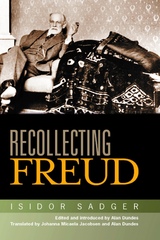
As a student, Sadger attended Freud's lectures from 1895 through 1904. Two years later Freud nominated Sadger to his Wednesday Psychological Society (later called the Viennese Psychoanalytic Society). Sadger, however, was not part of Freud's inner circle, but more a participant observer of the early years of the psychoanalytic movement and of Freud as teacher, therapist, and clinician.
Sadger was considered one of the most devoted followers of Freud and hoped to become one of Freud's "favorite sons." At the First Psychoanalytic Congress held in Salzburg in 1908, Sadger was chosen to be one of the principal speakers along with Freud, Jones, Alder, Jung, Prince, Rifkin, Abraham, and Stekel, an honor that bespeaks Sadger's early role in the movement. But Freud and many of his disciples were also openly critical of Sadger's work, calling it at various times overly simplistic, unimaginative, reductionist, orthodox, and rigid.
In 1930 Sadger published his memoir, Sigmund Freud: Persönliche Erinnerungen. With the rise of Nazism and World War II, the book became lost to the world of psychoanalytic history. Recently, Alan Dundes learned of its existence and mounted a search that led him around the world to one of the few extant copies—in a research library in Japan. The result of his fascinating quest is Recollecting Freud, a long-lost personal account that provides invaluable insights into Freud and his social, cultural, and intellectual context.
There are more psychoanalytic theories today than anyone knows what to do with, and the heterogeneity and complexity of the entire body of psychoanalytic though have become staggering. In Relational Concepts in Psychoanalysis, Stephen A. Mitchell weaves strands from the principal relational-model traditions (interpersonal psychoanalysis, British school object-relations theories, self psychology, and existential psychoanalysis) into a comprehensive approach to many of the knottiest problems and controversies in theoretical and clinical psychoanalysis.
Mitchell’s earlier book, Object Relations in Psychoanalytic Theory, co-authored with Jay Greenberg, set the stage for this current integration by providing a broad comparative analysis of important thinking on the nature of human relationships. In that classic study Greenberg and Mitchell distinguished between two basic paradigms: the drive model, in which relations with others are generated and shaped by the need for drive gratifications, and various relational models, in which relations themselves are taken as primary and irreducible. In Relational Concepts in Psychoanalysis, Mitchell argues that the drive model has since outlived its usefulness. The relational model, on the other hand, has been developed piecemeal by different authors who rarely acknowledge and explore the commonality of their assumptions or the rich complementarity of their perspectives.
In this bold effort at integrative theorizing, Mitchell draws together major lines of relational-model traditions into a unified framework for psychoanalytic thought, more economical than the anachronistic drive model and more inclusive than any of the singular relational approaches to the core significance of sexuality, the impact of early experience, the relation of the past to the present, the interpenetration of illusion and actuality, the centrality of the will, the repetition of painful experience, the nature of analytic situation, and the process of analytic change. As such, his book will be required reading for psychoanalytic scholars, practitioners, candidates in psychoanalysis, and students in the field.
---Louis Sass, author of Madness and Modernism
"The scope of this book is daunting, ranging from madness in the ancient Greco-Roman world, to Christianized concepts of medieval folly, through the writings of early modern authors such as Shakespeare, Cervantes, and Descartes, and on to German Romantic philosophy, fin de siècle French poetry, and Freud . . . Artaud, Duras, and Plath."
---Isis
"This provocative and closely argued work will reward many readers."
---Choice
In Revels in Madness, Allen Thiher surveys a remarkable range of writers as he shows how conceptions of madness in literature have reflected the cultural assumptions of their era. Thiher underscores the transition from classical to modern theories of madness-a transition that began at the end of the Enlightenment and culminates in recent women's writing that challenges the postmodern understanding of madness as a fall from language or as a dysfunction of culture.
As psychoanalysis approaches its second century, it seems no closer to being a science than when Freud first invented the discipline. All the clinical experience of the past hundred years, Donald Spence tells us in this trenchant book, has not overcome a tendency to decouple theory from evidence. Deprived of its observational base, theory operates more like shared fantasy. In support of this provocative claim, Spence mounts a powerful critique of the way psychoanalysis functions—as a clinical method and as a scholarly discipline or “science.” In the process, he prescribes an antidote for the uncontrolled rhetoric that currently governs psychoanalytic practice.
The reliance on rhetoric is the problem Spence identifies, and he attributes the troubling lack of progress in psychoanalysis to its outmoded method of data collection and its preference for fanciful argument over hard fact. Writing to Jung in 1911, Freud admitted that he “was not at all cut out to be an inductive researcher—I was entirely meant for intuition.” His intuitive approach led him to retreat form traditional Baconian principles of inductive investigation and to move toward a more Aristotelian approach that emphasized choice specimens and favorite examples, played down replication, and depended on arguments based on authority. Detailing this development, with particular attention to the role of self-analysis in the Freudian myth and the evidential drawbacks of the case study genre, Spence shows how psychoanalysis was set on its present course and how rhetorical maneuvers have taken the place of evidence.
With this diagnosis, Spence offers a remedy—an example of the sort of empirical research that can transform clinical wisdom into useful knowledge. His book holds out the hope that, by challenging the traditions and diminishing the power rhetoric, psychoanalysis can remain a creative enterprise, but one based on a solid scientific foundation.

This book describes and contrasts various psychiatric teaching programs in medical schools. After an examination of the differing and frequently unsatisfactory states of these programs, it also proposes a comprehensive plan for the future.
In preparing this study the author visited numerous medical schools, observing a wide range of teaching methods, goals, and facilities. His aim here is fourfold: to describe and compare existing medical school psychiatry programs in detail; to illustrate by example and anecdote the relation of teachers and students to these programs; to construct a synthesis of existing psychiatry programs that will offer optimum training and to outline a new program based on this synthesis and some additional proposals; and finally to show how methodology is a crucial but as yet unappreciated part of many psychiatry programs.
Dr. Werkman attempts to be a reporter in depth to his psychiatric colleagues about new and important developments in modern psychiatric teaching. The great scope and variety which the field of psychiatry has acquired since the Second World War has often meant that psychiatrists know little in detail of what their colleagues are doing. The author finds as well that there is often a lack of communication both within a single department and between departments in different medical schools, and that the attitude of many non-psychiatrists on the faculties ranges from ignorance to hostility--an attitude often reflected by the students.
READERS
Browse our collection.
PUBLISHERS
See BiblioVault's publisher services.
STUDENT SERVICES
Files for college accessibility offices.
RECENTLY PUBLISHED






UChicago Accessibility Resources
home | accessibility | search | about | contact us
BiblioVault ® 2001 - 2026
The University of Chicago Press