
 A SCHOLARLY BOOK REPOSITORY
7 start with R start with R
The answer turns out to be surprising and rich. The space between stars is filled with an exotic substance called “dark matter” that exerts gravity but does not emit, absorb, or reflect light. The space between galaxies is rife with “dark energy” that creates a sort of cosmic antigravity causing the expansion of the universe to accelerate. Together, dark matter and dark energy account for 95 percent of the content of the universe. News reporters and science journalists routinely talk about these findings using terms that they assume we have a working knowledge of, but do you really understand how astronomers arrive at their findings or what it all means?
Cosmologists face a conundrum: how can we study substances we cannot see, let alone manipulate? A powerful approach is to observe objects whose motion is influenced by gravity. Einstein predicted that gravity can act like a lens to bend light. Today we see hundreds of cases of this—instances where the gravity of a distant galaxy distorts our view of a more distant object, creating multiple images or spectacular arcs on the sky. Gravitational lensing is now a key part of the international quest to understand the invisible substance that surrounds us, penetrates us, and binds the universe together.
A Ray of Light in a Sea of Dark Matter offers readers a concise, accessible explanation of how astronomers probe dark matter. Readers quickly gain an understanding of what might be out there, how scientists arrive at their findings, and why this research is important to us. Engaging and insightful, Charles Keeton gives everyone an opportunity to be an active learner and listener in our ever-expanding universe.
The parts of the solar system that are most accessible from Earth—the Moon, the near-Earth asteroids, Mars and its moons—are rich in materials of great potential value to humanity. Resources of Near-Earth Space explores the possibilities both of utilizing these materials to produce propellants, structural metals, refractories, life-support fluids, and other materials on site to reduce the costs of space exploration, and of providing a source of materials and energy for our own planet that would not be environmentally destructive to Earth.This volume summarizes the present state of the art in attempts to realize these possibilities: identifying the resources, mining and processing, transportation, and economics. As a broad survey of a rapidly evolving field, it is intended as a technical introduction to the use of nonterrestrial materials for scientists, engineers, and industrial and governmental project managers who seek to make space more accessible.
When the first X-ray detectors revealed many places in the universe that are too hot to be seen by optical and radio telescopes, pioneering X-ray astronomers realized they were onto something big. They knew that a large X-ray observatory must be created if they were ever to understand such astonishing phenomena as neutron stars, supernovas, black holes, and dark matter. What they could not know was how monumental in time, money, and effort this undertaking would be. Revealing the Universe tells the story of the Chandra X-ray Observatory.
From the first proposal for a large X-ray telescope in 1970 to the deployment of Chandra by the Space Shuttle Columbia in 1999, this book chronicles the technical feats, political struggles, and personal dramas that transformed an inspired vision into the world's supreme X-ray observatory. With an insider's knowledge and a storyteller's instincts, Wallace and Karen Tucker describe the immense challenges that this project posed for such high-tech industry giants as TRW, Eastman Kodak, and Hughes Danbury Optical Systems (now Raytheon Optical Systems). Their portrayal of the role of NASA is itself an extraordinary case study of multibillion-dollar government decisionmaking, and a cautionary tale for future large space astronomy missions.Revealing the Universe is primarily the story of the men and women whose discoveries, skills, failures, and successes made the Chandra X-ray Observatory possible.
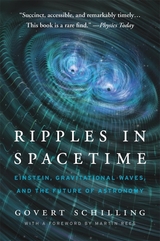
It has already been called the scientific breakthrough of the century: the detection of gravitational waves. Einstein predicted these tiny ripples in the fabric of spacetime nearly a hundred years ago, but they were never perceived directly until now. Decades in the making, this momentous discovery has given scientists a new understanding of the cataclysmic events that shape the universe and a new confirmation of Einstein’s theory of general relativity. Ripples in Spacetime is an engaging account of the international effort to complete Einstein’s project, capture his elusive ripples, and launch an era of gravitational-wave astronomy that promises to explain, more vividly than ever before, our universe’s structure and origin.
The quest for gravitational waves involved years of risky research and many personal and professional struggles that threatened to derail one of the world’s largest scientific endeavors. Govert Schilling takes readers to sites where these stories unfolded—including Japan’s KAGRA detector, Chile’s Atacama Cosmology Telescope, the South Pole’s BICEP detectors, and the United States’ LIGO labs. He explains the seeming impossibility of developing technologies sensitive enough to detect waves from two colliding black holes in the very distant universe, and describes the astounding precision of the LIGO detectors. Along the way Schilling clarifies concepts such as general relativity, neutron stars, and the big bang using language that readers with little scientific background can grasp.
Ripples in Spacetime provides a window into the next frontiers of astronomy, weaving far-reaching predictions and discoveries into a gripping story of human ambition and perseverance.
A Physics Today Best Book of the Year
A Forbes “For the Physics and Astronomy Lover in Your Life” Selection
“Succinct, accessible, and remarkably timely… This book is a rare find.”
—Physics Today
“Belongs on the shelf of anyone interested in learning the scientific, historical, and personal stories behind some of the most incredible scientific advances of the 21st century.”
—Forbes
The detection of gravitational waves has already been called the scientific breakthrough of the century. Einstein predicted these tiny ripples in the fabric of spacetime over a hundred years ago, but they were only recently perceived directly for the first time. Ripples in Spacetime is an engaging account of the international effort to complete Einstein’s project, capture his elusive ripples, and launch an era of gravitational-wave astronomy that promises to explain, more vividly than ever before, our universe’s structure and origin.
“Schilling’s deliciously nerdy grand tour takes us through compelling backstory, current research, and future expectations.”
—Nature
“A lively and readable account… Schilling underlines that this discovery is the opening of a new window on the universe, the beginning of a new branch of science.”
—Graham Farmelo, The Guardian
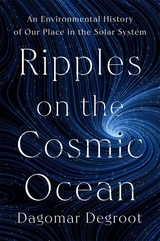
The untold story of how environmental change throughout the cosmos shaped five hundred years of human civilization.
Our solar system is a dynamic arena where asteroids careen off course and solar winds hurl charged particles across billions of miles of space. Yet we seldom consider how these events, so immense in scale, influence our fragile blue planet: Earth.
In Ripples on the Cosmic Ocean, Dagomar Degroot traces the surprising threads linking human endeavor to the rest of the solar system. He reveals how variability in planetary environments has shaped geopolitics, spurred scientific and cultural innovation, and encouraged new ideas about the emergence and fate of life. Martian dust storms altered the trajectory of the Cold War and inspired fantastical stories about alien civilizations. Comet impacts on Jupiter led to the first planetary defense strategy. And volcanic eruptions spewed sulfuric acid into Venus’s atmosphere, exposing the existential risks of climate change at home.
As we stand on the brink of a new era of space settlement, cosmic environments are becoming increasingly vulnerable to human activity. They may also hold the key to slowing the destruction of environments on Earth. Ripples on the Cosmic Ocean urges us to develop an interplanetary environmentalism across a vast mosaic of entangled worlds and to consider the profound connections that bind us to the cosmos and each other.
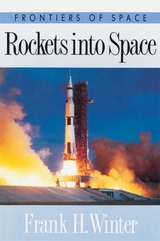
Since ancient times, men and women have dreamed of soaring among the stars, but only in this century has that dream been realized. In Rockets into Space, Frank Winter tells the fascinating story of the modern launch vehicle, from the mythological musings of the Babylonians and Greeks to the present-day reality of manned and unmanned space flight.
In concise yet comprehensive chapters dense with anecdotal detail, Winter tracks the theoretical formulations and technological breakthroughs that have charted the evolution of rocket propulsion and vehicle design. He pays particular attention to the remarkable contributions of pioneers Konstantin Tsiolkovsky, Robert Goddard, Hermann Oberth, Eugen Sänger, and Sergei Korolev, whose genius and vision paved the way for later innovation. He describes the clandestine development of the V-2 rocket in Germany, under the technical leadership of Wernher von Braun, and its dramatic impact on postwar rocket research and satellite development in the United States and the Soviet Union. He also chronicles the complex events of the last three decades, which have produced ever more sophisticated rockets capable of launching larger payloads, from weapons to weather and communications satellites. Finally, he surveys exotic propulsion systems—nuclear, electric, solar, photon, laser—that lie on the frontiers of science today but that will shape the spaceflight and space policy decisions of tomorrow.
Rockets into Space is an authoritative, entertaining guidebook for all who are interested in the history of space travel.
READERS
Browse our collection.
PUBLISHERS
See BiblioVault's publisher services.
STUDENT SERVICES
Files for college accessibility offices.
RECENTLY PUBLISHED






UChicago Accessibility Resources
home | accessibility | search | about | contact us
BiblioVault ® 2001 - 2026
The University of Chicago Press