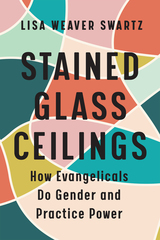
front cover of Stained Glass Ceilings
Stained Glass Ceilings
How Evangelicals Do Gender and Practice Power
Lisa Weaver Swartz
Rutgers University Press, 2023
Stained Glass Ceilings speaks to the intersection of gender and power within American evangelicalism by examining the formation of evangelical leaders in two seminary communities.Southern Baptist Theological Seminary inspires a vision of human flourishing through gender differentiation and male headship. Men practice “Godly Manhood," and are taught to act as the "head" of a family, while their wives are socialized into codes of “Godly Womanhood" that prioritize prescribed gender roles. This power structure privileges men yet offers agency to their wives in women-centered spaces and through marital relationships. Meanwhile, Asbury Theological Seminary promises freedom from gendered hierarchies. Appealing to a story of gender-blind equality, Asbury welcomes women into classrooms, administrative offices, and pulpits. But the institution’s construction of egalitarianism obscures the fact that women are rewarded for adapting to an existing male-centered status quo rather than for developing their own voices as women. Featuring high-profile evangelicals such as Al Mohler and Owen Strachan, along with young seminarians poised to lead the movement in the coming decades, Stained Glass Ceilings illustrates the liabilities of white evangelical toolkits and argues that evangelical culture upholds male-centered structures of power even as it facilitates meaning and identity.
[more]

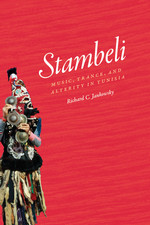
front cover of Stambeli
Stambeli
Music, Trance, and Alterity in Tunisia
Richard C. Jankowsky
University of Chicago Press, 2010
In Stambeli, Richard C. Jankowsky presents a vivid ethnographic account of the healing trance music created by the descendants of sub-Saharan slaves brought to Tunisia during the eighteenth and nineteenth centuries. Stambeli music calls upon an elaborate pantheon of sub-Saharan spirits and North African Muslim saints to heal humans through ritualized trance. Based on nearly two years of participation in the musical, ritual, and social worlds of stambeli musicians, Jankowsky’s study explores the way the music evokes the cross-cultural, migratory past of its originators and their encounters with the Arab-Islamic world in which they found themselves. Stambeli, Jankowsky avers, is thoroughly marked by a sense of otherness—the healing spirits, the founding musicians, and the instruments mostly come from outside Tunisia—which creates a unique space for profoundly meaningful interactions between sub-Saharan and North African people, beliefs, histories, and aesthetics.

Part ethnography, part history of the complex relationship between Tunisia’s Arab and sub-Saharan populations, Stambeli will be welcomed by scholars and students of ethnomusicology, anthropology, African studies, and religion.
[more]

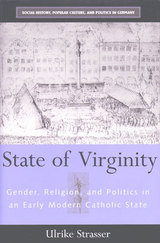
front cover of State of Virginity
State of Virginity
Gender, Religion, and Politics in an Early Modern Catholic State
Ulrike Strasser
University of Michigan Press, 2006

Winner: 2005 Book Award from the Society for the Study of Early Modern Women; Selected by the German Studies Association as one of the top five books of 2004 in early modern history

"A fresh, original study of gender roles and religious ideology in the early modern Catholic state. . . . Using a rich array of archival sources, Strasser explores ways in which an increasingly centralized Bavarian government in Munich inaugurated marriage and convent reforms and a civil religion based on the veneration of the Virgin Mary. Her carefully selected case studies show how church and state collaborated to produce a shared discourse and consistent policies proscribing extramarital sex, and excluding those without property from marriage. "

Choice

Ulrike Strasser is Associate Professor of History, Affiliate Faculty in Women's Studies, and Core Faculty in Religious Studies at the University of California, Irvine.
[more]

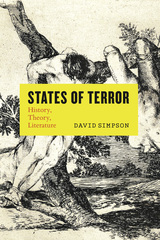
front cover of States of Terror
States of Terror
History, Theory, Literature
David Simpson
University of Chicago Press, 2019
How have we come to depend so greatly on the words terror and terrorism to describe broad categories of violence? David Simpson offers here a philology of terror, tracking the concept’s long, complicated history across literature, philosophy, political science, and theology—from Plato to NATO.

Introducing the concept of the “fear-terror cluster,” Simpson is able to capture the wide range of terms that we have used to express extreme emotional states over the centuries—from anxiety, awe, and concern to dread, fear, and horror. He shows that the choices we make among such words to describe shades of feeling have seriously shaped the attribution of motives, causes, and effects of the word “terror” today, particularly when violence is deployed by or against the state. At a time when terror-talk is widely and damagingly exploited by politicians and the media, this book unpacks the slippery rhetoric of terror and will prove a vital resource across humanistic and social sciences disciplines.
 
[more]

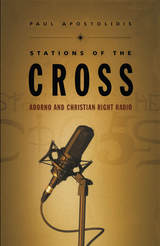
front cover of Stations of the Cross
Stations of the Cross
Adorno and Christian Right Radio
Paul Apostolidis
Duke University Press, 2000
Since the 1970s, American society has provided especially fertile ground for the growth of the Christian right and its influence on both political and cultural discourse. In Stations of the Cross political theorist Paul Apostolidis shows how a critical component of this movement’s popular culture—evangelical conservative radio—interacts with the current U.S. political economy. By examining in particular James Dobson’s enormously influential program, Focus on the Family—its messages, politics, and effects—Apostolidis reveals the complex nature of contemporary conservative religious culture.
Public ideology and institutional tendencies clash, the author argues, in the restructuring of the welfare state, the financing of the electoral system, and the backlash against women and minorities. These frictions are nowhere more apparent than on Christian right radio. Reinvigorating the intellectual tradition of the Frankfurt School, Apostolidis shows how ideas derived from early critical theory—in particular that of Theodor W. Adorno—can illuminate the political and social dynamics of this aspect of contemporary American culture. He uses and reworks Adorno’s theories to interpret the nationally broadcast Focus on the Family, revealing how the cultural discourse of the Christian right resonates with recent structural transformations in the American political economy. Apostolidis shows that the antidote to the Christian right’s marriage of religious and market fundamentalism lies not in a reinvocation of liberal fundamentals, but rather depends on a patient cultivation of the affinities between religion’s utopian impulses and radical, democratic challenges to the present political-economic order.
Mixing critical theory with detailed analysis, Stations of the Cross provides a needed contribution to sociopolitical studies of mass movements and will attract readers in sociology, political science, philosophy, and history.
[more]

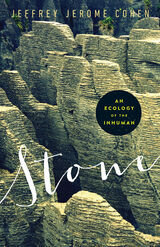
front cover of Stone
Stone
An Ecology of the Inhuman
Jeffrey Jerome Cohen
University of Minnesota Press, 2015

Stone maps the force, vivacity, and stories within our most mundane matter, stone. For too long stone has served as an unexamined metaphor for the “really real”: blunt factuality, nature’s curt rebuke. Yet, medieval writers knew that stones drop with fire from the sky, emerge through the subterranean lovemaking of the elements, tumble along riverbeds from Eden, partner with the masons who build worlds with them. Such motion suggests an ecological enmeshment and an almost creaturely mineral life.

Although geological time can leave us reeling, Jeffrey Jerome Cohen argues that stone’s endurance is also an invitation to apprehend the world in other than human terms. Never truly inert, stone poses a profound challenge to modernity’s disenchantments. Its agency undermines the human desire to be separate from the environment, a bifurcation that renders nature “out there,” a mere resource for recreation, consumption, and exploitation.

Written with great verve and elegance, this pioneering work is notable not only for interweaving the medieval and the modern but also as a major contribution to ecotheory. Comprising chapters organized by concept —“Geophilia,” “Time,” “Force,” and “Soul”—Cohen seamlessly brings together a wide range of topics including stone’s potential to transport humans into nonanthropocentric scales of place and time, the “petrification” of certain cultures, the messages fossils bear, the architecture of Bordeaux and Montparnasse, Yucca Mountain and nuclear waste disposal, the ability of stone to communicate across millennia in structures like Stonehenge, and debates over whether stones reproduce and have souls.

Showing that what is often assumed to be the most lifeless of substances is, in its own time, restless and forever in motion, Stone fittingly concludes by taking us to Iceland⎯a land that, writes the author, “reminds us that stone like water is alive, that stone like water is transient.”
[more]

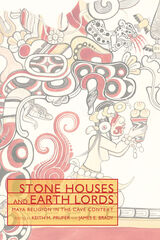
front cover of Stone Houses and Earth Lords
Stone Houses and Earth Lords
Maya Religion in the Cave Context
Keith M. Prufer
University Press of Colorado, 2021
Cave archaeology in the New World, now a focus of intense research, was still a peripheral area of inquiry just fifteen years ago. Stone Houses and Earth Lords is the first volume dedicated exclusively to the use of caves in the Maya Lowlands, covering primarily Classic Period archaeology from A.D. 100 through the Spaniards' arrival. Although the caves that riddled the lowlands show no signs of habitation, most contain evidence of human use - evidence that suggests that they functioned as ritual spaces.

Demonstrating the importance of these subterranean spaces to Maya archaeology, contributors provide interpretations of archaeological remains that yield insights into Maya ritual and cosmology. Compiling the best current scholarship in this fast-growing area of research, Stone Houses and Earth Lords is a vital reference for Mayanists, Mesoamerican specialists, and others interested in the human use of caves in the New World. Contributors include: Juan Luis Bonor, James E. Brady, Robert Burnett, Allan B. Cobb, Pierre Robert Colas, Cesar Espinosa, Sergio Garza, David M. Glassman, Christina T. Halperin, Amalia Kenward, Andrew Kindon, Patricia McAnany, Christopher Morehart, Holley Moyes, Vanessa A. Owen, Shankari Patel, Polly Peterson, Keith M. Prufer, Timothy. W. Pugh, Frank Saul, Julie Saul, Ann M. Scott, Andrea Stone, and Vera Tiesler.
[more]

front cover of Stones, Bones, and the Sacred
Stones, Bones, and the Sacred
Essays on Material Culture and Ancient Religion in Honor of Dennis E.
Alan H. Cadwallader
SBL Press, 2016

A crucial text for any university course on the interaction of archaeology and the Bible

The world of early Christians was not a world lived in texts; it was a world saturated with material reality and concerns: what, where and when to eat or drink; how to present oneself in the space of bodily life and that of death; how to move from one place to another; what impacted status or the adjudication of legal charges. All these and more controlled so much of life in the ancient world. The Christians were not immune from the impact of these realities. Sometimes they absorbed their surrounds; sometimes they quite explicitly rejected the material practices bearing in on them; frequently they modified the practice and the rationale to create a significant Christian alternative. The collection of essays in this volume come from a range of international scholars who, for all their different interests and critical commitments, are yet united in treasuring research into the Greek and Roman worlds in which Christians sought to make their way. They offer these essays in honor of one who has made a lifetime's work in mining ancient material culture to extract nuggets of insight into early Christian dining practices: Dennis E. Smith.

Features

  • Rich examples of method in the utilization of ancient material culture for biblical interpretation.
  • Thirteen essays with a response from Dennis E. Smith
  • Maps, diagrams, and plates
[more]

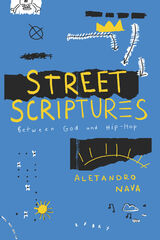
front cover of Street Scriptures
Street Scriptures
Between God and Hip-Hop
Alejandro Nava
University of Chicago Press, 2022
This book explores an important aspect of hip-hop that is rarely considered: its deep entanglement with spiritual life.
 
The world of hip-hop is saturated with religion, but rarely is that element given serious consideration. In Street Scriptures, Alejandro Nava focuses our attention on this aspect of the music and culture in a fresh way, combining his profound love of hip-hop, his passion for racial and social justice, and his deep theological knowledge. Street Scriptures offers a refreshingly earnest and beautifully written journey through hip-hop’s deep entanglement with the sacred.
 
Nava reveals a largely unheard religious heartbeat in hip-hop, exploring crosscurrents of the sacred and profane in rap, reggaeton, and Latinx hip-hop today. Ranging from Kendrick Lamar, Chance the Rapper, Lauryn Hill, Cardi B, and Bad Bunny to St. Augustine and William James, Nava examines the ethical-political, mystical-prophetic, and theological qualities in hip-hop, probing the pure sonic and aesthetic signatures of music, while also diving deep into the voices that invoke the spirit of protest. The result is nothing short of a new liberation theology for our time, what Nava calls a “street theology.”
[more]

front cover of Strictly Observant
Strictly Observant
Amish and Ultra-Orthodox Jewish Women Negotiating Media
Rivka Neriya-Ben Shahar
Rutgers University Press, 2024
Yonathan Shapiro Best Book Award from the Association for Israel Studies 

The Amish and ultra-Orthodox Jewish communities have typically been associated with strict religious observance, a renunciation of worldly things, and an obedience of women to men. Women’s relationship to media in these communities, however, betrays a more nuanced picture of the boundaries at play and women’s roles in negotiating them.
 
Strictly Observant presents a compelling ethnographic study of the complex dynamic between women in both the Pennsylvanian Old Order Amish and Israeli ultra-Orthodox Jewish communities and contemporary media technologies. These women regularly establish valuable social, cultural, and religious capital through the countless decisions for use and nonuse of media that they make in their daily lives, and in ways that challenge the gender hierarchies of each community. By exhibiting a deep awareness of how media can be managed to increase their social and religious reputations, these women prompt us to reconsider our outmoded understanding of the Amish and ultra-Orthodox Jewish communities, the role that women play in these communities as agents of change, and our own relationship to media today.
 
[more]

front cover of Struggle for the Soul of the Postwar South
Struggle for the Soul of the Postwar South
White Evangelical Protestants and Operation Dixie
Elizabeth Fones-Wolf and Ken Fones-Wolf
University of Illinois Press, 2015
In 1946, the Congress of Industrial Organizations (CIO) undertook Operation Dixie, an initiative to recruit industrial workers in the American South. Elizabeth and Ken Fones-Wolf plumb rarely used archival sources and rich oral histories to explore the CIO's fraught encounter with the evangelical Protestantism and religious culture of southern whites.
 
The authors' nuanced look at working class religion reveals how laborers across the surprisingly wide evangelical spectrum interpreted their lives through their faith. Factors like conscience, community need, and lived experience led individual preachers to become union activists and mill villagers to defy the foreman and minister alike to listen to organizers. As the authors show, however, all sides enlisted belief in the battle. In the end, the inability of northern organizers to overcome the suspicion with which many evangelicals viewed modernity played a key role in Operation Dixie's failure, with repercussions for labor and liberalism that are still being felt today.
 
Identifying the role of the sacred in the struggle for southern economic justice, and placing class as a central aspect in southern religion, Struggle for the Soul of the Postwar South provides new understandings of how whites in the region wrestled with the options available to them during a crucial period of change and possibility.
[more]

front cover of The Struggle over Class
The Struggle over Class
Socioeconomic Analysis of Ancient Christian Texts
G. Anthony Keddie
SBL Press, 2021

An interdisciplinary discussion engaging classics, archaeology, religious studies, and the social sciences

The Struggle over Class brings together scholars from the fields of New Testament and early Christianity to examine Christian texts in light of the category of class. Historically rigorous and theoretically sophisticated, this collection presents a range of approaches to, and applications of, class in the study of the epistles, the gospels, Acts, apocalyptic texts, and patristic literature. Contributors Alicia J. Batten, Alan H. Cadwallader, Cavan W. Concannon, Zeba Crook, James Crossley, Lorenzo DiTommaso, Philip F. Esler, Michael Flexsenhar III, Steven J. Friesen, Caroline Johnson Hodge, G. Anthony Keddie, Jaclyn Maxwell, Christina Petterson, Jennifer Quigley, Elisabeth Schüssler Fiorenza, Daniëlle Slootjes, and Emma Wasserman challenge both scholars and students to articulate their own positions in the ongoing scholarly struggle over class as an analytical category.
[more]

front cover of Subject to Death
Subject to Death
Life and Loss in a Buddhist World
Robert Desjarlais
University of Chicago Press, 2016
If any anthropologist living today can illuminate our dim understanding of death’s enigma, it is Robert Desjarlais. With Subject to Death, Desjarlais provides an intimate, philosophical account of death and mourning practices among Hyolmo Buddhists, an ethnically Tibetan Buddhist people from Nepal. He studies the death preparations of the Hyolmo, their specific rituals of grieving, and the practices they use to heal the psychological trauma of loss. Desjarlais’s research marks a major advance in the ethnographic study of death, dying, and grief, one with broad implications. Ethnologically nuanced, beautifully written, and twenty-five years in the making, Subject to Death is an insightful study of how fundamental aspects of human existence—identity, memory, agency, longing, bodiliness—are enacted and eventually dissolved through social and communicative practices.
 
[more]

front cover of Subversive Habits
Subversive Habits
Black Catholic Nuns in the Long African American Freedom Struggle
Shannen Dee Williams
Duke University Press, 2022
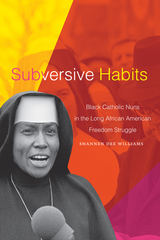
In Subversive Habits, Shannen Dee Williams provides the first full history of Black Catholic nuns in the United States, hailing them as the forgotten prophets of Catholicism and democracy. Drawing on oral histories and previously sealed Church records, Williams demonstrates how master narratives of women’s religious life and Catholic commitments to racial and gender justice fundamentally change when the lives and experiences of African American nuns are taken seriously. For Black Catholic women and girls, embracing the celibate religious state constituted a radical act of resistance to white supremacy and the sexual terrorism built into chattel slavery and segregation. Williams shows how Black sisters—such as Sister Mary Antona Ebo, who was the only Black member of the inaugural delegation of Catholic sisters to travel to Selma, Alabama, and join the Black voting rights marches of 1965—were pioneering religious leaders, educators, healthcare professionals, desegregation foot soldiers, Black Power activists, and womanist theologians. In the process, Williams calls attention to Catholic women’s religious life as a stronghold of white supremacy and racial segregation—and thus an important battleground in the long African American freedom struggle.
[more]

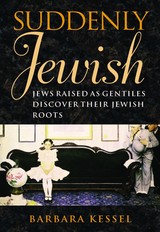
front cover of Suddenly Jewish
Suddenly Jewish
Jews Raised as Gentiles Discover Their Jewish Roots
Barbara Kessel
Brandeis University Press, 2007
One woman learned on the eve of her Roman Catholic wedding. One man as he was studying for the priesthood. Madeleine Albright famously learned from the Washington Post when she was named Secretary of State. "What is it like to find out you are not who you thought you were?" asks Barbara Kessel in this compelling volume, based on interviews with over 160 people who were raised as non-Jews only to learn at some point in their lives that they are of Jewish descent. With humor, candor, and deep emotion, Kessel's subjects discuss the emotional upheaval of refashioning their self-image and, for many, coming to terms with deliberate deception on the part of parents and family. Responses to the discovery of a Jewish heritage ranged from outright rejection to wholehearted embrace. For many, Kessel reports, the discovery of Jewish roots confirmed long-held suspicions or even, more mysteriously, conformed to a long-felt attraction toward Judaism. For some crypto-Jews in the southwest United States (descendants of Jews who fled the Spanish Inquisition), the only clues to their heritage are certain practices and traditions handed down through the generations, whose significance may be long since lost. In Poland and other parts of eastern Europe, many Jews who were adopted as infants to save them from the Holocaust are now learning of their heritage through the deathbed confessions of their adoptive parents. The varied responses of these disparate people to a similar experience, presented in their own words, offer compelling insights into the nature of self-knowledge. Whether they had always suspected or were taken by surprise, Kessel's respondents report that confirmation of their Jewish heritage affected their sense of self and of their place in the world in profound ways. Fascinating, poignant, and often very funny, Suddenly Jewish speaks to crucial issues of identity, selfhood, and spiritual community.
[more]

logo for Pluto Press
Suicide Bombers
Allah's New Martyrs
Farhad Khosrokhavar
Pluto Press, 2005

front cover of Superchurch
Superchurch
The Rhetoric and Politics of American Fundamentalism
Jonathan J. Edwards
Michigan State University Press, 2015
Christian Fundamentalism is a doctrine and a discourse in tension. Fundamentalists describe themselves as both marginal and a majority. They announce the imminent end of the world while building massive megachurches and political lobbying organizations. They speak of the need for purity and separation from the outside world while continually innovating in their search for more effective and persuasive ways to communicate with and convert outsiders. To many outsiders, Fundamentalist speech seems contradictory, irrational, intolerant, and dangerously antidemocratic. To understand the complexity of Fundamentalism, we have to look inside the tensions and the paradoxes. We have to take seriously the ways in which Fundamentalists describe themselves to themselves, and to do that, we must begin by exploring the central role of “the church” in Fundamentalist rhetoric and politics. Drawing on five fascinating case studies, Superchurch blends a complex yet readable treatment of rhetorical and political theory with a sophisticated approach to Fundamentalism that neither dismisses its appeal nor glosses over its irresolvable tensions. Edwards challenges theories of rhetoric, counterpublics, deliberation, and civility while offering critical new insights into the evolution and continuing influence of one of the most significant cultural and political movements of the past century.
[more]

front cover of Supper at Emmaus
Supper at Emmaus
Glenn W. Olsen
Catholic University of America Press, 2016
Supper at Emmaus traces various important intellectual topics from the ancient world to the modern period. Generally, as in its treatment of the question of whether the long-standing contrast between cyclical and linear views of history is helpful, it introduces important thinkers who have considered the question. A preoccupation of the book is the appearance and reappearance across the centuries of patterns used to organize temporal and cultural experience. After an opening essay on transcendental truth and cultural relativism, the second chapter traces a distinction, common in historical writings during the past two centuries, between an alleged ancient classical "cyclic" view of time and history, used to describe the claimed repetitiveness of and similarities between historical events ("nothing is new under the sun"), and a contrasting Jewish-Christian linear view, sometimes described as providential in that it moves through a series of unique events to some end intended by God. In the latter, history is "about something," the education of the human race or the redemption of humankind. As in each of the remaining essays, the book then attempts to draw out the limitations of what the current consensus on this topic has become. It does this for such things as our current understanding of religious toleration, humanism, natural law, and teleology. Some of the essays, such as those on debate about Augustine's understanding of marriage or the concluding illustrated essay on the baroque city of Lecce, are published for the first time. Others are based on previously published contributions to the scholarly literature, though generally each of these chapters concludes with a postscript that engages with current scholarly debate on the subject.
[more]

front cover of A Sustainable Life
A Sustainable Life
Douglas Gwyn
QuakerPress, 2014

front cover of Swedenborg and Esoteric Islam
Swedenborg and Esoteric Islam
HENRY CORBIN
Swedenborg Foundation Publishers, 1995

This volume makes two essays by Henry Corbin, the eminent French scholar of Islam, available in English for the first time. Although his primary interest was the esoteric tradition of Islam, Corbin was also a lifelong student of the theological works of Emanuel Swedenborg. The first essay, "Mundus Imaginalis, or The Imaginary and the Imaginal," clarifies Corbin's use of the term he coined, mundus imaginalis, or "the imaginal world." This important concept appears in both Swedenborgian and esoteric Islamic spirituality. The second piece, "Comparative Spiritual Hermeneutics," compares the revelation of the internal sense of the sacred boks of two distinct religions, Christianity and Islam.
[more]

front cover of Sweet Tea
Sweet Tea
A Play
E. Patrick Johnson; With a Foreword by Jane M. Saks
Northwestern University Press, 2020
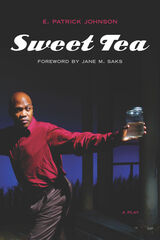
This book is the stage version of E. Patrick Johnson’s Sweet Tea: Black Gay Men of the South—An Oral History, a groundbreaking text for the fields of Black studies, queer studies, and southern oral history and ethnography. Between 2004 and 2006, Johnson edited a series of narratives from Black gay men who were born and raised in the South and have continued to live there. While the scholarly text of Sweet Tea has enjoyed wide circulation, Johnson knew that the stories of these individuals weren’t able to come fully alive on the page. He transformed the text into a theatrical performance, which originally toured the country as Pouring Tea; the oral history has also been adapted into a feature-length documentary, Making Sweet Tea.

Based on several tours and individual stagings, Sweet Tea: A Play invites readers, students, theater practitioners, and audiences from different backgrounds to engage with the lives of eleven men and one gender-nonconforming person—incredible characters all originally played by the author in a one-man show.
[more]


Send via email Share on Facebook Share on Twitter