logo for Tupelo Press
Salat
Dujie Tahat
Tupelo Press, 2020
Dujie Tahat’s Salat is a book of poems written in a compelling new form of the poet’s own invention that participate, fully — they praise, weep, spit, beg, laugh, choke, sing. In this murderous age it is increasingly unconscionable to be inert, in one’s living or in one’s art. Tahat tells us: “There’s a river in heaven, and I am the star that belongs to it.” Salat is boisterously, resoundingly alive.
[more]

logo for Tupelo Press
Sanderlings
Geri Doran
Tupelo Press, 2011
Like the wading birds of the title, the poems in this collection find their sustenance in the ground, tilling the earthly measure, even as they lift questions toward the heavens. Summoning the pastoral and the oracular by turns, the poems of Sanderlings achieve a preternatural rapture, both sensual and learned.

[more]

logo for Tupelo Press
Settler
Maggie Queeney
Tupelo Press, 2021
These fourteen-line poems give voice to the individual and collective experiences of women. They are windows into a stark otherworld, one filled with the raw materials of experience: sex, birth, cloth, pain. Spare and strange beauty marks the lives and worlds of these women, defined by their struggle for survival in the physical and psychological captivity of the domestic realm. The speaker moves between the singular and plural, sounding out the overlapping experiences of women as both subject and object of the domination inherent in settler colonialism.
[more]

logo for Tupelo Press
Severance Songs
Joshua Corey
Tupelo Press, 2011
In his third full-length book of poems, Joshua Corey puts the sonnet to the test with this sequence of fractured, ventilated, and unrhymed poems written in the aftermath of 9/11 while Corey was living at a pastoral remove from war and terror in upstate New York. The tension between idyllic personal circumstances and horrific world-historical events led Corey to produce this series of layered poems, variously sardonic and sincere in tone.

[more]

logo for Tupelo Press
Shahr-E-Jaanaan
The City of the Beloved
Adeeba Shahid Talukder
Tupelo Press, 2020
Shahr-e-jaanaan sets out to recreate the universe of Urdu and Persian poetic tradition, its tropes both lenses and mirrors for the speaker’s reality. As she maps her romances onto legends, directing their characters perform her own tragedy, their fantastical metaphors easily lend themselves to her fluctuating mental state. Cycling between delirious grandeur and wretched despair, she is torn between two selves— the pitiable lover continually rejected, and the cruel, unattainable beloved comparable in her exaltation to a god. Shahr-e-jaanaan explores, interrogates, and distorts these dichotomies and their symbolism, calling into question the forces that elevate some to divinity even as they damn others to injustice and oppression.
[more]

logo for Tupelo Press
Silver Road
Kazim Ali
Tupelo Press, 2018
In 1953, Yoko Ono wrote a score called “Secret Piece,” an open-ended formula for musical performance in a forest at daybreak. Beginning with this invitation to creation, and using essays, diary entries, prose maps, and verse fragments, Kazim Ali marks a path through quantum physics, sixth-century Chola Empire sculptures, the challenges of literary translation and of climate change, and destruction of a priceless set of handmade flutes by airport security. Amid shards from far-flung histories and geographies he finds the cosmos.
[more]

logo for Tupelo Press
Sleep Tight Satellite
Stories
Carol Guess
Tupelo Press, 2023
Central to Sleep Tight Satellite is the theme of queer chosen family. This positive form of connection contrasts with violent pseudo-communities formed by policing, government control, and technological surveillance. Characters struggle to survive the pandemic, but their survival skills were honed long before the Covid-19 outbreak. There’s a gritty realism to the odd jobs characters take to survive, and the ways they create loving communities of mutual aid.
[more]

logo for Tupelo Press
Slick Like Dark
Meg Wade
Tupelo Press, 2020
Delving into dark desire and mystery, Slick Like Dark pierces through the noise of aimless reality. These collected poems are haunting and passionate, honest and vivid, asking who bears the blame as they scatter us about the South. Poet Meg Wade carefully crafts an examination of the Southern body and the experience of a woman living in it. Depicting relationships, personal struggles and religion, lines such as “A wasp/nest, gristled angels/it’s strange, how scared/I am-quick write/down” show the complexities of creativity. Wade brings us into the intensity of this strangely relatable life while reflecting on the darker sides of what could be done or what could have been. In her characteristic, poignant style, Wade writes “This could have been a place where I would love him like a woman/who wants to have babies would”, leaving open the harsh possibilities of love unredeemed. As thrilling as they are contemplative, these poems bring us to realizations we would have shied from before.
[more]

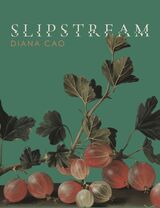
front cover of Slipstream
Slipstream
Diana Cao
Tupelo Press, 2026

The poems in Slipstream deal with the slippery concept of home, with robots and the internet and other human inventions, and with what we can learn from the natural world around us. 

Winner of the Berkshire Prize, Slipstream is a bracing, intimate, and formally adventurous debut that moves with equal grace through personal memory, inherited history, myth, and the ambient technologies of contemporary life. Diana Cao’s poems braid ancient Chinese legend, family migration, illness, love, and grief with moon landers, algorithms, privacy policies, and online ritual, creating a lyric field where the ancestral and the digital speak fluently to one another. The book is formally restless and assured. Sonnets, sestinas, villanelles, fables, and linked sequences feel conversational rather than ornate, their intelligence worn lightly, their music precise and unforced. Throughout, Cao writes with a clarity that never flattens complexity: humor and vulnerability coexist with philosophical rigor. Tenderness is sharpened, not softened, by attention to politics, history, and care. 

What emerges is a voice attuned to relational life in all its registers—daughterhood, friendship, desire, citizenship, species—asking how to live, love, and remain lucid inside systems that both sustain and estrange us. Slipstream is a book of uncommon range and emotional intelligence, one that feels fully of this moment while remaining in deep, living conversation with the past. 
[more]

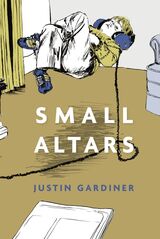
front cover of Small Altars
Small Altars
Justin Gardiner
Tupelo Press, 2024
A book that bends time and fragments narrative.

In Small Altars, Justin Gardiner delves into the world of comic books and superheroes as a means for coming to terms with the many struggles of his brother’s life, as well as his untimely death, offering a lyric and honest portrayal of the tolls of mental illness, the redemptive powers of art and familial love, and the complex workings of grief.  
 
[more]

logo for Tupelo Press
Soldier On
Gale Marie Thompson
Tupelo Press, 2015
Fascinated by what emerges from unlikely sources when absorbed into memory, Gale Marie Thompson’s poems delight in what remains: John Wayne, Bewitched, turnip fields, camellias and canned figs, and—of course—kitchens. Soldier On uses the light of the kitchen as a starting (and ending) point to explore remembered spaces, which take on new facets and textures in a flood of associations and the mind’s endless cross-indexing. Inside a world of objects, people, and artifacts, Soldier On constructs the language in which we love and lose love.
[more]

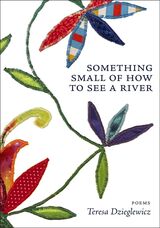
front cover of Something Small of How to See a River
Something Small of How to See a River
Teresa Dzieglewicz
Tupelo Press, 2025
Through the weaving of documentary poetics, first-hand accounts, dialogue, and lyric, these poems tell the story of co-running a school at the Ocethi Sakowin Camp at Standing Rock. 

Something Small of How to See a River interrogates the idea of narrative. Who gets to tell a story and what does it mean when the official story, the story told by the governor, the police, or the local media, is a fundamentally dishonest one? The poems collected here meditate on failure: how systems fail us and our environment, how whiteness fails to hold itself accountable, how future generations and the land are being failed—and how, in the face of all this, the Standing Rock movement was not a failure. At the heart of this collection is the strength, care, and radical joy of the movement, which shines through and against the violence.

[more]

front cover of Song in Tammuz
Song in Tammuz
Avia Tadmor
Tupelo Press, 2026

Winner of the International Berkshire Prize, this collection draws from an incredible range of literary forms, from familiar couplets and tercets to footnotes, dictionary definitions, and luminous lyric fragments. 

While stylistically daring, even virtuosic, Avia Tadmor’s stunning debut is unified by its enduring engagement with questions of language and alterity. What does it mean to be othered by and through language? What happens when grammar, syntax, and the concepts of identity housed within them are at odds? Does a revolutionary message demand new forms of discourse? “I can say it through the distance of this other tongue,” Tadmor writes. 

Indeed, she considers the role of language—from conceptual framework to vast storehouse of history, culture, and inheritance—in shaping the self, ultimately revealing our agency within a grammar and syntax we did not choose. As Tadmor writes, “Her pen is a stronghold, a lighthouse / flickering late in July.”

[more]

logo for Tupelo Press
Stone Lyre
René Char
Tupelo Press, 2010
“René Char is the conscience of modern French poetry and also its calm of mind. Nancy Naomi Carlson, in these splendid translations, casts new light upon the sublime consequence of Char’s poetic character, and in Stone Lyre the case for sublimity is purely made.”—Donald Revell, poet and translator of Rimbaud and Apollinaire
[more]

logo for Tupelo Press
The Strings Are Lightning and Hold You In
Chee Brossy
Tupelo Press, 2022
In this stunning collection, Chee Brossy forges a poetics of wonder, dailiness, and transformation. Here, the “sugar cane Coke” and “the leafy houseplant[s]” of the speaker’s daily life, those artifacts of routine, are revealed as glimpses into all that is unknowable, subtle reminders of “today’s mystery.” Indeed, Brossy’s work, with its understated approach and artful evocation, reads as a celebration of all that lies beyond what can be said in language. For Brossy, a meditation on the ineffable, with its innate poeticism and philosophical allure, is not merely an exercise in aesthetics; it is revealing of culture and of the body politic. Here, we witness questions of power, agency, and resistance bound up in what seem at first like simple acts of perception and aesthetic pleasure. “A red-tipped fox trots lazily out. The knives adjust themselves in the dishwasher,” Brossy tells us in language that shines with lyricism and invention. He shows us, in fearful and loving detail, the “starlight vapor in our lungs” and the “terrible dust” within each one of us. “Strength runs through blood like horses,” Brossy reminds us. This is a complex and ultimately transformative debut.
[more]

logo for Tupelo Press
Sundays
Thomas Gardner
Tupelo Press, 2020
Continuing the work begun in 2014’s Poverty Creek Journal, the lyric essays in Thomas Gardner’s Sundays focus on moments in our ordinary lives when something within us breaks and we are cast out to wander and sing, “feeling [our] way toward something [in the invisible] that will press back.” “Deep within us is a river, under it all, where everything comes undone,” Gardner writes, and over a year’s-worth of Sundays, in an improvisatory prose that “holds its breath at its [own] undoing,” he takes us there, urging us each to find that same space opening within. Twenty turkeys in the backyard, a walk with friends from overseas to a plunging waterfall, moments in the dark when flashes across the eye become a boat in rising wind tugging against its mooring—these lyric pieces, much like the sentences from Marilynne Robinson’s novel Housekeeping Gardner discovers one morning pasted on the doors and windows and staircases of the building he works in, offer us pieces of the ordinary set apart, “tiny squares of print, unfixed from narrative,” so carefully tied together under the surface that the everyday world, like Gardner’s building, seems everywhere “ringed and veined with thought.”
[more]

logo for Tupelo Press
Swallowing the Sea
On Writing & Ambition, Boredom, Purity & Secrecy
Lee Upton
Tupelo Press, 2012
This is an inspiring book about writing and—more unusually—a book that honors ambition, that idiosyncratic drive that compels writers and other artists to action despite every kind of obstacle. Upton explores forces that threaten our ability to fulfill the most daring aspirations, and she examines ambition’s adjuncts, including failure, boredom, and purity, offering a provocative antidote:obsession. Ultimately Upton argues for a new perception of literary art as “a good secret” for our time, when our interior lives and our imaginations are under threat.
[more]


Send via email Share on Facebook Share on Twitter