
 A SCHOLARLY BOOK REPOSITORY
26 start with S start with S

The term “secular” inspires thinking about disenchantment, periodization, modernity, and subjectivity. The essays in Sacred and Secular Transactions in the Age of Shakespeare argue that Shakespeare’s plays present “secularization” not only as a historical narrative of progress but also as a hermeneutic process that unleashes complex and often problematic transactions between sacred and secular. These transactions shape ideas about everything from pastoral government and performative language to wonder and the spatial imagination.
Thinking about Shakespeare and secularization also involves thinking about how to interpret history and temporality in the contexts of Shakespeare’s medieval past, the religious reformations of the sixteenth century, and the critical dispositions that define Shakespeare studies today. These essays reject a necessary opposition between “sacred” and “secular” and instead analyze how such categories intersect. In fresh analyses of plays ranging from Hamlet and The Tempest to All’s Well that Ends Well and All Is True, secularization emerges as an interpretive act that explores the cultural protocols of representation within both Shakespeare’s plays and the critical domains in which they are studied and taught.
The volume’s diverse disciplinary perspectives and theoretical approaches shift our focus from literal religion and doctrinal issues to such aspects of early modern culture as theatrical performance, geography, race, architecture, music, and the visual arts.
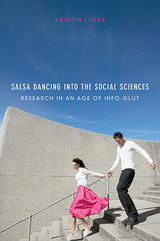
“You might think that dancing doesn’t have a lot to do with social research, and doing social research is probably why you picked this book up in the first place. But trust me. Salsa dancing is a practice as well as a metaphor for a kind of research that will make your life easier and better.”
Savvy, witty, and sensible, this unique book is both a handbook for defining and completing a research project, and an astute introduction to the neglected history and changeable philosophy of modern social science. In this volume, Kristin Luker guides novice researchers in: knowing the difference between an area of interest and a research topic; defining the relevant parts of a potentially infinite research literature; mastering sampling, operationalization, and generalization; understanding which research methods best answer your questions; beating writer’s block.
Most important, she shows how friendships, non-academic interests, and even salsa dancing can make for a better researcher.
“You know about setting the kitchen timer and writing for only an hour, or only 15 minutes if you are feeling particularly anxious. I wrote a fairly large part of this book feeling exactly like that. If I can write an entire book 15 minutes at a time, so can you.”
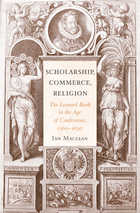
A decade ago in the Times Literary Supplement, Roderick Conway Morris claimed that “almost everything that was going to happen in book publishing—from pocket books, instant books and pirated books, to the concept of author’s copyright, company mergers, and remainders—occurred during the early days of printing.” Ian Maclean’s colorful survey of the flourishing learned book trade of the late Renaissance brings this assertion to life.
The story he tells covers most of Europe, with Frankfurt and its Fair as the hub of intellectual exchanges among scholars and of commercial dealings among publishers. The three major religious confessions jostled for position there, and this rivalry affected nearly all aspects of learning. Few scholars were exempt from religious or financial pressures. Maclean’s chosen example is the literary agent and representative of international Calvinism, Melchior Goldast von Haiminsfeld, whose activities included opportunistic involvement in the political disputes of the day. Maclean surveys the predicament of underfunded authors, the activities of greedy publishing entrepreneurs, the fitful interventions of regimes of censorship and licensing, and the struggles faced by sellers and buyers to achieve their ends in an increasingly overheated market.
The story ends with an account of the dramatic decline of the scholarly book trade in the 1620s, and the connivance of humanist scholars in the values of the commercial world through which they aspired to international recognition. Their fate invites comparison with today’s writers of learned books, as they too come to terms with new technologies and changing academic environments.
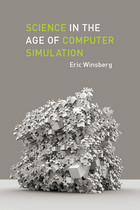
Computer simulation was first pioneered as a scientific tool in meteorology and nuclear physics in the period following World War II, but it has grown rapidly to become indispensible in a wide variety of scientific disciplines, including astrophysics, high-energy physics, climate science, engineering, ecology, and economics. Digital computer simulation helps study phenomena of great complexity, but how much do we know about the limits and possibilities of this new scientific practice? How do simulations compare to traditional experiments? And are they reliable? Eric Winsberg seeks to answer these questions in Science in the Age of Computer Simulation.
Scrutinizing these issue with a philosophical lens, Winsberg explores the impact of simulation on such issues as the nature of scientific evidence; the role of values in science; the nature and role of fictions in science; and the relationship between simulation and experiment, theories and data, and theories at different levels of description. Science in the Age of Computer Simulation will transform many of the core issues in philosophy of science, as well as our basic understanding of the role of the digital computer in the sciences.
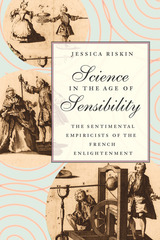
Riskin argues that sentimental empiricism brought together ideas and institutions, practices and politics. She shows, for instance, how the study of blindness, led by ideas about the mental and moral role of vision and by cataract surgeries, shaped the first school for the blind; how Benjamin Franklin's electrical physics, ascribing desires to nature, engaged French economic reformers; and how the question of the role of language in science and social life linked disputes over Antoine Lavoisier's new chemical names to the founding of France's modern system of civic education.
Recasting the Age of Reason by stressing its conjunction with the Age of Sensibility, Riskin offers an entirely new perspective on the development of modern science and the history of the Enlightenment.

In a cultural history filled with musicians, listeners, scholars, and business people, Miller describes how folklore studies and the music industry helped to create a “musical color line,” a cultural parallel to the physical color line that came to define the Jim Crow South. Segregated sound emerged slowly through the interactions of southern and northern musicians, record companies that sought to penetrate new markets across the South and the globe, and academic folklorists who attempted to tap southern music for evidence about the history of human civilization. Contending that people’s musical worlds were defined less by who they were than by the music that they heard, Miller challenges assumptions about the relation of race, music, and the market.


Jason Strange shows where homesteaders fit, and don't fit, within contemporary America. Blending history with personal stories, Strange visits pig roasts and bohemian work parties to find people engaged in a lifestyle that offers challenge and fulfillment for those in search of virtues like self-employment, frugality, contact with nature, and escape from the mainstream. He also lays bare the vast differences in education and opportunity that leave some homesteaders dispossessed while charting the tensions that arise when people seek refuge from the ills of modern society—only to find themselves indelibly marked by the system they dreamed of escaping.
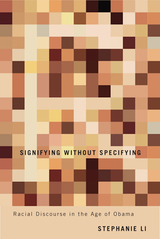
On the campaign trail, Barack Obama faced a difficult task—rallying African American voters while resisting his opponents’ attempts to frame him as “too black” to govern the nation as a whole. Obama’s solution was to employ what Toni Morrison calls “race-specific, race-free language,” avoiding open discussions of racial issues while using terms and references that carried a specific cultural resonance for African American voters.
Stephanie Li argues that American politicians and writers are using a new kind of language to speak about race. Challenging the notion that we have moved into a “post-racial” era, she suggests that we are in an uneasy moment where American public discourse demands that race be seen, but not heard. Analyzing contemporary political speech with nuanced readings of works by such authors as Toni Morrison, Jhumpa Lahiri, and Colson Whitehead, Li investigates how Americans of color have negotiated these tensions, inventing new ways to signal racial affiliations without violating taboos against open discussions of race.

Laura Tunbridge explores the renewed vitality of this refugee musical form between the world wars, offering a fresh perspective on a period that was pervaded by anxieties of displacement. Through richly varied case studies, Singing in the Age of Anxiety traces how lieder were circulated, presented, and consumed in metropolitan contexts, shedding new light on how music facilitated unlikely crossings of nationalist and internationalist ideologies during the interwar period.

How six groundbreaking women redefined American food—what we eat, how we eat it, and why it matters.
From wartime nutrition science to modern food activism, Six Women Who Shaped What Americans Eat examines the pivotal roles six women played in rewriting the rules of American cuisine. Michelle Mart offers a rich and accessible narrative that connects dietary trends, food marketing, and public health movements to the voices of the women who helped drive them.
Part one highlights Hazel Stiebeling’s development of dietary guidelines and RDAs, Poppy Cannon’s promotion of processed foods for convenience and gourmet meals, and Julia Child’s introduction of French cuisine with an emphasis on fresh ingredients and culinary techniques. Part two shifts the focus to women who challenged the food system itself: Frances Moore Lappé’s advocacy for vegetarianism and sustainable practices, Marion Nestle’s exposure of food corporations’ manipulative practices, and Alice Waters’s emphasis on locally sourced, organic ingredients and sustainable food systems. Thoughtful and timely, this book explores how culture, politics, and personal vision collided in the kitchens and campaigns of six food pioneers—leaving a lasting imprint on what America eats today.


The nineteenth-century novel is generally assumed to owe its basic social imaginaries to the ideologies, institutions, and practices of modern civil society. In Sovereign Fictions, Ilya Kliger asks what happens to the novel when its fundamental sociohistorical orientation is, as in the case of Russian realism, toward the state. Kliger explores Russian realism’s distinctive construals of sociality through a broad range of texts from the 1830s to the 1870s, including major works by Tolstoy, Dostoevsky, Gogol, Pushkin, Lermontov, Goncharov, and Turgenev, and several lesser-known but influential books of the period, including Alexander Druzhinin’s Polinka Saks (1847), Aleksei Pisemsky’s One Thousand Souls (1858), and Vasily Sleptsov’s Hard Times (1865). Challenging much current scholarly consensus about the social dynamics of nineteenth-century realist fiction, Sovereign Fictions offers an important intervention in socially inflected theories of the novel and in current thinking on representations of power and historical poetics.

Contributors: David Bruin, Annie Dorsen, Shonni Enelow, Miriam Felton-Dansky, Jacob Gallagher-Ross, Caden Manson, John H. Muse, Jemma Nelson, Jennifer Parker-Starbuck, Alexandro Segade, Tom Sellar


This book assesses the changing nature of state intervention in the economies of the affluent democracies. Against a widespread understanding that contemporary developments, such as globalization and new technologies, are pressing for a rollback of state regulation in the economy, the book shows that these same forces are also creating new demands and opportunities for state intervention. Thus, state activism has shifted, rather than simply eroded.
State authorities have shifted from a market-steering orientation to a market-supporting one. Chief among the new state missions are: repairing the main varieties of capitalism (liberal, corporatist, and statist); making labor markets and systems of social protection more employment-friendly; recasting regulatory frameworks to permit countries to cross major economic and technological divides; and expanding market competition at home and abroad.
Because the changes from market steering to market support are so controversial and far-reaching, state officials often find themselves making choices that produce clear winners and losers. Such choices require a capacity to act unilaterally and decisively, even in the face of substantial societal opposition. As a result, state activism, autonomy, and occasionally imposition remain essential for meeting the challenges of today's globalizing economy.

As the technological phenomenon known as the worldwide web permeates civilization, it creates some cultures and destroys others. In this pioneering book, philosopher Thomas Langan explores "virtual reality"Can inherently contradictory phrase"and the effects of technology on our very being. In our present-day high- technology environment, making simple, everyday decisions is difficult because the virtual world we've created doesn't necessarily operate according to the old "common sense." To retain our intellectual fitness, we must, Langan argues, consider these essential questions: If virtual reality is, in fact, reality, what is this life that we are caught up in? What is being within the context of virtual reality? How can we establish a system for distinguishing truth from fiction?
Although technology minimizes distances between people and makes the information they seek more accessible, it simultaneously blurs the line dividing fact from falsehood and real from virtual. An individual's intellectual survival is threatened as technological advancement challenges our collective understanding of what reality is. Because much of the information that is presented as fact simply works to fulfill a specific agenda, we cannot accept as truth everything that appears on the internet or in the media. To survive, we must learn to manage our lives and resources despite the flood of information we are bombarded with daily.
Addressing the general educated reader, Surviving the Age of Virtual Reality expertly interweaves the worlds of technology and philosophy, pushing the analysis of this technological and human phenomenon to new depths.

Although the key to the side accords' anticipated success lay in their ostensibly generous encouragement of a participatory politics and sustainable development opportunities, Sustaining the Borderlands reveals that the Mexican border populations for which they were largely created are effectively excluded from participating due to the ongoing online, territorial, class, and cultural barriers that shape the borderlands. Rather than experiencing the side accords and their companion institutions as transparent and accessible, residents experienced them as opaque and indecipherable. Simon concludes that the side accords have failed to deliver on their promise of bringing democracy to Mexico because practical mechanisms that would ensure their effective implementation were never put in place.
NAFTA took effect at a time when Mexico was undergoing a democratic transition. The treaty was supposed to encourage this transition and improve environmental and labor conditions on the US-Mexico border. This book demonstrates that, twenty years later, the promises of NAFTA have not come to pass.
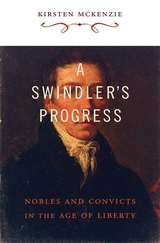
In May 1835 in a Sydney courtroom, a slight, balding man named John Dow stood charged with forgery. The prisoner shocked the room by claiming he was Edward, Viscount Lascelles, eldest son of the powerful Earl of Harewood. The Crown alleged he was a confidence trickster and serial impostor. Was this really the heir to one of Britain's most spectacular fortunes?
Part Regency mystery, part imperial history, A Swindler's Progress is an engrossing tale of adventure and deceit across two worlds—British aristocrats and Australian felons—bound together in an emerging age of opportunity and individualism, where personal worth was battling power based on birth alone. The first historian to unravel the mystery of John Dow and Edward Lascelles, Kirsten McKenzie illuminates the darker side of this age of liberty, when freedom could mean the freedom to lie both in the far-flung outposts of empire and within the established bastions of British power.
The struggles of the Lascelles family for social and political power, and the tragedy of their disgraced heir, demonstrate that British elites were as fragile as their colonial counterparts. In ways both personal and profound, McKenzie recreates a world in which Britain and the empire were intertwined in the transformation of status and politics in the nineteenth century.
READERS
Browse our collection.
PUBLISHERS
See BiblioVault's publisher services.
STUDENT SERVICES
Files for college accessibility offices.
RECENTLY PUBLISHED




UChicago Accessibility Resources
home | accessibility | search | about | contact us
BiblioVault ® 2001 - 2026
The University of Chicago Press