
 A SCHOLARLY BOOK REPOSITORY
14 start with S start with S

Jaan Kross's historical novel Sailing Against the Wind fictionalizes the life of Bernhard Schmidt (1879–1935), an Estonian-born inventor. Schmidt lost an arm in his youth while experimenting with a homemade rocket, resulting in psychological trauma that would plague him for the rest of his life. Largely self-taught, Schmidt was driven to seek recognition of his talents.
He moved to Germany in the 1930s, where, after perfecting techniques for polishing lenses, he began developing ideas for improving astronomical telescopes. He was arrested for selling one to the Russians, and although he got off with only a warning, he later suffered a breakdown and was sent to a mental hospital, where he soon died. Sailing Against the Wind becomes a meditation on national identity, the relationship between history and the individual life, and the mechanisms of the historical novel as a genre.
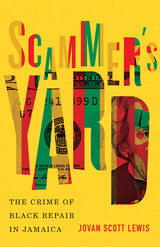
Tells the story of Jamaican “scammers” who use crime to gain autonomy, opportunity, and repair
There is romance in stealing from the rich to give to the poor, but how does that change when those perceived rich are elderly white North Americans and the poor are young Black Jamaicans? In this innovative ethnography, Jovan Scott Lewis tells the story of Omar, Junior, and Dwayne. Young and poor, they strive to make a living in Montego Bay, where call centers and tourism are the two main industries in the struggling economy. Their experience of grinding poverty and drastically limited opportunity leads them to conclude that scamming is the best means of gaining wealth and advancement. Otherwise, they are doomed to live in “sufferation”—an inescapable poverty that breeds misery, frustration, and vexation.
In the Jamaican lottery scam run by these men, targets are told they have qualified for a large loan or award if they pay taxes or transfer fees. When the fees are paid, the award never arrives, netting the scammers tens of thousands of U.S. dollars. Through interviews, historical sources, song lyrics, and court testimonies, Lewis examines how these scammers justify their deceit, discovering an ethical narrative that reformulates ideas of crime and transgression and their relationship to race, justice, and debt.
Scammer’s Yard describes how these young men, seeking to overcome inequality and achieve autonomy, come to view crime as a form of liberation. Their logic raises unsettling questions about a world economy that relegates postcolonial populations to deprivation even while expecting them to follow the rules of capitalism that exacerbate their dispossession. In this groundbreaking account, Lewis asks whether true reparation for the legacy of colonialism is to be found only through radical—even criminal—means.
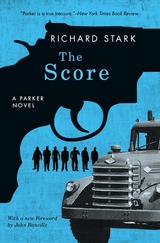
An action-packed crime novel starring Parker, the heister starring in the forthcoming Shane Black film Play Dirty!
Richard Stark's Parker novels are the hardest of hard-boiled, classic crime novels where the heists are huge, the body counts are high, and the bad guys usually win.
The Parker novels have been a huge influence on countless writers and filmmakers, including Quentin Tarantino, Stephen King, George Pelecanos, Colson Whitehead, Lucy Sante, John Banville, and many more. Their stripped-down language and hard-as-nails amorality create an unforgettable world where the next score could be the big one, but your next mistake could also be your last. There's nothing else like them.
It was an impossible crime: knock off an entire town—a huge plant payroll, all the banks, and all the stores—in one night. But there was one thief good enough to try—Parker. In The Score, Parker takes on his biggest job yet. All he needs are the right men, the right plan, and the right kind of help from Lady Luck. But as everyone knows, you can never count on that last one. This chilling caper could either be the perfect crime… or a set-up that would land him in jail — for life.

An action-packed crime novel starring Parker, the heister starring in the forthcoming Shane Black film Play Dirty!
Richard Stark's Parker novels are the hardest of hard-boiled, classic crime novels where the heists are huge, the body counts are high, and the bad guys usually win.
The Parker novels have been a huge influence on countless writers and filmmakers, including Quentin Tarantino, Stephen King, George Pelecanos, Colson Whitehead, Lucy Sante, John Banville, and many more. Their stripped-down language and hard-as-nails amorality create an unforgettable world where the next score could be the big one, but your next mistake could also be your last. There's nothing else like them.
The robbery was a piece of cake. The getaway was clean. The only thing left to do is split the cash—then it all goes wrong. In The Seventh, the heist of a college football game turns sour and the take is stolen from right under Parker’s nose. With the cops on his tail, Parker must figure out who crossed him—and how he can pay the culprit back.
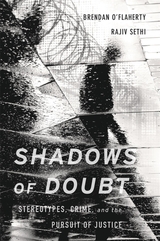
Shadows of Doubt reveals how deeply stereotypes distort our interactions, shape crime, and deform the criminal justice system.
If you’re a robber, how do you choose your victims? As a police officer, how afraid are you of the young man you’re about to arrest? As a judge, do you think the suspect in front of you will show up in court if released from pretrial detention? As a juror, does the defendant seem guilty to you? Your answers may depend on the stereotypes you hold, and the stereotypes you believe others hold. In this provocative, pioneering book, economists Brendan O’Flaherty and Rajiv Sethi explore how stereotypes can shape the ways crimes unfold and how they contaminate the justice system through far more insidious, pervasive, and surprising paths than we have previously imagined.
Crime and punishment occur under extreme uncertainty. Offenders, victims, police officers, judges, and jurors make high-stakes decisions with limited information, under severe time pressure. With compelling stories and extensive data on how people act as they try to commit, prevent, or punish crimes, O’Flaherty and Sethi reveal the extent to which we rely on stereotypes as shortcuts in our decision making. Sometimes it’s simple: Robbers tend to target those they stereotype as being more compliant. Other interactions display a complex and sometimes tragic interplay of assumptions: “If he thinks I’m dangerous, he might shoot. I’ll shoot first.”
Shadows of Doubt shows how deeply stereotypes are implicated in the most controversial criminal justice issues of our time, and how a clearer understanding of their effects can guide us toward a more just society.
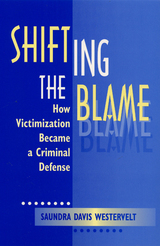
More than just a study of legal history, Shifting the Blame looks at the "abuse excuse" defense as an indicator of broad social change in cultural understandings of victimization, responsibility, and womanhood. The introduction of victimization as an exculpatory condition within the context of a criminal defense tells the story of a society that has accepted victimization as a new way of explaining and excusing misbehavior.
Through case law analysis, the book documents the initial development of the strategy in three different types of cases in the 1970s - "rotten social background", brainwashing, and battered women's self-defense cases. Since its initial acceptance in battered women's cases in the early 1980s, the use of the strategy has expanded to a variety of offenders in different types of relationships arguing different defenses. In lively, readable prose, Westervelt examines each form of expansion, revealing that while the expansion of the strategy has been fairly extensive, it has also been limited in some important ways. Her research shows readers that only certain types of "victims," particularly victims of physical abuse, have successfully used this defense. Shifting the Blame exposes the ways in which the acceptance of this new defense strategy illuminates a cultural shift in understandings of individual responsibility and shows how the law plays a role in defining who can be an acceptable victim.
Saundra D. Westervelt is an assistant professor in the Sociology Department at the University of North Carolina at Greensboro.
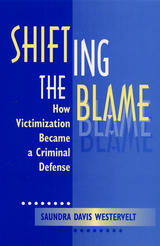
More than just a study of legal history, Shifting the Blame looks at the "abuse excuse" defense as an indicator of broad social change in cultural understandings of victimization, responsibility, and womanhood. The introduction of victimization as an exculpatory condition within the context of a criminal defense tells the story of a society that has accepted victimization as a new way of explaining and excusing misbehavior.
Through case law analysis, the book documents the initial development of the strategy in three different types of cases in the 1970s - "rotten social background", brainwashing, and battered women's self-defense cases. Since its initial acceptance in battered women's cases in the early 1980s, the use of the strategy has expanded to a variety of offenders in different types of relationships arguing different defenses. In lively, readable prose, Westervelt examines each form of expansion, revealing that while the expansion of the strategy has been fairly extensive, it has also been limited in some important ways. Her research shows readers that only certain types of "victims," particularly victims of physical abuse, have successfully used this defense. Shifting the Blame exposes the ways in which the acceptance of this new defense strategy illuminates a cultural shift in understandings of individual responsibility and shows how the law plays a role in defining who can be an acceptable victim.
Saundra D. Westervelt is an assistant professor in the Sociology Department at the University of North Carolina at Greensboro.

Inside Half Moon Bay, a sparkling California coastal town, Ester Prynn is dulled and diminished by struggles with work, money, marriage, her senile father, a troubled teenage son, and old guilt she can’t assuage. When a masked gunman robs the convenience store where Ester works, he upends her fraught life and propels her toward passions buried, like singing; desires discovered, like a same-sex infatuation; and wrongs righted, like bringing the violent assailant to justice. But as the armed robber commits new crimes and continues to evade capture, the trauma from the holdup climbs, threatening Ester’s newfound delights and longings and forcing her to contend with her burning regrets and what-ifs. In the reckoning between Ester and these growing, molten upsets, she’s faced with enormous choices and must determine what and who can bring her to her best life.
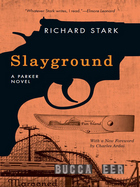
An action-packed crime novel starring Parker, the heister starring in the forthcoming Shane Black film Play Dirty!
Richard Stark's Parker novels are the hardest of hard-boiled, classic crime novels where the heists are huge, the body counts are high, and the bad guys usually win.
The Parker novels have been a huge influence on countless writers and filmmakers, including Quentin Tarantino, Stephen King, George Pelecanos, Colson Whitehead, Lucy Sante, John Banville, and many more. Their stripped-down language and hard-as-nails amorality create an unforgettable world where the next score could be the big one, but your next mistake could also be your last. There's nothing else like them.
The hunter becomes prey, as a heist goes sour and Parker finds himself trapped in a shuttered amusement park, besieged by a bevy of local mobsters, in Slayground. There are no exits from Fun Island. Outnumbered and outgunned, Parker can’t afford a single miscalculation. He’s low on bullets and making it out alive is a long shot—but, as anyone who’s crossed his path knows, no one is better at playing higher stakes with shorter odds.
The wildest of all Parker novels, Slayground offers nonstop action, shuddering suspense, and jaw-dropping surprises.
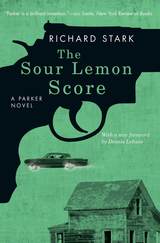
An action-packed crime novel starring Parker, the heister starring in the forthcoming Shane Black film Play Dirty!
Richard Stark's Parker novels are the hardest of hard-boiled, classic crime novels where the heists are huge, the body counts are high, and the bad guys usually win.
The Parker novels have been a huge influence on countless writers and filmmakers, including Quentin Tarantino, Stephen King, George Pelecanos, Colson Whitehead, Lucy Sante, John Banville, and many more. Their stripped-down language and hard-as-nails amorality create an unforgettable world where the next score could be the big one, but your next mistake could also be your last. There's nothing else like them.
Bank robberies should run like clockwork, right? If your name’s Parker, you expect nothing less. The Sour Lemon Score finds Parker wrapping up a heist where everything has gone right. But then one of his partners gets too greedy for his own good. The four-way split following a job leaves too small a take for George Uhl, who begins to pick off his fellow heisters, one by one. The first mistake? That he doesn’t begin things by putting a bullet in Parker. That means he won’t get the chance to make a second. One of the darkest novels in the series, this caper proves the adage that no one crosses Parker and lives.
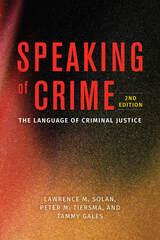
An essential introduction to the use and misuse of language within the criminal justice system, updated for a new generation.
Does everyone understand the Miranda warning? Why do people confess to a crime they did not commit? Can linguistic experts identify who wrote an anonymous threatening letter? Since its first publication, Speaking of Crime has been answering these questions. Introducing major topics and controversies at the intersection of language and law, Lawrence M. Solan, Peter M. Tiersma, and Tammy Gales apply multidisciplinary insights to examine the complex role of language within the US justice system.
The second edition features in-depth discussions of recent cases, new legislation, and innovative research advances, and includes a new chapter on who interprets the laws governing linguistic contexts. Thoroughly updated and approachable, Speaking of Crime is a state-of-the-art survey that will be useful to scholars, students, and practitioners throughout the criminal justice system.
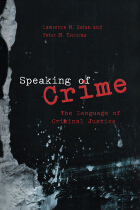
Speaking of Crime answers these questions and examines the complex role of language within our criminal justice system. Lawrence M. Solan and Peter M. Tiersma compile numerous cases, ranging from the Lindbergh kidnapping to the impeachment trial of Bill Clinton to the JonBenét Ramsey case, that provide real-life examples of how language functions in arrests, investigations, interrogations, confessions, and trials. In a clear and accessible style, Solan and Tiersma show how recent advances in the study of language can aid in understanding how legal problems arise and how they might be solved.
With compelling discussions current issues and controversies, this book is a provocative state-of-the-art survey that will be of enormous value to legal scholars and professionals throughout the criminal justice system.

In the largely undocumented sphere of political violence in eastern India, Qadir the Spider is a mythological killer and casanova, known for the various assassinations and liaisons he carries out across the region. His oldest son Rahim is the latest entry to the field. A 13-year-old killer, the boy bides his time like his father—killing, farming, and getting high as the battles go on around him. In this world where they only follow orders, mutilation becomes their only expression, the nature of violence their only meaningful form of autonomy in the various power struggles of interior Bengal.
After his first year in the field, as the child is groomed by his father to carry on the ways of their mercenary clan, he begins to confront the various legends surrounding the Spider. However, while roaming the strange, spectral forests surrounding the town, his chance encounter with a pair of wandering musicians leads him to question the killings that pattern his life. As he searches for the answers around him, he is slowly led to confront the man his father truly is, as well as the man he knows he will become.
A gripping tale of inherited violence and identity in politically volatile Bengal, Aurko Maitra’s The Spider contains powerful, disturbing parallels to modern-day conflicts. Boldly interrogating our concepts of autonomy and survival in chaos, this revelatory novel explores the impact of political violence and timeless issues of legacy and intergenerational violence.
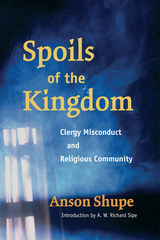
Drawing on case evidence, Shupe employs classical and modern social exchange theories to explain the institutional dynamics of clergy misconduct. He argues that there is an implicit contract of reciprocity and compliance between congregants and religious leaders that, when amplified by the charismatic awe often associated with religious authorities, can lead to misconduct.
READERS
Browse our collection.
PUBLISHERS
See BiblioVault's publisher services.
STUDENT SERVICES
Files for college accessibility offices.
RECENTLY PUBLISHED




UChicago Accessibility Resources
home | accessibility | search | about | contact us
BiblioVault ® 2001 - 2025
The University of Chicago Press