front cover of Six Women Who Shaped What Americans Eat
Six Women Who Shaped What Americans Eat
Food Choice in an Age of Abundance
Michelle Mart, Foreword by Mark D. Hersey
University of Alabama Press, 2025

How six groundbreaking women redefined American food—what we eat, how we eat it, and why it matters.

From wartime nutrition science to modern food activism, Six Women Who Shaped What Americans Eat examines the pivotal roles six women played in rewriting the rules of American cuisine. Michelle Mart offers a rich and accessible narrative that connects dietary trends, food marketing, and public health movements to the voices of the women who helped drive them.

Part one highlights Hazel Stiebeling’s development of dietary guidelines and RDAs, Poppy Cannon’s promotion of processed foods for convenience and gourmet meals, and Julia Child’s introduction of French cuisine with an emphasis on fresh ingredients and culinary techniques. Part two shifts the focus to women who challenged the food system itself: Frances Moore Lappé’s advocacy for vegetarianism and sustainable practices, Marion Nestle’s exposure of food corporations’ manipulative practices, and Alice Waters’s emphasis on locally sourced, organic ingredients and sustainable food systems. Thoughtful and timely, this book explores how culture, politics, and personal vision collided in the kitchens and campaigns of six food pioneers—leaving a lasting imprint on what America eats today.

[more]

front cover of Slaw and the Slow Cooked
Slaw and the Slow Cooked
Culture and Barbecue in the Mid-South
James R. Veteto
Vanderbilt University Press, 2011
Texas has its barbecue tradition, and a library of books to go with it. Same with the Carolinas. The mid-South, however, is a region with as many opinions as styles of cooking. In The Slaw and the Slow Cooked, editors James Veteto and Edward Maclin seek to right a wrong--namely, a deeper understanding of the larger experience of barbecue in this legendary American culinary territory.


In developing the book, Veteto and Maclin cast a wide net for divergent approaches. Food writer John Edge introduces us to Jones Bar-B-Q Diner in Marianna, Arkansas, a possibly century-old restaurant serving top-notch pork and simultaneously challenging race and class boundaries. Kristen Bradley-Shurtz explores the 150-plus-year tradition of the St. Patrick's Irish Picnic in McEwen, Tennessee. And no barbecue book would be complete without an insider's story, provided here by Jonathan Deutsch's "embedded" reporting inside a competitive barbecue team. Veteto and Maclin conclude with a glimpse into the future of barbecue culture: online, in the smoker, and fresh from the farm.


The Slaw and the Slow Cooked stands as a challenge to barbecue aficionados and a statement on the Mid-South's important place at the table. Intended for food lovers, anthropologists, and sociologists alike, The Slaw and the Slow Cooked demonstrates barbecue's status as a common language of the South.

[more]

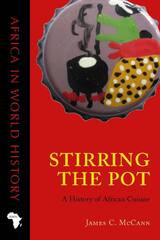
front cover of Stirring the Pot
Stirring the Pot
A History of African Cuisine
James C. McCann
Ohio University Press, 2009

Africa’s art of cooking is a key part of its history. All too often Africa is associated with famine, but in Stirring the Pot, James C. McCann describes how the ingredients, the practices, and the varied tastes of African cuisine comprise a body of historically gendered knowledge practiced and perfected in households across diverse human and ecological landscape. McCann reveals how tastes and culinary practices are integral to the understanding of history and more generally to the new literature on food as social history.

Stirring the Pot offers a chronology of African cuisine beginning in the sixteenth century and continuing from Africa’s original edible endowments to its globalization. McCann traces cooks’ use of new crops, spices, and tastes, including New World imports like maize, hot peppers, cassava, potatoes, tomatoes, and peanuts, as well as plantain, sugarcane, spices, Asian rice, and other ingredients from the Indian Ocean world. He analyzes recipes, not as fixed ahistorical documents,but as lively and living records of historical change in women’s knowledge and farmers’ experiments. A final chapter describes in sensuous detail the direct connections of African cooking to New Orleans jambalaya, Cuban rice and beans, and the cooking of African Americans’ “soul food.”

Stirring the Pot breaks new ground and makes clear the relationship between food and the culture, history, and national identity of Africans.


[more]


Send via email Share on Facebook Share on Twitter