
 A SCHOLARLY BOOK REPOSITORY
12 start with S start with S

Discusses the process of the economic annihilation of the Jews in Hungary, who– from the economic point of view – were more influential than any other Jewish community in Europe. Following the German occupation in March 1944 the collaborating Hungarian government attempted to assert its claim concerning the complete confiscation of Jewish assets at all stages of the road leading to the extermination camps. The cooperation with the Germans proved to be the most problematic in this area.
The story of the Jewish Gold Train is a relatively small but all the more emblematic chapter of the economic annihilation. The circumstances of the freight’s assembling, the German-Hungarian conflicts concerning the train, the looting attempts, the fate of the assets seized by the Allies (double victimization of the survivors) provide the reader with an insight into the history of the repeated looting of the Hungarian Jewry
The book analyzes the role played by SS-Obersturmbannführer Kurt Becher, one of the most controversial and mysterious figures in the Hungarian and universal history of the Holocaust. Becher, delegated to Hungary by Himmler, administered and benefited from the confiscation of an enormous amount of Jewish assets.

A masterpiece of twentieth-century Hungarian fiction, Kosztolányi's Skylark is a classic portrait of provincial life in the Austro-Hungarian monarchy. Set in the autumn of 1899, it focuses on one extraordinary week in the otherwise uneventful lives of an elderly Hungarian couple. Their ugly spinster daughter, nicknamed Skylark, has left them for an unprecedented holiday with relatives in the country. At first, the couple, whose entire existence revolves around their daughter, are devastated by her absence. Slowly, however, they rediscover the delights and diversions of small-town life, finally reaching the shocking conclusion that their daughter is a burden to them.
In this beautifully written tale Kosztolányi turns family sentiment on its head with an irony that is as telling now as it was nearly seventy years ago.



This first detailed account of Soviet military operations is based on access to unpublished material in Soviet archives, which have recently been reclassified.
The major contribution made by the book is its source material, which reveals new information on the organization, command, strategy, and tactics of the Soviet armed forces which invaded Hungary in 1956. Particularly interesting is the precise documentation of the irrationally large size of the forces. The volume is based on research in Soviet archives, and this alone makes it of unique scholarly importance.
The book opens with a substantial introductory essay by the editors, and includes a major study by the Russian military historian Alexandr Kirov, based on research in Soviet military archives. One of the real strengths of the book is that it also includes the memoirs of General Yevgeny Malashenko, in 1956 a colonel in the Soviet Army and acting Chief of Staff of the Special Corps in Budapest. He provides unparalleled insights into Soviet military procedures, politico-military co-operation, and the actual fighting strengths and weaknesses of the Red Army. Very few other high-ranking Soviet officers have ever published their memoirs in the West.
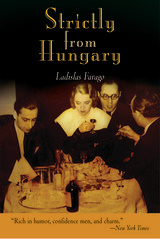
Known for his best-selling military histories, Ladislas Farago also wrote a witty tribute to his homeland, Strictly from Hungary. Noting that Hungary has produced some of the world's most renowned artists, scientists, and financiers as well as its share of world-class con-artists, charlatans, and rakes, Farago sets out to explain just how one tiny country can be responsible for so much talent, both good and bad. Using stories from his days as a struggling writer in the bustling café scenes of Budapest and New York City, Farago demonstrates the Hungarian knack for remaining irrepressible and optimistic even in the face of catastrophe. Here we meet Zoltan, a fellow Bohemian who presents his astonished benefactor with a play "about nothing," a theme later made famous by another writer of Hungarian descent, Jerry Seinfeld. Farago also introduces us to "Baby Kiss," a vivacious Hungarian beauty queen, and the story of how she ended up in Fort Worth, Texas; Orkeny, a double agent for America at the height of the Cold War who "spiced up" his reports to keep everyone happy, and the author's own experience getting mustered into the supposedly non-existent Royal Hungarian Army. Farago's reminiscence validates what most Hungarians believe: that Hungary is the center of the world and that everyone has some connection to the land of the Magyars. In that spirit, Farago learns that George Washington himself was "strictly from Hungary." This edition is introduced by the author's son, who shows that the same vibrant spirit described by his father remains the hallmark of the Hungarian temperament.

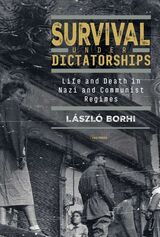
A complex array of individual responses to the abuse of power by the state is represented in this book in three horrific episodes in the history of East-Central Europe. The three events followed each other within a span of about ten years: the deportation and murder of Hungarian Jews in Nazi death and labor camps; the Arrow Cross terrorist rule in Budapest; and finally the Stalinist terror in Hungary and East-Central Europe. Through the prism of survival, László Borhi explores the relationship between the individual and power, attempting to understand the mechanism of oppression and terror produced by arbitrary, unbridled power through the experience of normal people.
Despite the obvious peculiarities of time and place, the Hungarian cases convey universal lessons about the Holocaust, Nazism, and Stalinism. In the author's conception, the National Socialist and Stalinist experiences are linked on several levels. Both regimes defended their visions of the future against social groups whom they saw as implacable enemies of those visions, and who therefore had to be destroyed for sake of social perfection. Furthermore, the social practices of National Socialism were passed on. And although Stalinism was imposed by a foreign power, some of the survival skills for coping with it were rehearsed under the previous hellish experience.
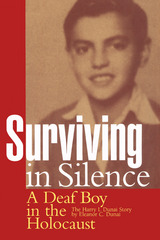
Izrael Zachariah Deutsch was born on March 15, 1934, in Komjata, Czechoslovakia. The second youngest child, Izrael lived a bucolic existence with nine brothers and sisters on a farm, differing from them only in that he was deaf. When he was six, his mother took him to Budapest, Hungary, and enrolled him in a Jewish school for deaf children, where he thrived. Soon, however, the Nazi regime in Germany and the Arrow Cross fascists in Hungary destroyed Izrael’s world forever.
Izrael realized that by being both Jewish and deaf, he faced a double threat of being exported to the gas chambers in Poland. But at every lethal junction, he found a way to survive, first by buying and reselling pastries for extra money that later saved his life in the Budapest ghetto. Still, Izrael was close to death from starvation when he was liberated by Russian soldiers on January 18, 1945.
Izrael survived the war only to learn that his parents and two brothers had been murdered by the Nazis. The rest of his brothers and sisters scattered to distant parts of the world. Forced to remain in Budapest, Izrael finished school and became an accomplished machinist. He avoided any part in the Hungarian uprising in 1956 so that he could secure a visa to leave for Sweden. From Sweden he traveled throughout Europe and Israel, using an amazing network of Holocaust survivors, relatives, and deaf friends to ease his journey. He finally settled in Los Angeles, where he married a deaf Jewish woman he had met years before. Along the way, he changed his name from Izrael Deutsch to Harry Dunai.
READERS
Browse our collection.
PUBLISHERS
See BiblioVault's publisher services.
STUDENT SERVICES
Files for college accessibility offices.
RECENTLY PUBLISHED





UChicago Accessibility Resources
home | accessibility | search | about | contact us
BiblioVault ® 2001 - 2026
The University of Chicago Press