
 A SCHOLARLY BOOK REPOSITORY
28 start with S start with S
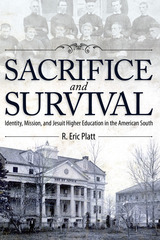
R. Eric Platt examines in Sacrifice and Survival the history and evolution of Jesuit higher education in the American South and hypothesizes that the identity and mission of southern Jesuit colleges and universities may have functioned as catalytic concepts that affected the “town and gown” relationships between the institutions and their host communities in ways that influenced whether they failed or adapted to survive.
The Catholic religious order known as the Society of Jesus (Jesuits) manages a global network of colleges and universities with a distinct Catholic identity and mission. Despite this immense educational system, several Jesuit institutions have closed throughout the course of the order’s existence. Societal pressures, external perceptions or misperceptions, unbalanced curricular structures rooted in liberal arts, and administrators’ slow acceptance of courses related to practical job seeking may all influence religious-affiliated educational institutions. The religious identity and mission of these colleges and universities are fundamentals that influence their interaction with external environs and contribute to their survival or failure.
Platt traces the roots of Jesuit education from the rise of Ignatius Loyola in the mid-sixteenth century through the European development of the Society of Jesus, Jesuit educational identity and mission, the migration of Jesuits to colonial New Orleans, the expulsion of Jesuits by Papal mandate, the reorganization of Jesuit education, their attempt to establish a network of educational institutions across the South, and the final closure of all but two southern Jesuit colleges and a set of high schools.
Sacrifice and Survival explores the implications of the Galveston Hurricane of 1900, yellow fever, Georgia floods, devastating fires, the Civil War, the expansion of New Orleans due to the 1884 Cotton Centennial Exposition, and ties between town and gown, as well as anti-Catholic/anti-Jesuit sentiment as the Society of Jesus pushed forward to create a system of southern institutions. Ultimately, institutional identity and mission critically impacted the survival of Jesuit education in the American South.

Sartorial Fandom shines a spotlight on the fashion and beauty cultures that undergird fandoms, considering the retailers, branded products, and fan-made objects that serve as forms of identity expression. This collection is invested in the subcultural and mainstream expression of style and in the spaces where the two intersect. Fan culture is, in many respects, an optimal space to situate a study of style because fandom itself is often situated between the subcultural and the mainstream. Collectively, the chapters in this anthology explore how various axes of lived identity interact with a growing movement to consider fandom as a lifestyle category, ultimately contending that sartorial practices are central to fan expression but also indicative of the primacy of fandom in contemporary taste cultures.

Seattle Sports: Play, Identity, and Pursuit in the Emerald City, edited by Terry Anne Scott, explores the vast and varied history of sports in this city where diversity and social progress are reflected in and reinforced by play. The work gathered here covers Seattle’s professional sports culture as well as many of the city’s lesser-known figures and sports milestones. Fresh, nuanced takes on the Seattle Mariners, Supersonics, and Seahawks are joined by essays on gay softball leagues, city court basketball, athletics in local Japanese American communities during the interwar years, ultimate, the fierce women of roller derby, and much more. Together, these essays create a vivid portrait of Seattle fans, who, in supporting their teams—often in rain, sometimes in the midst of seismic activity—check the country’s implicit racial bias by rallying behind outspoken local sporting heroes.

In Seized with the Temper of the Times Identity and Rebellion in Pre-Revolutionary America, historian Abby Chandler explores, as never before, the complex local and transatlantic tensions which infused the early imperial crisis. She argues that colonial responses to the Stamp Act were rooted in local tensions and that the Regulator Rebellion was fueled by trans-Atlantic tensions. These two paradoxes, a local crisis cast as imperial affair and an imperial affair cast as local crisis, tell a very different story than the one to which we are accustomed. Without pre-existing local tensions, the fury of the Stamp Act crisis might not have spilled over during the summer of 1765, and, without the added strains of the imperial crisis, the Regulator Rebellion might not have lasted for five years. The questions about the intersecting roles of local and imperial/federal interests and identities raised during both the Stamp Act crisis and the Regulator Rebellion would also continue to inform political thought in Rhode Island and North Carolina in the coming decades. Both colonies had long histories of challenges to their autonomy and their residents embraced the coming revolution before many of their counterparts, but they would also be reluctant participants in the rising union envisioned by the framers of the Constitution.

In the interviews that form the heart of the book, the FTMs speak about their struggles to define themselves and their diverse experiences, from the pressures of gender conformity in adolescence to being mistaken for "butch lesbians," from hormone treatments and surgeries to relationships with families, partners, and acquaintances. Their stories of feeling betrayed by their bodies and of undergoing a "second puberty" are vivid and thought-provoking. Throughout the interviews, the subjects' claims to having "core male identities" are remarkably consistent and thus challenge anti-essentialist assumptions in current theories of gender, embodiment, and identity.
Rubin uses two key methods to analyze and interpret his findings. Adapting Foucault's notions of genealogy, he highlights the social construction of gender categories and identities. His account of the history of endocrinology and medical technologies for transforming bodies demonstrates that the "family resemblance" between transsexuals and intersexuals was a necessary postulate for medical intervention into the lives of the emerging FTMs. The book also explores the historical emergence of the category of FTM transsexual as distinguished from the category of lesbian woman and the resultant "border disputes" over identity between the two groups. Rubin complements this approach with phenomenological concepts that stress the importance of lived experience and the individual's capacity for knowledge and action.
An important contribution to several fields, including sociology of the body, gender and masculinity, human development, and the history of science, Self-Made Me will be of interest to anyone who has seriously pondered what it means to be a man and how men become men.

As the first comparative study of how comics artists from a wide range of backgrounds use the form to write and draw themselves into cultural visibility, Serial Selves will be of interest to anyone interested in the current boom in autobiographical comics, as well as issues of representation in comics and visual culture more broadly.

Ostertag situates this history alongside the story of an increasingly visible and political lesbian, gay, bisexual, and transgender population. He persuasively argues that scholarship on the development of sex hormone chemicals does not take into account LGBT history and activism, nor has work in LGBT history fully considered the scientific research that has long attempted to declare a chemical essence of gender. In combining these histories, Ostertag reveals the complex motivations behind hormone research over generations and expresses concern about the growing profits from estrogen and testosterone, which now are marketed with savvy ad campaigns to increase their use across multiple demographics.
Ostertag does not argue against the use of pharmaceutical hormones. Instead he points out that at a time when they are increasingly available, it is more important than ever to understand the history and current use of these powerful chemicals so that everyone—within the LGBT community and beyond—can make informed choices.
In this short, thoughtful, and engaging book, Ostertag tells a fascinating story while opening up a wealth of new questions and debates about gender, sexuality, and medical treatments.
How the “bad feelings” of trans experience inform trans survival and flourishing
Some days—or weeks, or months, or even years—being trans feels bad. Yet as Hil Malatino points out, there is little space for trans people to think through, let alone speak of, these bad feelings. Negative emotions are suspect because they unsettle narratives of acceptance or reinforce virulently phobic framings of trans as inauthentic and threatening.
In Side Affects, Malatino opens a new conversation about trans experience that acknowledges the reality of feeling fatigue, envy, burnout, numbness, and rage amid the ongoing onslaught of casual and structural transphobia in order to map the intricate emotional terrain of trans survival. Trans structures of feeling are frequently coded as negative on both sides of transition. Before transition, narratives are framed in terms of childhood trauma and being in the “wrong body.” Posttransition, trans individuals—especially trans people of color—are subject to unrelenting transantagonism. Yet trans individuals are discouraged from displaying or admitting to despondency or despair.
By moving these unloved feelings to the center of trans experience, Side Affects proposes an affective trans commons that exists outside political debates about inclusion. Acknowledging such powerful and elided feelings as anger and exhaustion, Malatino contends, is critical to motivating justice-oriented advocacy and organizing—and recalibrating new possibilities for survival and well-being.
This book is a study of a Soviet cultural phenomenon of the 1950s through the 1980s known as guitar poetry—songs accompanied by guitar and considered poetry in much the same way as those of, for example, Bob Dylan. Platonov’s is the most comprehensive book in English to date to analyze guitar poetry, which has rarely received scholarly attention outside of Russia. Going well beyond the conventional, text-centered view of guitar poetry as a form of political or artistic dissent, largely a function of the Cold War climate in which it began, Platonov argues for a more complex understanding of guitar poetry as a means of self-invention and community formation. Although grounded in literary studies, the book effectively brings historical, anthropological, and musicological perspectives to bear on an understudied phenomenon of the post-Stalin period.

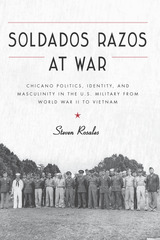
What were the catalysts that motivated Mexican American youth to enlist or readily accept their draft notices in World War II, Korea, or Vietnam? In Soldados Razos at War, historian and veteran Steven Rosales chronicles the experiences of Chicano servicemen who fought for the United States, explaining why these men served, how they served, and the impact of their service on their identity and political consciousness.
As a social space imbued with its own martial and masculine ethos, the U.S. military offers an ideal way to study the aspirations and behaviors that carried over into the civilian lives of these young men. A tradition of martial citizenship forms the core of the book. Using rich oral histories and archival research, Rosales investigates the military’s transformative potential with a particular focus on socioeconomic mobility, masculinity, and postwar political activism across three generations.
The national collective effort characteristic of World War II and Korea differed sharply from the highly divisive nature of American involvement in Vietnam. Thus, for Mexican Americans, military service produced a wide range of ideological reactions, with the ideals of each often in opposition to the others. Yet a critical thread connecting these diverse outcomes was a redefined sense of self and a willingness to engage in individual and collective action to secure first-class citizenship.

A revealing account of the three main disciples of Rabbi Joseph B. Soloveitchik, an essential figure in Orthodox Judaism in America
Orthodox Judaism is one of the fastest-growing religious communities in contemporary American life. Anyone who wishes to understand more about Judaism in America will need to consider the tenets and practices of Orthodox Judaism: who its adherents are, what they believe in, what motivates them, and to whom they turn for moral, intellectual, and spiritual guidance.
Among those spiritual leaders none looms larger than Rabbi Joseph B. Soloveitchik, heir to the legendary Talmudic dynasty of Brisk and a teacher and ordainer of thousands of rabbis during his time as a Talmud teacher at Yeshiva University from the Second World War until the 1980s. Soloveitchik was not only a Talmudic authority but a scholar of Western philosophy. While many books and articles have been written about Soloveitchik’s legacy and his influence on American Orthodoxy, few have looked carefully at his disciples in Torah and Talmud study, and even fewer at his disciples in Jewish thought and philosophy.
Soloveitchik’s Children: Irving Greenberg, David Hartman, Jonathan Sacks, and the Future of Jewish Theology in America is the first book to study closely three of Soloveitchik’s major disciples in Jewish thought and philosophy: Rabbis Irving (“Yitz”) Greenberg, David Hartman, and Jonathan Sacks. Daniel Ross Goodman narrates how each of these three major modern Jewish thinkers learned from and adapted Soloveitchik’s teachings in their own ways, even while advancing his philosophical and theological legacy.
The story of religious life and Judaism in contemporary America is incomplete without an understanding of how three of the most consequential Jewish thinkers of this generation adapted the teachings of one of the most consequential Jewish thinkers of the previous generation. Soloveitchik’s Children tells this gripping intellectual and religious story in a learned and engaging manner, shining a light on where Jewish religious thought in the United States currently stands—and where it may be heading in future generations.
Originally published in 2003 in Portuguese, The Sorcery of Color argues that there are longstanding and deeply-rooted relationships between racial and gender inequalities in Brazil. In this pioneering book, Elisa Larkin Nascimento examines the social and cultural movements that have attempted, since the early twentieth century, to challenge and eradicate these conjoined inequalities.
The book's title describes the social sleight-of-hand that disguises the realities of Brazilian racial inequity. According to Nascimento, anyone who speaks of racism—or merely refers to another person as black—traditionally is seen as racist. The only acceptably non-racist attitude is silence. At the same time, Afro-Brazilian culture and history have been so overshadowed by the idea of a general "Brazilian identity" that to call attention to them is also to risk being labeled racist.
Incorporating leading international scholarship on Pan Africanism and Afrocentric philosophy with the writing of Brazilian scholars, Nascimento presents a compelling feminist argument against the prevailing policy that denies the importance of race in favor of a purposefully vague concept of ethnicity confused with color.
Huntington’s analysis shows how these writers and others challenge the aesthetic and political conventions that privilege written texts over orality and invite readers-listeners to participate in critical dialogues—to sound off, as it were, in local and global communities.
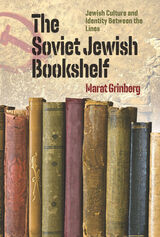
In The Soviet Jewish Bookshelf, Marat Grinberg argues that in an environment where Judaism had been all but destroyed, and a public Jewish presence routinely delegitimized, reading uniquely provided many Soviet Jews with an entry to communal memory and identity. The bookshelf was both a depository of selective Jewish knowledge and often the only conspicuously Jewish presence in their homes. The typical Soviet Jewish bookshelf consisted of a few translated works from Hebrew and numerous translations from Yiddish and German as well as Russian books with both noticeable and subterranean Jewish content. Such volumes, officially published, and not intended solely for a Jewish audience, afforded an opportunity for Soviet Jews to indulge insubordinate feelings in a largely safe manner. Grinberg is interested in pinpointing and decoding the complex reading strategies and the specifically Jewish uses to which the books on the Soviet Jewish bookshelf were put. He reveals that not only Jews read them, but Jews read them in a specific way.
Part 1. Reconstruction: Language Varieties, Language Use, and Language Attitudes
1. Crossing Social and Cultural Borders: The Road to Language Hybridity, María Dolores Gonzales
2. Fighting Words: Latina Girls, Gangs, and Language Attitudes, Norma Mendoza-Denton
Part 2. Reflection: Testimonios
3. Speaking as a Chicana: Tracing Cultural Heritage through Silence and Betrayal, Jacqueline M. Martínez
4. The Power of Language: From the Back of the Bus to the Ivory Tower, Christine Marín
5. Challenging Tradition: Opening the Headgate, Ida M. Luján
6. Mexican Blood Runs through My Veins, Aurora E. Orozco
Part 3. Innovation: Speaking Creatively/Creatively Speaking
7. Searching for a Voice: Ambiguities and Possibilities, Erlinda Gonzales-Berry
8. Sacred Cults, Subversive Icons: Chicanas and the Pictorial Language of Catholicism, Charlene Villaseñor Black
9. Caló and Taboo Language Use among Chicanas: A Description of Linguistic Appropriation and Innovation, D. Letticia Galindo
10. Máscaras, Trenzas, y Greñas: Un/Masking the Self While Un/Braiding Latina Stories and Legal Discourse, Margaret E. Montoya
Drawing upon detailed observations and in-depth interviews, Chepp tells the story of a diverse group of young adults from Washington, D.C. who use spoken word to create a more just and equitable world. Outlining the contours of this approach, she interrogates spoken word activism’s emphasis on personal storytelling and “truth,” the strategic uses of aesthetics and emotions to politically engage across difference, and the significance of healing in sustainable movements for change. Weaving together their poetry and personally told stories, Chepp shows how poets tap into the beautiful, emotional, personal, and therapeutic features of spoken word to empathically connect with others, advance intersectional and systemic analyses of inequality, and make social justice messages relatable across a diverse public. By creating allies and forging connections based on friendship, professional commitments, lived experiences, emotions, artistic kinship, and political views, this activist approach is highly integrated into the everyday lives of its practitioners, online and face-to-face.
Chepp argues that spoken word activism is a product of, and a call to action against, the neoliberal era in which poets have come of age, characterized by widening structural inequalities and increasing economic and social vulnerability. She illustrates how this deeply personal and intimate activist approach borrows from, builds upon, and diverges from previous social movement paradigms. Spotlighting the complexity and mutual influence of modern-day activism and the world in which it unfolds, Speaking Truths contributes to our understanding of contemporary social change-making and how neoliberalism has shaped this political generation’s experiences with social injustice.
This is the first in-depth study of the entire corpus of Latina theater, based on close readings of works both published and in manuscript. It considers a large body of productions and performances, including works by such internationally known authors as Dolores Prida, Cherríe Moraga, and Janis Astor del Valle.
Applying feminist and postcolonial theory as well as theories of transculturation, Sandoval-Sánchez and Sternbach show how, despite cultural differences among Latinas, their works share a common poetics by building upon the politics of representation, identity, and location. In addition to covering theater, this study also shows that solo performance has its own history, properties, structure, and poetics. It examines performances of Carmelita Tropicana, Monica Palacios, and Marga Gomez—artists whose hybrid identities as Latina lesbians constitute living examples of transculturation in the making—to show how solo performance has roots in and digresses from more traditional modes of theater. With their Latina heritage as a unifying link, these women reflect common traits, patterns, dramatic structures, and properties that overcome regional differences. Stages of Life reads these eclectic cultural productions as a unified body of work that contributes to the formation of Latina identity in America today.
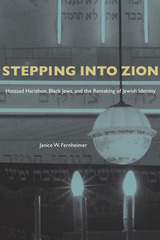
Hatzaad Harishon ("The First Step") was a New York-based, multiracial Jewish organization that worked to increase recognition and legitimacy for Black Jews in the sixties and seventies. In Stepping into Zion, Janice W. Fernheimer examines the history and archives of Hatzaad Harishon to illuminate the shifting definitions and borders of Jewish identity, which have critical relevance to Jews of all traditions as well as to non-Jews.
Fernheimer focuses on a period when Jewish identity was in flux and deeply influenced by the Civil Rights and Black Power movements. In 1964, white and Black Jews formed Hatzaad Harishon to foster interaction and unity between Black and white Jewish communities. They raised the question of who or what constitutes Jewishness or Jewish identity, and in searching for an answer succeeded—both historically and rhetorically—in gaining increased recognition for Black Jews. Fernheimer traces how, despite deep disagreement over definitions, members of Hatzaad Harishon were able to create common ground in a process she terms "interruptive invention": an incremental model for rhetorical success that allows different groups to begin and continue important but difficult discussions when they share little common ground or make unequal claims to institutional and discursive power, or when the nature of common ground is precisely what is at stake. Consequently, they provide a practical way out of the seemingly incommensurable stalemate incompatible worldviews present.
Through insightful interpretations of Hatzaad Harishon's archival materials, Fernheimer chronicles the group's successes and failures within the larger rhetorical history of conflicts that emerge when cultural identities shift or expand.

Storm from Paradise was first published in 1992. Minnesota Archive Editions uses digital technology to make long-unavailable books once again accessible, and are published unaltered from the original University of Minnesota Press editions.
"Usefully complicating common sense understandings of history, catastrophe, loss, otherness, and possibility through reflections on contemporary Jewishness, Boyarin draws on Benjamins's famous image of the Angel of History blown into the future by a "storm from paradise" to constantly interrogate and recuperate the past, "without pretending for long that we can recoup its plentitude". The book's seven thoughtful essays are at times deliberately intangible but always worth reading. An important book for the rethinking of the relevance of Jewishness to anthropology and cultural studies." –Religious Studies Review
"An essay in the richest sense of that term, inspired by and modeled on Walter Benjamin's essays. Based on varied, diverse, and abundantly cross-disciplinary readings, it moves and builds, questions and interrogates, and ultimately convinces us that the Jewish experience with being the 'other' and, conversely and recently, with 'othering' is indeed relevant to theorists of contemporary culture." –Marianne Hirsch
Jonathan Boyarin is the author of Palestine and Jewish History, and co-editor, with Daniel Boyarin, of Jews and Other Differences and Powers of Diaspora.

Adapts Mikhail Bakhtin's theory of the grotesque, as well as the latest in gender and psychoanalytic theory, to the major works of acclaimed southern writer Carson McCullers.
This innovative reconsideration of the themes of Carson McCullers's fiction argues that her work has heretofore suffered under the pall of narrow gothic interpretations, obscuring a more subversive agenda. By examining McCullers’s major novels—The Heart is a Lonely Hunter, Reflections in a Golden Eye, The Member of the Wedding, and The Ballad of the Sad Café—Gleeson-White locates a radical and specific form of the grotesque in the author's fiction: the liberating and redemptive possibilities of errant gender roles and shifting sexuality. She does this by employing Bakhtin's theory of the grotesque, which is both affirming and revolutionary, and thereby moves McCullers's texts beyond the 'gloom and doom' with which they have been charged for over fifty years.
The first chapter explores female adolescence by focusing on McCullers's tomboys in the context of oppressive southern womanhood. The second chapter analyzes McCullers's fascinating struggle to depict homosexual desire outside of traditional stereotypes. Gleeson-White then examines McCullers's portrayals of feminine and masculine gender through the tropes of cross-dressing, transvestism, and masquerade. The final chapter takes issue with earlier readings of androgyny in the texts to suggest a more useful concept McCullers herself called "the hybrid." Underpinning the whole study is the idea of a provocative, dynamic form of the grotesque that challenges traditional categories of normal and abnormal.
Because the characters and themes of McCullers's fiction were created in the 1940s and 1950s, a time of tension between the changing status of women and the southern ideal of womanhood, they are particularly fertile ground for a modern reexamination of this nature. Gleeson-White's study will be valued by scholars of American literature and gender and queer studies, by students of psychology, by academic libraries, and by readers of Carson McCullers. Strange Bodies is a thoughtful, highly credible analysis that adds dimension to the study of southern literature.

The Stranger within Your Gates analyzes virtually every reference to converts in the full corpus of rabbinic literature. The intellectual dilemma that converts posed for classical Judaism played itself out in discussions of marriage, religious practice, inheritance of property, and much else. Reviewing the rabbinic literature text by text, Porton exposes the rabbis' frequently ambivalent and ambiguous views.
The Stranger within Your Gates is the only examination of conversion in rabbinic literature to draw upon the full scope of contemporary anthropological and sociological studies of conversion. It is also unique in its focus on the opinions of the community into which the convert enters, rather than on the testimony of the convert. By approaching data with new methods, Porton heightens our understanding of conversion and the nature of the People of Israel in rabbinic literature.
In the 1970s, the three groups most intimately involved in the Orme Dam—younger Bureau of Reclamation employees committed to "rational choice" decision making, older Bureau engineers committed to the dam, and the Yavapai community—all found themselves and their values transformed by their struggles. Wendy Nelson Espeland lays bare the relations between interests and identities that emerged during the conflict, creating a contemporary tale of power and colonization, bureaucracies and democratic practice, that asks the crucial question of what it means to be "rational."

In Summoned, Tavory takes readers to the heart of the exhilarating—at times exhausting—life of the Beverly-La Brea Orthodox community. Just blocks from West Hollywood’s nightlife, the Orthodox community thrives next to the impure sights, sounds, and smells they encounter every day. But to sustain this life, as Tavory shows, is not simply a moral decision they make. To be Orthodox is to be constantly called into being. People are reminded of who they are as they are called upon by organizations, prayer quorums, the nods of strangers, whiffs of unkosher food floating through the street, or the rarer Anti-Semitic remarks. Again and again, they find themselves summoned both into social life and into their identity as Orthodox Jews. At the close of Tavory’s fascinating ethnography, we come away with a better understanding of the dynamics of social worlds, identity, interaction and self—not only in Beverly-La Brea, but in society at large.
Swahili literature is a hybrid that is being reconfigured by a conjuncture of global and local forces. As the interweaving of elements of the colonizer and the colonized, this hybrid formation provides a representation of cultural difference that is said to constitute a “third space,” blurring existing boundaries and calling into question established identitarian categorizations. This cultural dialectic is clearly evident in the Swahili literary experience as it has evolved in the crucible of the politics of African cultural production.
However, Swahili Beyond the Boundaries demonstrates that, from the point of view of Swahili literature, while hybridity evokes endless openness on questions of home and identity, it can simultaneously put closure on specific forms of subjectivity. In the process of this contestation, a new synthesis may be emerging that is poised to subject Swahili literature to new kinds of challenges in the politics of identity, compounded by the dynamics and counterdynamics of post–Cold War globalization.
READERS
Browse our collection.
PUBLISHERS
See BiblioVault's publisher services.
STUDENT SERVICES
Files for college accessibility offices.
RECENTLY PUBLISHED


UChicago Accessibility Resources
home | accessibility | search | about | contact us
BiblioVault ® 2001 - 2026
The University of Chicago Press