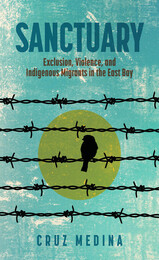
front cover of Sanctuary
Sanctuary
Exclusion, Violence, and Indigenous Migrants in the East Bay
Cruz Medina
The Ohio State University Press, 2024
In Sanctuary, Cruz Medina presents a powerful counterstory to dominant narratives surrounding Latin American and Global South im/migration by bringing attention to the displacement of Indigenous Guatemalan Maya people who seek refuge in the United States. These migrants have exchanged gang and narcotrafficker violence for the dehumanizing and exclusionary rhetoric of US political leaders, militarized immigration enforcement, false promises of empowerment through literacy, and further displacement from gentrification. Medina combines decolonial critical race theory with autoethnography to examine white supremacist policies that impact US and transnational Indigenous populations who have been displaced by neocolonial projects of capitalism.

Taking a Northern California community of migrants from Guatemala as a case study, Medina demonstrates the ways in which immigration policy and educational barriers exclude Indigenous migrant populations. He follows the community at the “Sanctuary”—a Spanish-speaking church in the East Bay Area that serves as a place of worship, English language instruction, and refuge for migrants. Medina assembles participant observations, interviews, surveys, and other data to provide points of entry into intersecting issues of immigration, violence, language, and property and to untangle aspects of citizenship, exclusion, and assumptions about literacy.
[more]

front cover of Scrap Theory
Scrap Theory
Reproductive Injustice in the Black Feminist Imagination
Mali D. Collins
The Ohio State University Press, 2025
Reproductive justice debates have often focused on the right to not have children, but rarely do they address the right to remember children lost to violence. Turning her attention to visual and written works by Black women documenting mother–child separation, Mali D. Collins invites us to deploy a theory of “scraps” to understand the ways that the lives of Black mothers and children are documentations of centuries of racialized and gendered torment. Focusing on creative works from the late twentieth century through the present, including the writings of Toni Cade Bambara, M. NourbeSe Philip, and Edwidge Danticat; the critical activism of Erica Garner; and visual/material art by Samaria Rice and Elizabeth Catlett, Collins argues that Black women’s creative work should be recognized as memory work that plays a crucial role in the cultural processing of racial and maternal trauma. By centering creative scraps—interstitial, fragmentary, or discarded elements—of maternal dispossession, Scrap Theory brings together theories of archival injustice and reproductive injustice to illuminate how the archival erasure of Black motherhood is an urgent concern for the movement for reproductive justice.
[more]

front cover of The Seductions of Quantification
The Seductions of Quantification
Measuring Human Rights, Gender Violence, and Sex Trafficking
Sally Engle Merry
University of Chicago Press, 2016
We live in a world where seemingly everything can be measured. We rely on indicators to translate social phenomena into simple, quantified terms, which in turn can be used to guide individuals, organizations, and governments in establishing policy. Yet counting things requires finding a way to make them comparable. And in the process of translating the confusion of social life into neat categories, we inevitably strip it of context and meaning—and risk hiding or distorting as much as we reveal.

With The Seductions of Quantification, leading legal anthropologist Sally Engle Merry investigates the techniques by which information is gathered and analyzed in the production of global indicators on human rights, gender violence, and sex trafficking. Although such numbers convey an aura of objective truth and scientific validity, Merry argues persuasively that measurement systems constitute a form of power by incorporating theories about social change in their design but rarely explicitly acknowledging them. For instance, the US State Department’s Trafficking in Persons Report, which ranks countries in terms of their compliance with antitrafficking activities, assumes that prosecuting traffickers as criminals is an effective corrective strategy—overlooking cultures where women and children are frequently sold by their own families. As Merry shows, indicators are indeed seductive in their promise of providing concrete knowledge about how the world works, but they are implemented most successfully when paired with context-rich qualitative accounts grounded in local knowledge.
[more]

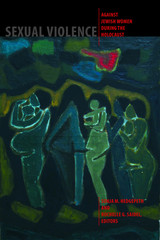
front cover of Sexual Violence against Jewish Women during the Holocaust
Sexual Violence against Jewish Women during the Holocaust
Edited by Sonja M. Hedgepeth and Rochelle G. Saidel
Brandeis University Press, 2010
Using testimonies, Nazi documents, memoirs, and artistic representations, this volume broadens and deepens comprehension of Jewish women’s experiences of rape and other forms of sexual violence during the Holocaust. The book goes beyond previous studies, and challenges claims that Jewish women were not sexually violated during the Holocaust. This anthology by an interdisciplinary and international group of scholars addresses topics such as rape, forced prostitution, assaults on childbearing, artistic representations of sexual violence, and psychological insights into survivor trauma. These subjects have been relegated to the edges or completely left out of Holocaust history, and this book aims to shift perceptions and promote new discourse.
[more]

front cover of A Single Star and Bloody Knuckles
A Single Star and Bloody Knuckles
A History of Politics and Race in Texas
By Bill Minutaglio
University of Texas Press, 2021
Finalist, 2021 Writers’ League of Texas Book Award

For John Nance “Cactus Jack” Garner, there was one simple rule in politics: “You’ve got to bloody your knuckles.” It’s a maxim that applies in so many ways to the state of Texas, where the struggle for power has often unfolded through underhanded politicking, backroom dealings, and, quite literally, bloodshed. The contentious history of Texas politics has been shaped by dangerous and often violent events, and been formed not just in the halls of power but by marginalized voices omitted from the official narratives.

A Single Star and Bloody Knuckles traces the state’s conflicted and dramatic evolution over the past 150 years through its pivotal political players, including oft-neglected women and people of color. Beginning in 1870 with the birth of Texas’s modern political framework, Bill Minutaglio chronicles Texas political life against the backdrop of industry, the economy, and race relations, recasting the narrative of influential Texans. With journalistic verve and candor, Minutaglio delivers a contemporary history of the determined men and women who fought for their particular visions of Texas and helped define the state as a potent force in national affairs.

[more]

front cover of Slavery at Sea
Slavery at Sea
Terror, Sex, and Sickness in the Middle Passage
Sowande M Mustakeem
University of Illinois Press, 2016
Most times left solely within the confine of plantation narratives, slavery was far from a land-based phenomenon. This book reveals for the first time how it took critical shape at sea. Expanding the gaze even more deeply, the book centers how the oceanic transport of human cargoes--infamously known as the Middle Passage--comprised a violently regulated process foundational to the institution of bondage.

Sowande' Mustakeem's groundbreaking study goes inside the Atlantic slave trade to explore the social conditions and human costs embedded in the world of maritime slavery. Mining ship logs, records and personal documents, Mustakeem teases out the social histories produced between those on traveling ships: slaves, captains, sailors, and surgeons. As she shows, crewmen manufactured captives through enforced dependency, relentless cycles of physical, psychological terror, and pain that led to the the making--and unmaking--of enslaved Africans held and transported onboard slave ships. Mustakeem relates how this process, and related power struggles, played out not just for adult men, but also for women, children, teens, infants, nursing mothers, the elderly, diseased, ailing, and dying. Mustakeem offers provocative new insights into how gender, health, age, illness, and medical treatment intersected with trauma and violence transformed human beings into the world's most commercially sought commodity for over four centuries.

[more]

front cover of The Specter and the Speculative
The Specter and the Speculative
Afterlives and Archives in the African Diaspora
Mae G. Henderson
Rutgers University Press, 2024
The Specter and the Speculative: Afterlives and Archives in the African Diaspora engages in a critical conversation about how historical subjects and historical texts within the African Diaspora are re-fashioned, re-animated, and re-articulated, as well as parodied, nostalgized, and defamiliarized, to establish an “afterlife” for African Atlantic identities and narratives. These essays focus on transnational, transdisciplinary, and transhistorical sites of memory and haunting—textual, visual, and embodied performances—in order to examine how these “living” archives circulate and imagine anew the meanings of prior narratives liberated from their original context. Individual essays examine how historical and literary performances—in addition to film, drama, music, dance, and material culture—thus revitalized, transcend and speak across temporal and spatial boundaries not only to reinstate traditional meanings, but also to motivate fresh commentary and critique. Emergent and established scholars representing diverse disciplines and fields of interest specifically engage under explored themes related to afterlives, archives, and haunting.
[more]

logo for University of North Texas Press
Still the Arena of Civil War
Violence and Turmoil in Reconstruction Texas, 1865-1874
Kenneth W. Howell
University of North Texas Press, 2012

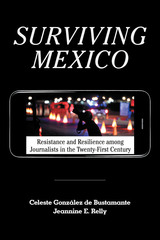
front cover of Surviving Mexico
Surviving Mexico
Resistance and Resilience among Journalists in the Twenty-first Century
By Celeste González de Bustamante and Jeannine E. Relly
University of Texas Press, 2021

Mott KTA Journalism and Mass Communication Research Award, Kappa Tau Alpha
Tankard Book Award, Association for Education in Journalism and Mass Communication (AEJMC)
Knudson Latin America Prize, Association for Education in Journalism and Mass Communication (AEJMC)

Since 2000, more than 150 journalists have been killed in Mexico. Today the country is one of the most dangerous in the world in which to be a reporter. In Surviving Mexico, Celeste González de Bustamante and Jeannine E. Relly examine the networks of political power, business interests, and organized crime that threaten and attack Mexican journalists, who forge ahead despite the risks.

Amid the crackdown on drug cartels, overall violence in Mexico has increased, and journalists covering the conflict have grown more vulnerable. But it is not just criminal groups that want reporters out of the way. Government forces also attack journalists in order to shield corrupt authorities and the very criminals they are supposed to be fighting. Meanwhile some news organizations, enriched by their ties to corrupt government officials and criminal groups, fail to support their employees. In some cases, journalists must wait for a “green light” to publish not from their editors but from organized crime groups. Despite seemingly insurmountable constraints, journalists have turned to one another and to their communities to resist pressures and create their own networks of resilience. Drawing on a decade of rigorous research in Mexico, González de Bustamante and Relly explain how journalists have become their own activists and how they hold those in power accountable.

[more]


Send via email Share on Facebook Share on Twitter