
 A SCHOLARLY BOOK REPOSITORY
137 start with T start with T

Like the Bouthilliers, the Colberts, the Fouquets, and the Letelliers, the Arnauld family rose to prominence at the end of the sixteenth century by attaching themselves to the king. Their power and influence depended upon absolute loyalty and obedience to the sovereign whose own power they sought to enhance. Dictates of conscience, however, brought all that to an end and put them in conflict with both king and pope. As a result of the religious conversion of Angélique Arnauld early in the seventeenth century, the family eventually adopted a set of religious principles that appeared Calvinist to some ecclesiastical authorities. These "Jansenist" principles were condemned by the papacy and Louis XIV.
The travails of conscience experienced by the Arnauld family, and the resulting religious schism that separated different branches, divided husbands from wives and parents from children. However, neither the historic achievements of individual family members nor the differences of opinion between them could obscure the sense of family solidarity.
The dramatic appeal of this book is underscored by a tumultuous period in French history which coincides with and punctuates the Arnauld family's struggle with the world. We see how this extraordinary family reacted to momentous political and religious developments, as well as the ways in which individual members, by means of their own convictions, helped shape the history of their time.
Nicolaus Steno (1638–1686) was a renowned anatomist in his lifetime. He reformed the anatomical understanding of glands, argued that the heart was a muscle, renamed the so-called female testicles as ovaries, and developed a mathematical model for understanding muscle contraction—discoveries that were fundamental to the fields of anatomy and physiology. However, other aspects of Steno’s life have come to define him: his claim that mountains’ strata reveal the history of the Earth and his conversion to Catholicism as a practicing scientist. This excessive attention to his geological discoveries and to asking whether science and religion are compatible, Nuno Castel-Branco argues, has obscured his significant accomplishments as an anatomist. The Traveling Anatomist thus restores Steno to his rightful place as a crucial figure in early modern science.
Using Steno’s extensive travels as a framework, this book depicts him as an active participant in the Republic of Letters. Castel-Branco traverses Leiden, Paris, Copenhagen, Florence, and Rome as he follows Steno in his sojourns through different scientific academies, courts, and artisanal workshops. There he developed new friends, some of whom were women, with whom he researched and exchanged ideas. Drawing on Steno’s books, correspondence, and novel archival material, Castel-Branco invites us to approach Steno and his accomplishments in anatomy, mathematics, and geology through the eyes of his contemporaries. Doing so, Castel-Branco reconstructs the rich and overlapping worlds of scientific disciplines that shaped Steno’s work, revealing the richness of interdisciplinary research in early modern intellectual life. And through Steno, he illustrates larger developments and new networks of significance in mid-seventeenth-century science. By focusing on ideas, scientific genres, institutions, and friendships, Castel-Branco offers a way others might also productively study science from the early modern period until today.
Artist and writer Mina Loy (1882-1966) traversed continents, participated in Futurism, Dada, and Surrealism, and depicted poetic and painterly vistas ranging from lunar landscapes to the gritty streets of the Bowery. Travels with Mina Loy: Navigating the Avant-Garde, a companion text to the award-winning, multi-authored web resource Mina Loy: Navigating the Avant-Garde, offers an illustrated tour of Mina Loy’s long and varied career, contextualized with in-depth explorations of key places that shaped her life and work. Shedding new light on Loy's poetic responses to Italy, her theatrical explorations in New York City, and her forays into the museums of Paris and New York, the book brings in newly discovered and critically overlooked Loy works, as well as fresh timelines and surveys of the critical corpus on her creative output. This essential guidebook to Mina Loy charts her migrations across geography, movements among artistic circles and people, and transit across arts to illuminate her evolving aesthetics, politics, and artistic commitments.

A revelatory intellectual biography of Tocqueville, told through his wide-ranging travels—most of them, aside from his journey to America, barely known.
It might be the most famous journey in the history of political thought: in 1831, Alexis de Tocqueville sailed from France to the United States, spent nine months touring and observing the political culture of the fledgling republic, and produced the classic Democracy in America.
But the United States was just one of the many places documented by the inveterate traveler. Jeremy Jennings follows Tocqueville’s voyages—by sailing ship, stagecoach, horseback, train, and foot—across Europe, North Africa, and of course North America. Along the way, Jennings reveals underappreciated aspects of Tocqueville’s character and sheds new light on the depth and range of his political and cultural commentary.
Despite recurrent ill health and ever-growing political responsibilities, Tocqueville never stopped moving or learning. He wanted to understand what made political communities tick, what elite and popular mores they rested on, and how they were adjusting to rapid social and economic change—the rise of democracy and the Industrial Revolution, to be sure, but also the expansion of empire and the emergence of socialism. He lauded the orderly, Catholic-dominated society of Quebec; presciently diagnosed the boisterous but dangerously chauvinistic politics of Germany; considered England the freest and most unequal place on Earth; deplored the poverty he saw in Ireland; and championed French colonial settlement in Algeria.
Drawing on correspondence, published writings, speeches, and the recollections of contemporaries, Travels with Tocqueville Beyond America is a panoramic combination of biography, history, and political theory that fully reflects the complex, restless mind at its center.
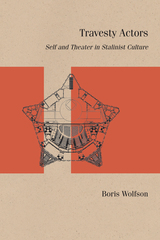
Talk of Joseph Stalin’s “show trials,” the public prosecutions in Moscow’s Hall of Columns in the late 1930s, is so familiar as to obscure the relationship between actual shows—in the Soviet Union’s major theaters—and politics. Travesty Actors: Self and Theater in Stalinist Culture examines theatrical performance within the context of the Soviet cultural establishment’s fashioning of a “genuine Soviet person.” Boris Wolfson focuses on prominent and controversial plays by artists including Aleksandr Afinogenov, Mikhail Bulgakov, Yuri Olesha, and Natalia Sats and the efforts of theater companies, like the Moscow Arts Theater, the Meyerhold Theater, and the Central Children’s Theater, to adhere to this cultural mandate while grappling with repression, censorship, and conflicting interpretations of its aims. Drawing on archival materials, diaries and memoirs and eyewitness accounts, Wolfson greatly illuminates the achievements of Soviet theater during this harsh period and the cultural significance of artistic theories and practices for articulating and enacting ideological programs.
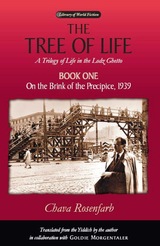
Winner of the 1972 J. J. Segal Prize and the 1979 Manger Prize for Yiddish Literature
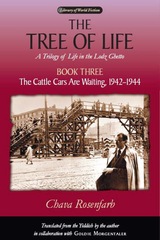
The third volume in this powerful trilogy, The Cattle Cars Are Waiting follows the tragic fate of the inhabitants of the ghetto. Chava Rosenfarb, herself a survivor of the Lodz Ghetto, Auschwitz, and Bergen-Belsen, draws on her own history to create characters who struggle daily to retain a sense of humanity and dignity despite the physical and psychological effects of ghetto life. Although the novel depicts horrendous experiences, the light of faith in the human spirit shines through every page.
Winner, Georges Bugnet Award for Best Novel, Writers Guild of Alberta
This volume describes the lives of the novel’s protagonists in the Lodz Ghetto at the beginning of World War II. Chava Rosenfarb, herself a survivor of the Lodz Ghetto, Auschwitz, and Bergen-Belsen, draws on her own history to create realistic characters who struggle daily to retain a sense of humanity and dignity despite the physical and psychological effects of ghetto life. Although horrendous experiences are depicted, the light of faith in the human spirit shines through this novel’s every page.
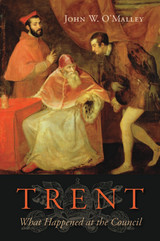
Winner of the John Gilmary Shea Prize
The Council of Trent (1545–1563), the Catholic Church’s attempt to put its house in order in response to the Protestant Reformation, has long been praised and blamed for things it never did. Now, in this first full one-volume history in modern times, John W. O’Malley brings to life the volatile issues that pushed several Holy Roman emperors, kings and queens of France, and five popes—and all of Europe with them—repeatedly to the brink of disaster.
During the council’s eighteen years, war and threat of war among the key players, as well as the Ottoman Turks’ onslaught against Christendom, turned the council into a perilous enterprise. Its leaders declined to make a pronouncement on war against infidels, but Trent’s most glaring and ironic silence was on the authority of the papacy itself. The popes, who reigned as Italian monarchs while serving as pastors, did everything in their power to keep papal reform out of the council’s hands—and their power was considerable. O’Malley shows how the council pursued its contentious parallel agenda of reforming the Church while simultaneously asserting Catholic doctrine.
Like What Happened at Vatican II, O’Malley’s Trent: What Happened at the Council strips mythology from historical truth while providing a clear, concise, and fascinating account of a pivotal episode in Church history. In celebration of the 450th anniversary of the council’s closing, it sets the record straight about the much misunderstood failures and achievements of this critical moment in European history.
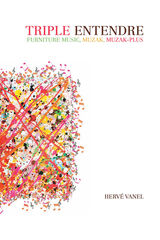
Vanel's discussion culminates in the creative response of the composer John Cage to the pervasiveness and power of background music in contemporary society. Cage neither opposed nor rejected Muzak, but literally answered its challenge by formulating a parallel concept that he called "Muzak-Plus." Forty years after Satie presented his work to general critical puzzlement, Cage saw how background music could be combined with mid-century technology and theories of art and performance to create a participatory soundscape on a scale that Satie could not have envisioned, again reconfiguring the listener's stance to music. By examining the subterranean connections existing between these three formulations of a singular idea, Triple Entendre analyzes and challenges the crucial boundary that separates an artistic concept from its actual implementation in life.
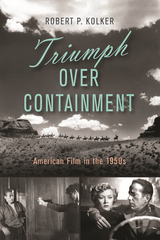
Triumph Over Containment offers an uncompromising look at some of the era’s greatest films and directors, from household names like Alfred Hitchcock and Stanley Kubrick to lesser-known iconoclasts like Samuel Fuller and Ida Lupino. Taking in everything from The Thing from Another World (1951) to Dr. Strangelove or: How I Learned to Stop Worrying and Love the Bomb (1964), acclaimed film scholar Robert P. Kolker scours a variety of different genres to find pockets of resistance to the repressive and oppressive norms of Cold War culture. He devotes special attention to two quintessential 1950s genres—the melodrama and the science fiction film—that might seem like polar opposites, but each offered pointed responses to containment culture.
This book takes a fresh look at such directors as Nicholas Ray, John Ford, and Orson Welles, while giving readers a new appreciation for the depth and artistry of 1950s Hollywood films.

Robert Service completes his masterful trilogy on the founding figures of the Soviet Union in an eagerly anticipated, authoritative biography of Leon Trotsky.
Trotsky is perhaps the most intriguing and, given his prominence, the most understudied of the Soviet revolutionaries. Using new archival sources including family letters, party and military correspondence, confidential speeches, and medical records, Service offers new insights into Trotsky. He discusses Trotsky’s fractious relations with the leaders he was trying to bring into a unified party before 1914; his attempt to disguise his political closeness to Stalin; and his role in the early 1920s as the progenitor of political and cultural Stalinism. Trotsky evinced a surprisingly glacial and schematic approach to making revolution. Service recounts Trotsky’s role in the botched German revolution of 1923; his willingness to subject Europe to a Red Army invasion in the 1920s; and his assumption that peasants could easily be pushed onto collective farms. Service also sheds light on Trotsky’s character and personality: his difficulties with his Jewish background, the development of his oratorical skills and his preference for writing over politicking, his inept handling of political factions and coldness toward associates, and his aversion to assuming personal power.
Although Trotsky’s followers clung to the stubborn view of him as a pure revolutionary and a powerful intellect unjustly hounded into exile by Stalin, the reality is very different. This illuminating portrait of the man and his legacy sets the record straight.
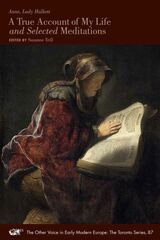
Born in the early 1620s, Anne, Lady Halkett (née Murray) grew up on the fringes of the English court during a period of increasing political tension. From 1644 to 1699, Halkett recorded her personal and political experiences in both England and Scotland in a series of manuscript meditations and an autobiographical narrative called A True Account of My Life. Royalism, romance, and contemporary religious debates are central to Halkett’s vivid portrayal of her life as a single woman, wife, mother, and widow. Collectively, the materials edited here offer the opportunity to explore how Halkett’s meditational practice informed her life writing in the only version of her writings to date available in a fully modernized edition. The forty-four meditations in this volume redefine the importance of Halkett’s contribution to seventeenth-century life writing.
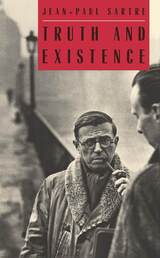
Truth and Existence is introduced by an extended biographical, historical, and analytical essay by Ronald Aronson.
"Truth and Existence is another important element in the recently published links between Sartre's existentialist ontology and his later ethical, political, and literary concerns. . . . The excellent introduction by Aronson will help readers not experienced in reading Sartre."—Choice
"Accompanied by an excellent introduction, this dense, lucidly translated treatise reveals Sartre as a characteristically 20th-century figure."—Publishers Weekly
Jean-Paul Sartre (1906-1980) was offered, but declined, the Nobel Prize for literature in 1964. His many works of fiction, drama, and philosophy include the monumental study of Flaubert, The Family Idiot, and The Freud Scenario, both published in translation by the University of Chicago Press.
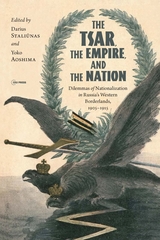
This collection of essays addresses the challenge of modern nationalism to the tsarist Russian Empire. First appearing on the empire’s western periphery this challenge, was most prevalent in twelve provinces extending from Ukrainian lands in the south to the Baltic provinces in the north, as well as to the Kingdom of Poland.
At issue is whether the late Russian Empire entered World War I as a multiethnic state with many of its age-old mechanisms run by a multiethnic elite, or as a Russian state predominantly managed by ethnic Russians. The tsarist vision of prioritizing loyalty among all subjects over privileging ethnic Russians and discriminating against non-Russians faced a fundamental problem: as soon as the opportunity presented itself, non-Russians would increase their demands and become increasingly separatist.
The authors found that although the imperial government did not really identify with popular Russian nationalism, it sometimes ended up implementing policies promoted by Russian nationalist proponents. Matters addressed include native language education, interconfessional rivalry, the “Jewish question,” the origins of mass tourism in the western provinces, as well as the emergence of Russian nationalist attitudes in the aftermath of the first Russian revolution.
In this impressive study, David Rich demonstrates how the modernization of Russia's general staff during the second half of the nineteenth century reshaped its intellectual and strategic outlook and equipped the staff to play a strong, and at times dominant, role in shaping Russian foreign policy.
Rich weaves together several levels of narrative to show how the increasingly sophisticated, scientific, and positivistic work attitudes and habits of the general staff acculturated younger officers, redefining their relationship with, and responsibilities to, the state. In time, this new generation of officers projected their characteristic notions onto the state and onto autocracy itself; professional concern for the security of the state eclipsed traditional unquestioning loyalty to the regime. Rich goes on to show how divergence between diplomatic and military aims among those responsible for making strategy cost the state dearly in terms of economic stability and international standing.
The author supports his findings with original research in Russian foreign policy and military archives and wide reading in published sources. The Tsar's Colonels contributes to a number of debates in Russian military and social history and offers new insights on the structural roots of the Great War, and on the theoretical problems of modernization and professionalization.
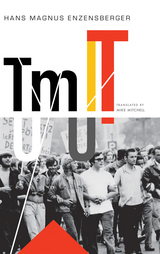
Hans Magnus Enzensberger, widely regarded as Germany’s greatest living poet, was already well known in the 1960s, the tempestuous decade of which Tumult is an autobiographical record. Derived from old papers, notes, jottings, photos, and letters that the poet stumbled upon years later in his attic, the volume is not so much about the man, but rather the many places he visited and people whom he met on his travels through the Soviet Union and Cuba during the 1960s. The book is made up of four long-form pieces written from 1963 to 1970, each episode concluding with a poem and postscript written in 2014. Translated by Mike Mitchell, the book is a lively and deftly written travelogue offering a glimpse into the history of leftist thought. Dedicated to “those who disappeared,” Tumult is a document of that which remains one of humanity’s headiest times.
The largest rebellion in the history of Spain's American empire—a conflict greater in territory and costlier in lives than the contemporaneous American Revolution—began as a local revolt against colonial authorities in 1780. As an official collector of tribute for the imperial crown, José Gabriel Condorcanqui had seen firsthand what oppressive Spanish rule meant for Peru's Indian population. Adopting the Inca royal name Tupac Amaru, he set events in motion that would transform him into Latin America's most iconic revolutionary figure.
Tupac Amaru's political aims were modest at first. He claimed to act on the Spanish king's behalf, expelling corrupt Spaniards and abolishing onerous taxes. But the rebellion became increasingly bloody as it spread throughout Peru and into parts of modern-day Bolivia, Chile, and Argentina. By late 1780, Tupac Amaru, his wife Micaela Bastidas, and their followers had defeated the Spanish in numerous battles and gained control over a vast territory. As the rebellion swept through Indian villages to gain recruits and overthrow the Spanish corregidors, rumors spread that the Incas had returned to reclaim their kingdom.
Charles Walker immerses readers in the rebellion's guerrilla campaigns, propaganda war, and brutal acts of retribution. He highlights the importance of Bastidas—the key strategist—and reassesses the role of the Catholic Church in the uprising's demise. The Tupac Amaru Rebellion examines why a revolt that began as a multiclass alliance against European-born usurpers degenerated into a vicious caste war—and left a legacy that continues to influence South American politics today.
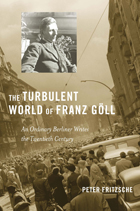
Franz Göll was a thoroughly typical Berliner. He worked as a clerk, sometimes as a postal employee, night watchman, or publisher's assistant. He enjoyed the movies, ate spice cake, wore a fedora, tamed sparrows, and drank beer or schnapps. He lived his entire life in a two-room apartment in Rote Insel, Berlin's famous working-class district. What makes Franz Göll different is that he left behind one of the most comprehensive diaries available from the maelstrom of twentieth-century German life. Deftly weaving in Göll’s voice from his diary entries, Fritzsche narrates the quest of an ordinary citizen to make sense of a violent and bewildering century.
Peter Fritzsche paints a deeply affecting portrait of a self-educated man seized by an untamable impulse to record, who stayed put for nearly seventy years as history thundered around him. Determined to compose a “symphony” from the music of everyday life, Göll wrote of hungry winters during World War I, the bombing of Berlin, the rape of his neighbors by Russian soldiers in World War II, and the flexing of U.S. superpower during the Reagan years. In his early entries, Göll grappled with the intellectual shockwaves cast by Darwin, Freud, and Einstein, and later he struggled to engage with the strange lifestyles that marked Germany's transition to a fluid, dynamic, unmistakably modern society.
With expert analysis, Fritzsche shows how one man's thoughts and desires can give poignant shape to the collective experience of twentieth-century life, registering its manifold shocks and rendering them legible.

Turning Points in Modern Times focuses on events after 1917: the rise of Nazism on the Right and authoritarianism on the Left. Bracher provides an incisive framework for understanding the great ideological confrontation of this century--democracy versus totalitarianism in the forms of fascism, Nazism, and communism. His analysis of the outcomes underscores the significance and power of democratic values and governments.
The doyen of German political history, Karl Dietrich Bracher extends the argument against dictatorship that runs through his life's work, offers a blueprint for dealing with the recent past of the communist East German State (DDR), looks at the true facts of the Stasi collaboration, and challenges misperceptions of Hitler, Stalin, and others. He demonstrates the kinship between fascism and communism, considers Weimar and liberalism, assesses the legacy of Nazism, and outlines the ethos of democracy. In all this Bracher exposes the twentieth-century threats to the democratic state so that they can never again subvert representative government.
A founder of the new history of Germany, which considers the larger context for Hitler and illuminates events through the theories of social science and the values of liberalism and democracy, Bracher writes in the tradition of Acton, Burckhardt, Croce, and Dahrendorf. This is a vital history lesson for our turbulent times, when once more democracy is on the march after a twilight century.

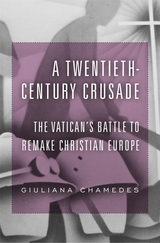
The first comprehensive history of the Vatican’s agenda to defeat the forces of secular liberalism and communism through international law, cultural diplomacy, and a marriage of convenience with authoritarian and right-wing rulers.
After the United States entered World War I and the Russian Revolution exploded, the Vatican felt threatened by forces eager to reorganize the European international order and cast the Church out of the public sphere. In response, the papacy partnered with fascist and right-wing states as part of a broader crusade that made use of international law and cultural diplomacy to protect European countries from both liberal and socialist taint.
A Twentieth-Century Crusade reveals that papal officials opposed Woodrow Wilson’s international liberal agenda by pressing governments to sign concordats assuring state protection of the Church in exchange for support from the masses of Catholic citizens. These agreements were implemented in Mussolini’s Italy and Hitler’s Germany, as well as in countries like Latvia, Lithuania, and Poland. In tandem, the papacy forged a Catholic International—a political and diplomatic foil to the Communist International—which spread a militant anticommunist message through grassroots organizations and new media outlets. It also suppressed Catholic antifascist tendencies, even within the Holy See itself.
Following World War II, the Church attempted to mute its role in strengthening fascist states, as it worked to advance its agenda in partnership with Christian Democratic parties and a generation of Cold War warriors. The papal mission came under fire after Vatican II, as Church-state ties weakened and antiliberalism and anticommunism lost their appeal. But—as Giuliana Chamedes shows in her groundbreaking exploration—by this point, the Vatican had already made a lasting mark on Eastern and Western European law, culture, and society.


Kant declared that philosophy began in 1781 with his Critique of Pure Reason. In 1806 Hegel announced that philosophy had now been completed. Eckart Förster examines the reasons behind these claims and assesses the steps that led in such a short time from Kant’s “beginning” to Hegel’s “end.” He concludes that, in an unexpected yet significant sense, both Kant and Hegel were indeed right.
“Presents a novel interpretation of the development of German idealism that is rich in both historical depth and philosophical insight…Förster sets forth a historically nuanced and philosophically discerning interpretation of the central debates of the era.”
—Peter Yong, Philosophy in Review
“[Förster’s] book does not disappoint…The amount of material covered by Förster is impressive…Förster’s book is rich in specificity…Wherever the discussion goes, it is going to have to go on by taking Förster’s big picture and all his detailed accounts into account.”
—Terry Pinkard, Notre Dame Philosophical Reviews
“Förster’s command of the historical sources is most impressive. Moreover, this book is clearly written, and Bowman’s translation is commendable. Scholars and graduate students will welcome this masterpiece.”
—J. M. Fritzman, Choice
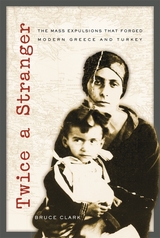
In the dismantling of the Ottoman Empire following World War I, nearly two million citizens in Turkey and Greece were expelled from homelands. The Lausanne treaty resulted in the deportation of Orthodox Christians from Turkey to Greece and of Muslims from Greece to Turkey. The transfer was hailed as a solution to the problem of minorities who could not coexist. Both governments saw the exchange as a chance to create societies of a single culture. The opinions and feelings of those uprooted from their native soil were never solicited.
In an evocative book, Bruce Clark draws on new archival research in Turkey and Greece as well as interviews with surviving participants to examine this unprecedented exercise in ethnic engineering. He examines how the exchange was negotiated and how people on both sides came to terms with new lands and identities.
Politically, the population exchange achieved its planners' goals, but the enormous human suffering left shattered legacies. It colored relations between Turkey and Greece, and has been invoked as a solution by advocates of ethnic separation from the Balkans to South Asia to the Middle East. This thoughtful book is a timely reminder of the effects of grand policy on ordinary people and of the difficulties for modern nations in contested regions where people still identify strongly with their ethnic or religious community.

In 1767, two “princes” of a ruling family in the port of Old Calabar, on the slave coast of Africa, were ambushed and captured by English slavers. The princes, Little Ephraim Robin John and Ancona Robin Robin John, were themselves slave traders who were betrayed by African competitors—and so began their own extraordinary odyssey of enslavement. Their story, written in their own hand, survives as a rare firsthand account of the Atlantic slave experience.
Randy J. Sparks made the remarkable discovery of the princes’ correspondence and has managed to reconstruct their adventures from it. They were transported from the coast of Africa to Dominica, where they were sold to a French physician. By employing their considerable language and interpersonal skills, they cleverly negotiated several escapes that took them from the Caribbean to Virginia, and to England, but always ended in their being enslaved again. Finally, in England, they sued for, and remarkably won, their freedom. Eventually, they found their way back to Old Calabar and, evidence suggests, resumed their business of slave trading.
The Two Princes of Calabar offers a rare glimpse into the eighteenth-century Atlantic World and slave trade from an African perspective. It brings us into the trading communities along the coast of Africa and follows the regular movement of goods, people, and ideas across and around the Atlantic. It is an extraordinary tale of slaves’ relentless quest for freedom and their important role in the creation of the modern Atlantic World.



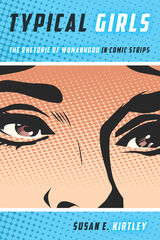
In the years following 1975, a group of female-created comic strips came to national attention in a traditionally male-dominated medium. Typical Girls: The Rhetoric of Womanhood in Comic Strips uncovers the understudied and developing history of these strips, defining and exploring the ramifications of this expression of women’s roles at a time of great change in history and in comic art. This impressive, engaging, and timely study illustrates how these comics express the complexities of women’s experiences, especially as such experiences were shaped by shifting and often competing notions of womanhood and feminism. Including the comics of Lynn Johnston (For Better or For Worse), Cathy Guisewite (Cathy), Nicole Hollander (Sylvia), Lynda Barry (Ernie Pook’s Comeek), Barbara Brandon-Croft (Where I’m Coming From), Alison Bechdel (Dykes to Watch Out For), and Jan Eliot (Stone Soup), Typical Girls is an important history of the representation of womanhood and women’s rights in popular comic strips.
READERS
Browse our collection.
PUBLISHERS
See BiblioVault's publisher services.
STUDENT SERVICES
Files for college accessibility offices.
RECENTLY PUBLISHED



UChicago Accessibility Resources
home | accessibility | search | about | contact us
BiblioVault ® 2001 - 2026
The University of Chicago Press