
 A SCHOLARLY BOOK REPOSITORY
6 start with T start with T
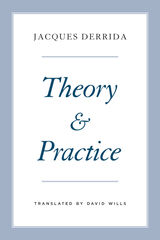
Theory and Practice is a series of nine lectures that Jacques Derrida delivered at the École Normale Supérieure in 1976 and 1977. The topic of “theory and practice” was associated above all with Marxist discourse and particularly the influential interpretation of Marx by Louis Althusser. Derrida’s many questions to Althusser and other thinkers aim at unsettling the distinction between thinking and acting.
Derrida’s investigations set out from Marx’s “Theses on Feuerbach,” in particular the eleventh thesis, which has often been taken as a mantra for the “end of philosophy,” to be brought about by Marxist practice. Derrida argues, however, that Althusser has no such end in view and that his discourse remains resolutely philosophical, even as it promotes the theory/practice pair as primary values. This seminar also draws fascinating connections between Marxist thought and Heidegger and features Derrida’s signature reconsideration of the dichotomy between doing and thinking. This text, available for the first time in English, shows that Derrida was doing important work on Marx long before Specters of Marx. As with the other volumes in this series, it gives readers an unparalleled glimpse into Derrida’s thinking at its best—spontaneous, unpredictable, and groundbreaking.
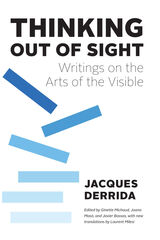
The book is divided into three sections. The first demonstrates Derrida’s preoccupation with visibility, image, and space. The second contains interviews and collaborations with artists on topics ranging from the politics of color to the components of painting. Finally, the book delves into Derrida’s writings on photography, video, cinema, and theater, ending with a text published just before his death about his complex relationship to his own image. With many texts appearing for the first time in English, Thinking out of Sight helps us better understand the critique of representation and visibility throughout Derrida’s work, and, most importantly, to assess the significance of his insights about art and its commentary.

This book begins with a brief critique of internalist views of emotion that hold that feelings are sequestered within a subject. Casey affirms that while certain emotions are felt as resonating within our subjectivity, many others are experienced as occurring outside any such subjectivity. These include intentional or expressive feelings that transpire between ourselves and others, such as an angry exchange between two people, as well as emotions or affects that come to us from beyond ourselves. Casey claims that such far‑out emotions must be recognized in a full picture of affective life. In this way, the book proposes to “turn emotion inside out.”

The relationships between philosophy and aesthetics and between philosophy and politics are especially pressing issues today. Those who explore these themes will applaud the publication—for the first time in English—of this important collection, one that reveals the scope and force of Philippe Lacoue-Labarthe’s reflections on mimesis, subjectivity, and representation in philosophical thought.
This coherent and rigorous body of work reflects the author’s complex and subtle treatment of mimesis in the history of philosophy from Plato to Heidegger. It contains close critical analyses of works by Plato, Diderot, Hölderlin, Reik, Girard, and Heidegger, and moves through topics such as music, autobiography, tragedy, and the problem of historical and political self-definition.
Because Lacoue-Labarthe deals with issues that cross disciplinary lines, his work will appeal to readers interested in philosophy as it relates to politics, history, and aesthetics, especially literature. By showing that the concept of mimesis is an integral part of philosophical reasoning, he provides a challenging approach to many of Heidegger’s ideas, and contributes to the poststructuralist (or postmodem) attempt to rethink the notions of reference and representation. This approach challenges readers to redefine their understanding of history and politics.
One of the most gifted and active of the younger French philosophers, Lacoue-Labarthe is a respected peer of Jacques Derrida, who has provided an extensive introduction to the book especially for American readers. Those who are familiar with Derrida’s writings will appreciate the opportunity to see his questions approached in an entirely different style by Lacoue-Labarthe, resulting in productive new insights.
READERS
Browse our collection.
PUBLISHERS
See BiblioVault's publisher services.
STUDENT SERVICES
Files for college accessibility offices.
RECENTLY PUBLISHED






UChicago Accessibility Resources
home | accessibility | search | about | contact us
BiblioVault ® 2001 - 2025
The University of Chicago Press