
 A SCHOLARLY BOOK REPOSITORY
4 start with T start with T
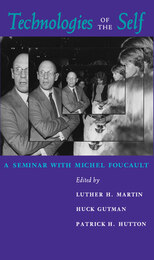
Shortly before his death in 1984, Michel Foucault spoke of an idea for a new book on “technologies of the self.” He described it as “composed of different papers about the self. . . . about the role of reading and writing in constituting the self. . . . and so on.” The book Foucault envisioned was based on a faculty seminar on “Technologies of the Self,” originally presented at the University of Vermont in the fall of 1982. This volume is a partial record of that seminar.
In many ways, Foucault's project on the self was the logical conclusion to his historical inquiry over twenty-five years into insanity, deviancy, criminality, and sexuality. Because Foucault died before he completed the revisions of his seminar presentations, this volume includes a careful transcription instead...as a prolegomenon to that unfinished task.
Foucault was a French philosopher, historian of ideas, social theorist, philologist and literary critic.
This volume was edited by Luther H. Martin, Huck Gutman, and Patrick H. Hutton.
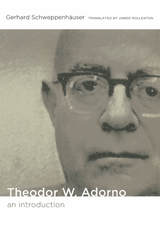
After providing a brief overview of Adorno’s life, Schweppenhäuser turns to the theorist’s core philosophical concepts, including post-Kantian critique, determinate negation, and the primacy of the object, as well as his view of the Enlightenment as a code for world domination, his diagnosis of modern mass culture as a program of social control, and his understanding of modernist aesthetics as a challenge to conceive an alternative politics. Along the way, Schweppenhäuser illuminates the works widely considered Adorno’s most important achievements: Minima Moralia, Dialectic of Enlightenment (co-authored with Horkheimer), and Negative Dialectics. Adorno wrote much of the first two of these during his years in California (1938–49), where he lived near Arnold Schoenberg and Thomas Mann, whom he assisted with the musical aesthetics at the center of Mann’s novel Doctor Faustus.
The first English-language translation of Vilém Flusser’s final series of lectures: the definitive introduction to his methods and ideas in new media theory
In summer 1991, shortly before his death, Vilém Flusser gave a series of lectures as guest professor at Ruhr University Bochum at the invitation of Friedrich Kittler. Flusser intended for these lectures to be the definitive introduction to his “communicology,” the study of human communication and the means by which acquired information is saved, processed, and passed on. In Thinking Further, Aaron Jaffe and Michael F. Miller have curated “fragments” from these lectures—first published in German in 2008—to present the most exciting and timely parts of Flusser’s foundational contributions to what is now known as media studies.
These fragments capture Flusser’s engagements with a wide range of theories, approaches, and interventions, including ecocriticism, posthumanities, game theory, cybernetics, and translinguistic exchanges. Offering sustained engagements with the ideas of Walter Benjamin, Michel Foucault, Michel Serres, and Jean Baudrillard, Thinking Further models possibilities for thinking through and clarifying the most obscure and obdurate implications of technology and modernity.
As they demonstrate Flusser’s contextual positionality and antiuniversalism, the writings presented here also underscore the pleasures and the power of his aphoristic style. Focusing less on Flusser-as-philosopher and more on his role as wry sage at the end of history, Thinking Further is a comprehensive but approachable introduction to his boundary-transcending exploration of the possibilities for communication, writing, and the human condition.
Retail e-book files for this title are screen-reader friendly.
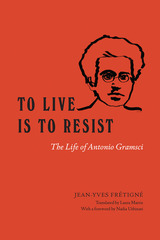
One of the most influential political thinkers of the twentieth century, Antonio Gramsci (1891–1937) has left an indelible mark on philosophy and critical theory. His innovative work on history, society, power, and the state has influenced several generations of readers and political activists, and even shaped important developments in postcolonial thought. But Gramsci’s thinking is scattered across the thousands of notebook pages he wrote while he was imprisoned by Italy’s fascist government from 1926 until shortly before his death.
To guide readers through Gramsci’s life and works, historian Jean-Yves Frétigné offers To Live Is to Resist, an accessible, compelling, and deeply researched portrait of an extraordinary figure. Throughout the book, Frétigné emphasizes Gramsci’s quiet heroism and his unwavering commitment to political practice and resistance. Most powerfully, he shows how Gramsci never surrendered, even in conditions that stripped him of all power—except, of course, the power to think.
READERS
Browse our collection.
PUBLISHERS
See BiblioVault's publisher services.
STUDENT SERVICES
Files for college accessibility offices.
RECENTLY PUBLISHED







UChicago Accessibility Resources
home | accessibility | search | about | contact us
BiblioVault ® 2001 - 2026
The University of Chicago Press