
 A SCHOLARLY BOOK REPOSITORY
4 start with T start with T

After the bombings of Oklahoma City in 1995, most Americans were shocked to discover that tens of thousands of their fellow citizens had banded together in homegrown militias. Within the next few years, numerous studies and media reports appeared revealing the unseen world of the American militia movement, a loose alliance of groups with widely divergent views. Not surprisingly, it was the movement’s most extreme voices that attracted the lion's share of attention.
In reality the militia movement was neither as irrational nor as new as it was portrayed in the press, Robert Churchill writes. What bound the movement together was the shared belief that citizens have a right, even a duty, to take up arms against wanton exercise of unconstitutional power by the federal government. Many were motivated to join the movement by what they saw as a rise in state violence, illustrated by the government assaults at Ruby Ridge, Idaho in 1992, and Waco, Texas in 1993. It was this perception and the determination to deter future state violence, Churchill argues, that played the greatest role in the growth of the American militia movement.
Churchill uses three case studies to illustrate the origin of some of the core values of the modern militia movement: Fries' Rebellion in Pennsylvania at the end of the eighteenth century, the Sons of Liberty Conspiracy in Civil War-era Indiana and Illinois, and the Black Legion in Michigan and Ohio during the Depression. Building on extensive interviews with militia members, the author places the contemporary militia movement in the context of these earlier insurrectionary movements that, animated by a libertarian interpretation of the American Revolution, used force to resist the authority of the federal government.
A historian of early America, Robert H. Churchill has published numerous articles on American political violence and the right to keep and bear arms. He is currently Associate Professor of History at the University of Hartford.
"This book is about how we think about the past, how cultural memories are formed and evolve, and how these memories then come to impact current understandings of issues. Churchill provides an enlightening analysis of the ideology, structure, and purpose of the militia movement. Where much scholarship has categorized it as a cohesive, single movement, Churchill begins the process of unraveling its complexity."
---Steve Chermak, Michigan State University
"To Shake Their Guns in the Tyrant's Face addresses an area---the relationship of American political violence to American ideology---that is of growing importance and that is commanding an ever increasing audience, and it does so in a way like nothing else in the field."
---David Williams, Indiana University Bloomington
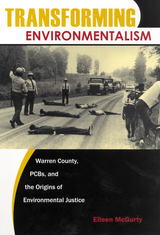
In Transforming Environmentalism, Eileen McGurty explores a moment central to the emergence of the environmental justice movement. In 1978, residents of predominantly African American Warren County, North Carolina, were horrified to learn that the state planned to build a landfill in their county to hold forty thousand cubic yards of soil that was contaminated with PCBs from illegal dumping. They responded to the state's plans with a four-year resistance, ending in a month of protests with over 500 arrests from civil disobedience and disruptive actions.McGurty traces the evolving approaches that residents took to contest "environmental racism" in their community and shows how activism in Warren County spurred greater political debate and became a model for communities across the nation. Transforming Environmentalism explores how the specific circumstances of the Warren County events shaped the formation of the environmental justice movement and influenced contemporary environmentalism.
Drawing on a rich archive of Korean, Japanese, and Chinese sources, Park describes how Koreans negotiated the contradictory demands of national and colonial powers. She demonstrates that the dynamics of global capitalism led the Chinese and Japanese to pursue capitalist expansion while competing for sovereignty. Decentering the nation-state as the primary analytic rubric, her emphasis on the role of global capitalism is a major innovation for understanding nationalism, colonialism, and their immanent links in social space.
Through a regional and temporal comparison of Manchuria from the late nineteenth century until 1945, Park details how national and colonial powers enacted their claims to sovereignty through the regulation of access to land, work, and loans. She shows that among Korean migrants, the complex connections among Chinese laws, Japanese colonial policies, and Korean social practices gave rise to a form of nationalism in tension with global revolution—a nationalism that laid the foundation for what came to be regarded as North Korea’s isolationist politics.
READERS
Browse our collection.
PUBLISHERS
See BiblioVault's publisher services.
STUDENT SERVICES
Files for college accessibility offices.
RECENTLY PUBLISHED






UChicago Accessibility Resources
home | accessibility | search | about | contact us
BiblioVault ® 2001 - 2026
The University of Chicago Press