
 A SCHOLARLY BOOK REPOSITORY
32 start with T start with T

Winner, Arab American National Museum's 2015 George Ellenbogen Poetry Award
Tahrir Suite is a book-length poem that contemplates immigration, homeland, and diaspora in the twenty-first century. The poem, inspired by recent events in Egypt, cycles through the journey of two Egyptians moving across borders, languages, cultures, landscapes, and political systems while their life in the U.S. diaspora evolves and their home country undergoes revolutionary change.
Written from a perspective and about a place that is virtually unexplored in contemporary American poetry, Tahrir Suite works to capture the complicated essence of what it means to be from a specific place that is experiencing such radical change and how our understandings of “home” and “place” constantly evolve. Tahrir Suite is a musical meditation on what it means to be a global citizen in contemporary times.
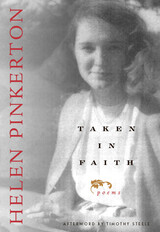
In 1967, Yvor Winters wrote of Helen Pinkerton, “she is a master of poetic style and of her material. No poet in English writes with more authority.” Unfortunately, in 1967 mastery of poetic style was not, by and large, considered a virtue, and Pinkerton’s finely crafted poems were neglected in favor of more improvisational and flashier talents. Though her work won the attention and praise of serious readers, who tracked her poems as they appeared in such journals as The Paris Review, The Sewanee Review, and The Southern Review, her verse has never been available in a trade book. Taken in Faith remedies that situation, bringing Pinkerton’s remarkable poems to a general audience for the first time.
Even her very earliest works embody a rare depth and seriousness. Primarily lyrical and devotional, they always touch on larger issues of human struggle and conduct. More recent poems, concerned in part with history, exhibit a stylistic as well as a thematic shift, moving away from the rhymed forms of her devotional works into a blank verse marked by a quiet flexibility and contemplative grace.
Like Virginia Adair, another poet who waited long for proper recognition, Pinkerton speaks as a woman who has lived fully and observed acutely and who has set the life and observations down in memorable verse. Taken in Faith represents a half-century of her poetic efforts.
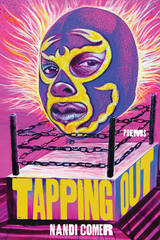
The harsh realities of being migrant and immigrant, being birthright and oppressed, are as hard-pressed as the plancha move to the body. Each poem in Tapping Out is a “freestyle movement” of language and complexity put on full display, under the bright lights and roars of survival. Comer’s splendid and barbed, Detroit style of language melts the masks with searing words.
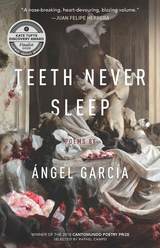
Finalist, 2019 PEN Open Book Award
Winner, 2019 American Book Award, Before Columbus Foundation
Drawing on folklore and fantasy, childhood memory and hallucination, and marked by a tone of piercing divulgence, Teeth Never Sleep nimbly negotiates the split consciousness a culture of dominance requires of men (especially men of color), highlighting the fissures in selfhood created by the pressure to seek submission over intimacy while still wanting desperately to be loved, and tracing the contorted route by which emotional pain finds expression in violence. “The night my girlfriend tells my mother I beat her, / I feel betrayed. This was a secret we kept between us. / That night, I was no longer my mother’s loving son,” the speaker in one poem confesses, and later “I never wanted to be this kind of animal.”
And yet, through the lens of Ángel García’s sharp imagining, men frequently appear as beasts (sometimes literally)—as hybrid beings both tender and brutal—that he steadfastly refuses to let off the hook as he obsessively catalogs the origins of toxic masculinity (the first time I made my mother cry, the first time I pitied my father, the first time I saw a girl bleed) and its quiet, lasting effects: “Still a part of me believes a / man shouldn’t cry in front of a woman, even in the dark.”
In a culture of weaponized masculinity, the poems in Teeth Never Sleep make a doorway of a wound, inviting readers to walk through and sit down inside the raw pain they harbor to meditate on two central, urgent questions: what it means to be a man and how, as a man, to love.
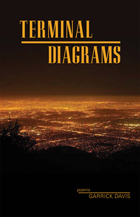
Garrick Davis’s Terminal Diagrams may have been inspired by the illustrated maps in airport lounges, or perhaps they are the blueprints of the Apocalypse, with their subjects and objects representing the bitter fruits of either some future nightmare or the present world. Regardless, their vision is so bleak and unsparing, only a few will be able to savor them. Here, the art of poetry has been mechanized just as the world has been mechanized. Whether his subject is a car accident on the freeways of Los Angeles or the Book of Revelation transmitted by television, Davis’s stanzas conjure a kind of futuristic noir. In poem after poem, he examines the artistic possibilities of the machine, and its alterations of human experience, with a modern spirit that—as Baudelaire defined it—has embraced “the sublimity and monstrousness of something new.”
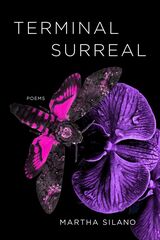
In her masterful poetry collection Terminal Surreal, Martha Silano confronts the reality of mortality with gorgeous attention to imagery and scene. The book follows a trajectory from early symptoms before diagnosis with amyotrophic lateral sclerosis (ALS) to full-blown illness and its effects on friends and family, including her children, who appear in poems like “After Dropping My Son Off at College” and “My Nineteen-Year-Old Daughter Is My Personal Assistant.”
With a devoted naturalist’s eye, Silano revels in birds, trees, and flowers in a way that reminds readers we are connected to the world around us. The book touches on the medical, the metaphysical, and even the cosmological (through encounters in medical offices and on a moon of Mars). With Nutter Butters and Lorna Doones, abecedarians and self-elegies, Silano’s singular, feisty, contemporary voice propels these poems of grief and acceptance as they explore the transformational power of art.
When I Learn Catastrophically
is an anagram of amyotrophic lateral sclerosis.
When I learn I probably have a couple years,
maybe (catastrophically) less, crossword puzzles
begin to feel meaningless, though not the pair
of mergansers, not the red cardinal of my heart.
The sky does all sorts of marvelously uncatastrophic
things that winter I shimmy between science
& song, between widgeons & windows, weather
& its invitation to walk. Walking, which becomes
my lose less, my less morsels, my lose smile
while more sore looms. . . .
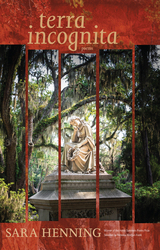
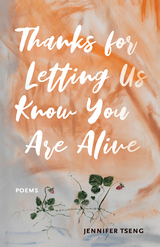
Crafted with lines from her late father’s letters, Jennifer Tseng’s Thanks for Letting Us Know You Are Alive is a portrait of an immigrant, a rootless person whose unspoken loss—that of his native geography, family, traditions, language—underlies every word. Though her father’s first language was Mandarin, for more than twenty years he wrote these letters in English, so that she could understand them. Some are riddled with errors, some nearly unintelligible. Lines from his letters appear as titles and are scattered throughout the poems, blending voices of father and daughter. This collection enacts what it means to lose someone and commune with them simultaneously—the paradox of grief and all it gives us.
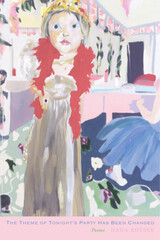
Sui generis, Dana Roeser's poems are spoken by a stand-up comic having a bad night at the local club. The long extended syntax, spread over her quirky, syncopated short lines, contains (barely) the speaker's anxieties over an aging father with Parkinson's, the maturation of two daughters, friends at twelve-step meetings and their sometimes suicidal urges—acted on or resisted—and her own place in a world that seems about to spin out of control. Bad weather and tiny economy cars speeding down the interstate next to Jurassic semis become the metaphor, or figurative vehicle, for this poet's sense of her own precariousness.
Roeser brings a host of characters into her poems—a Catholic priest raging against the commercialism of Mother's Day, the injured tennis player James Blake, a man struck by lightning, drunk partygoers, an ex-marine, Sylvia Plath's son Nicholas Hughes, a neighbor, travelers encountered in airport terminals, various talk therapists—and lets them speak. She records with high fidelity the nuances of our ordinary exigencies so that the poems become extraordinary arias sung by a husky-voiced diva with coloratura phrasing to die for, “the dark notes” that Lorca famously called the duende. The book is infused with the energy of misfortune, accident, coincidence, luck, grace, panic, hilarity. The characters and narrator, in extremis, speak their truths urgently.
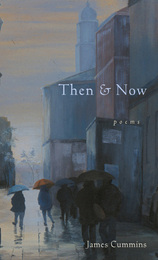
James Cummins’s first book of poems, The Whole Truth, became known throughout much of the poetry world as the “Perry Mason sestinas.” His second book, Portrait in a Spoon, was chosen by Richard Howard for the James Dickey Prize Contemporary Poetry Series.
His latest and most accomplished work is collected in Then and Now, which reflects the same inventiveness and wit evident in his earlier books, with a deepening of tone and spirit. The result is a collection of poems filled with feeling and with Cummins’s signature anguished humor.
If the language of poetry is a way into a hall of mirrors of the self, it can be a way out, too. The voice that emerges in Then and Now is sane, imaginative, bemused, and sly, not only taking responsibility for the character of the writer put fully on display, but ironically and affectionately exploring how this process occurs.
Doing Lunch
You have lunch with a friend.
You put on a false face for him,
because he is your friend.
You want to spare him your
maunderings,
your lies and malfeasance.
But this is just what your friend desires,
because he is your friend.
He wants your face to fall open
in front of him and twitch
like a rabbit hit on the fly.
He says he wants the latest word
from the border region between
narcissism and an inner life.
And laughs.
Shamelessly, you tell him everything,
because he is your friend.
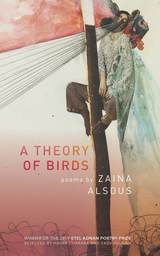
Winner of the 2019 Etel Adnan Poetry Prize
Inside the dodo bird is a forest, Inside the forest
a peach analog, Inside the peach analog a woman, Inside
the woman a lake of funerals
This layering of bird, woman, place, technology, and ceremony, which begins this first full-length collection by Zaina Alsous, mirrors the layering of insights that marks the collection as a whole. The poems in A Theory of Birds draw on inherited memory, historical record, critical theory, alternative geographies, and sharp observation. In them, birds—particularly extinct species—become metaphor for the violences perpetrated on othered bodies under the colonial gaze.
Putting ecological preservation in conversation with Arab racial formation, state vernacular with the chatter of birds, Alsous explores how categorization can be a tool for detachment, domination, and erasure. Stretching their wings toward de-erasure, these poems—their subjects and their logics—refuse to stay put within a single category. This is poetry in support of a decolonized mind.

A stunning modern translation of a Buddhist classic that is also one of the oldest literary texts in the world written by women.
The Therīgāthā, composed more than two millennia ago, is an anthology of poems in the Pali language by and about the first Buddhist women. These women were therīs, the senior ones, among ordained Buddhist women, and they bore that epithet because of their religious achievements. The poems they left behind are arguably among the most ancient examples of women’s writing in the world and they are unmatched for their quality of personal expression and the extraordinary insight they offer into the lives of women in the ancient Indian past—and indeed, into the lives of women as such.
This new version of the Therīgāthā, based on a careful reassessment of the major editions of the work and printed in the Roman script common for modern editions of Pali texts, offers the most powerful and the most readable translation ever achieved in English.
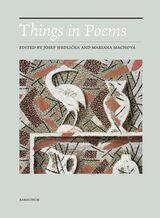
In this volume, fifteen scholars and poets, from Austria, Britain, Czechia, France, Germany, Ireland, Lithuania, and Russia, explore the topic of things and objects in poetry written in a number of different languages and in different eras. The book begins with ancient poetry, then moves on to demonstrate the significance of objects in the Chinese poetic tradition. From there, the focus shifts to things and objects in the poetry of the twentieth and the twenty-first century, examining the work of Czech, Polish, and Russian poets alongside other key figures such as Rilke, Francis Ponge, William Carlos Williams, and Paul Muldoon. Along the way, the reader gets an introduction to key terms and phrases that have been associated with things in the course of poetic history, such as ekphrasis, objective lyricism. and hyperobjects.

Winner of the 2023 Drinking Gourd Chapbook Poetry Prize
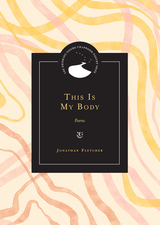
This Is My Body readily and unapologetically examines issues of race and ethnicity, ancestry and community, mental illness and recovery, queer sexuality and identity, and the body and disability. Traditionally religious language and hopeful imagery abound; so, too, do their spiritual antagonists: doubt, loss, isolation, and despair. But even in the darkest moments of a troubled inner life, insight and triumph intervene and sometimes even linger. An intimate exploration of the human experience, this debut collection proves itself more than the sum of its interior encounters—however revelatory or transformative any one given experience might be. It is a timely and necessary exercise in faith.
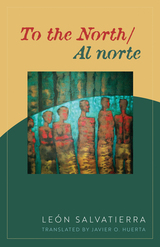
Salvatierra mixes lyrical and prose poems to explore the experience of exile in a new country. His powerful metaphors and fresh images inhabit spaces fraught with the violence, anxiety, and vulnerability that undocumented Central American migrants commonly face in their transnational journeys. His vivid memories of Nicaragua tie the personal experiences of his poetic subjects to the geopolitical history between the Central American region and the United States.
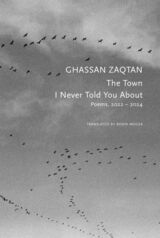
The Town I Never Told You About gathers poems written by celebrated Palestinian poet Ghassan Zaqtan between 2022 and 2024, at a time of intensifying conflict ravaging his homeland. Emerging from both memory and imagination, these poems trace the contours of hillscapes and villages, mapping a Palestine that is both historical and mythic, personal and collective. In Zaqtan’s hands, language threads its way through time—winding across landscapes marked by war, displacement, and enduring beauty. Each poem feels like part of a longer thread: a moment lifted from an ongoing inner epic, stitched into being with dreamlike clarity and haunting precision.
Long meditative pieces drift through shadow and sunlight, while other poems strike with the sharpness of remembered incident. This is poetry as pilgrimage—quiet, persistent, and full of echoes. A book that doesn’t so much end as continue resonating long after the last page is turned.
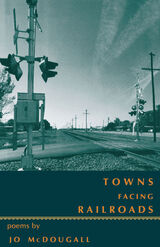
In her second book of poetry, Jo McDougall takes her readers to the dusty prairie towns of the central states, places where the flat terrain belies a complex human landscape. In short, dceptively simple lines, McDougall can so keenly trace the lineaments of place and era that her subject stands before us, its essence displayed and made timeless.
Quietly, with an almost aphoristic bit, McDougall writes about ordinary lives and small towns in a way that her readers may never forget.
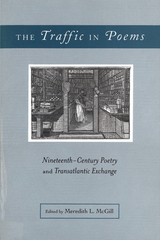
Drawing on examples such as Felicia Hemans's elaboration of the foundational American myth of Plymouth Rock, Emma Lazarus's ambivalent welcome of Europe's cast-off populations, black abolitionist Mary Webb's European performances of Hiawatha, and American reprints of Robert Browning and George Meredith, the eleven essays in this book focus on poetic depictions of exile, slavery, immigration, and citizenship and explore the often asymmetrical traffic between British and American poetic cultures.
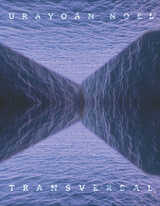
Featuring Noel’s bilingual playfulness, intellect, and irreverent political imagination, Transversal contains personal reflections on love, desire, and loss filtered through a queer approach to form, expanding upon Noel’s experiments with self-translation in his celebrated collection Buzzing Hemisphere/Rumor Hemisférico. This collection explores walking poems improvised on a smartphone, as well as remixed classical and experimental forms. Poems are presented in interlocking bilingual versions that complicate the relationship between translation and original, and between English and Spanish as languages of empire and popular struggle. The book creatively examines translation and its simultaneous urgency and impossibility in a time of global crisis.
Transversal seeks to disrupt standard English and Spanish, and it celebrates the nonequivalence between languages. Inspired by Caribbean poet and philosopher Édouard Glissant, the collection celebrates Caribbean practices of creolization as maximalist, people-centered, affect-loaded responses to the top-down violence of austerity politics. This groundbreaking, modular approach to poetic translation opens up alternative ways of reading in any language.
In his new collection of poems, Dick Davis, the acclaimed author of Belonging, addresses themes that he has long worked with—travel, the experience of being a stranger, the clash of cultures, the vagaries of love, the pleasures and epiphanies of meaning that art allows us. But A Trick of Sunlight introduces a new theme that revolves around the idea of happiness—is it possible, must it be illusory, is its fleetingness an essential part of its nature so that disillusion is inevitable?
Many of the poems are shaded by the poet’s awareness of growing older, and by the ways that this both shuts down many of life’s possibilities and frees us from their demands. The levity of some verses here is something of a departure for Davis, but his insights can be mordant too, revealing darknesses as often as they invoke frivolity.
As Davis’s readers have come to expect, the poems in A Trick of Sunlight. aim at the aesthetic satisfactions that accompany accurate observations expressed with wit, intelligence, and grace. But they achieve as well an immediacy and rawness of vision that seem to belie his careful craft.
Troubled Lovers in History demonstrates an exhilarating range: from the briefest of lyrics to rich and multipartite narrative adventures in exotic realms; from a comic monologue spoken in immigrant “Yinglish” to a soulful elegy set in San Antonio’s Pearl Beer brewery plant; from Martian invaders, through polar explorers, to all of us busy inflicting “words with edges” on those we love.
Goldbarth sets his unflinching study of individual hope and grief against the backdrop of history: the travels of Marco Polo; Bertha and Wilhelm Rontgen’s discovery of X-rays; an 1800 battle “twixt Dragon Sam, the great Exhaler of Gouts of Amazing Flame . . . and Liquid Dan, the Living Geyser.”
From the night stars to the little starring parts we all play every day, Troubled Lovers in History takes us into the text of our dreams and despairs, as witnessed by the writer whom Joyce Carol Oates called “a poet of remarkable gifts—a dazzling virtuoso who can break your heart.”
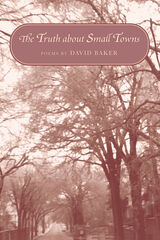
Winner of the 1998 Ohioana Poetry Award
Skilled at both extended narratives and intense, intimate lyrics, David Baker combines his talents in his fifth collection of poems. Working in syllabics, sonnets, couplets, and free verse, Baker can write unflinchingly about love, illness, madness, and perseverance.
His small towns are the burgs of the Midwest, where there is a constant tension between a future that’s coming and a past that may never vanish. The grocer on the corner now carries mango chutney, and the city council must decide—Wendy’s or wetlands.
From these rural towns, Baker evokes lovers, mothers and fathers, highway workmen, hospital patients, and the long dead. He spots the inner struggles of everyday living, as in these lines from “The Women”: “there comes a rubbing of hands, and not as in cleaning. / As when something’s put away, but it won’t stay down.”
Regional in the best sense, Baker’s poems capture the universal human commerce of love and conflict enduring under the water towers and storefronts of America’s heartland.
READERS
Browse our collection.
PUBLISHERS
See BiblioVault's publisher services.
STUDENT SERVICES
Files for college accessibility offices.
RECENTLY PUBLISHED



UChicago Accessibility Resources
home | accessibility | search | about | contact us
BiblioVault ® 2001 - 2025
The University of Chicago Press