
 A SCHOLARLY BOOK REPOSITORY
106 books about Race discrimination and 2
start with T
106 books about Race discrimination and 2
106 books about Race discrimination
2 start with T start with T
2 start with T start with T

Texas Mexican Americans and Postwar Civil Rights
By Maggie Rivas-Rodriguez
University of Texas Press, 2015
After World War II, Mexican American veterans returned home to lead the civil rights struggles of the fifties, sixties, and seventies. Many of their stories have been recorded by the Voces Oral History Project (formerly the U.S. Latino & Latina World War II Oral History Project), founded and directed by Maggie Rivas-Rodriguez at the University of Texas at Austin School of Journalism. In this volume, she draws upon the vast resources of the Voces Project, as well as archives in other parts of the country, to tell the stories of three little-known advancements in Mexican American civil rights. The first two stories recount local civil rights efforts that typified the grassroots activism of Mexican Americans across the Southwest. One records the successful effort led by parents to integrate the Alpine, Texas, public schools in 1969—fifteen years after the U.S. Supreme Court ruled that separate schools were inherently unconstitutional. The second describes how El Paso’s first Mexican American mayor, Raymond Telles, quietly challenged institutionalized racism to integrate the city’s police and fire departments, thus opening civil service employment to Mexican Americans. The final account provides the first history of the early days of the Mexican American Legal Defense and Educational Fund (MALDEF) and its founder Pete Tijerina Jr. from MALDEF’s incorporation in San Antonio in 1968 until its move to San Francisco in 1972.
[more]
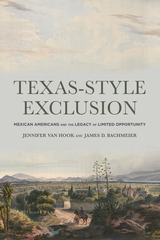
Texas-Style Exclusion
Mexican Americans and the Legacy of Limited Opportunity
Jennifer Van Hook
Russell Sage Foundation, 2024
While Americans largely support legal immigration, this support is conditional on the basis that immigrants do not make use of public assistance. Previous generations of immigrants, such as European-origin Industrial Era immigrants, came to U.S. impoverished, worked hard, and achieved the American Dream seemingly on their own. Mexican immigrants, the nation’s largest contemporary immigrant group, are often viewed with suspicion and are accused of being dependent on the government and refusing to integrate into American society the “right way.” In Texas-Style Exclusion, sociologists Jennifer Van Hook and James D. Bachmeier investigate such claims by comparing how American society has responded to different groups of immigrants over time.
Drawing on census and archival data on the quality of public schooling, Van Hook and Bachmeier find that Industrial Era European immigrants, who were primarily located in the northeastern U.S., benefited from programs and policies championed by the Americanization and Progressive movements. The Americanization movement sought to help acclimate new arrivals and transform “foreigners” into “Americans” by providing night school programs to promote civic integration and basic education, as well as other services. The Progressive movement, which aimed to improve education, work, and health conditions, sought to expand investment in public schools and make primary and secondary schooling mandatory, which kept working class children in school as opposed to entering the workforce. This access to education allowed for integration and astonishing intergenerational mobility.
Mexican immigrants in the 1920s and 1930s, the majority of whom resided in Texas, had radically different experiences from their European counterparts. Mexicans in Texas were subjected to racism, segregation, labor exploitation, and intentional school failures. This resulted in tremendous generational disadvantage that persists to the current day. Mexicans from this cohort who left Texas for states with strong Americanization and Progressive movements saw improved educational outcomes and integration. Additionally, Mexicans who immigrated after the Civil Rights Movement saw significantly greater inter-generational mobility and educational attainment than earlier cohorts due to the protections provided by civil rights laws. Van Hook and Bachmeier conclude that whether one is optimistic or pessimistic about the integration of Mexican Americans depends on when and where one looks.
Texas-Style Exclusion is an engaging examination of policies and practices that have been glossed over and forgotten that promoted mobility and integration for certain immigrant groups and impeded them for others.
Drawing on census and archival data on the quality of public schooling, Van Hook and Bachmeier find that Industrial Era European immigrants, who were primarily located in the northeastern U.S., benefited from programs and policies championed by the Americanization and Progressive movements. The Americanization movement sought to help acclimate new arrivals and transform “foreigners” into “Americans” by providing night school programs to promote civic integration and basic education, as well as other services. The Progressive movement, which aimed to improve education, work, and health conditions, sought to expand investment in public schools and make primary and secondary schooling mandatory, which kept working class children in school as opposed to entering the workforce. This access to education allowed for integration and astonishing intergenerational mobility.
Mexican immigrants in the 1920s and 1930s, the majority of whom resided in Texas, had radically different experiences from their European counterparts. Mexicans in Texas were subjected to racism, segregation, labor exploitation, and intentional school failures. This resulted in tremendous generational disadvantage that persists to the current day. Mexicans from this cohort who left Texas for states with strong Americanization and Progressive movements saw improved educational outcomes and integration. Additionally, Mexicans who immigrated after the Civil Rights Movement saw significantly greater inter-generational mobility and educational attainment than earlier cohorts due to the protections provided by civil rights laws. Van Hook and Bachmeier conclude that whether one is optimistic or pessimistic about the integration of Mexican Americans depends on when and where one looks.
Texas-Style Exclusion is an engaging examination of policies and practices that have been glossed over and forgotten that promoted mobility and integration for certain immigrant groups and impeded them for others.
[more]
READERS
Browse our collection.
PUBLISHERS
See BiblioVault's publisher services.
STUDENT SERVICES
Files for college accessibility offices.
RECENTLY PUBLISHED






UChicago Accessibility Resources
home | accessibility | search | about | contact us
BiblioVault ® 2001 - 2026
The University of Chicago Press